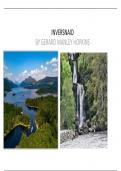
INVERSNAID
BY GERARD MANLEY HOPKINS
, GERARD MANLEY HOPKINS
• Born at Stratford, Essex, England, on July 28, 1844, Gerard Manley
Hopkins is regarded as one the Victorian era's greatest poets.
• He attended college in Oxford in 1863 and studied Classics. While
studying at Oxford he became a Roman Catholic and qualified as a
Jesuit priest (1868) – this decision estranged him from his family.
• After he became a Roman Catholic, he found it hard to be a poet and
serve God fully at the same time. At that time, he vowed to ‘write no
more...unless it were the wish of my superiors.’
• Less than a week after his conversion Hopkins made a bonfire, burnt
all the poems he had written to date and did not write any poetry again
for the next seven years - until 1875.
, GERARD MANLEY HOPKINS
• He was then asked by his religious superior to write a
poem to commemorate the sinking of the German
ship, the Deutschland which was wrecked during a
storm at the mouth of the Thames River.
• 157 people died, including five Franciscan nuns who
had left Germany due to harsh anti-Catholic laws. This
inspired one of his best poems: The Wreck of the
Deutschland.
• Hopkins took passionate pleasure in nature, his poetry
celebrates the unspoilt beauty of nature, in praise of
God.
, HOPKINS’S POETRY
• Hopkins is described as one of the greatest 19th century poets of
religion, nature and of melancholy.
• His poems are often in praise of God, celebrating God’s glory
through His works. He believed that God’s glory and goodness
could be seen in the natural world.
• However, his poetry was neither appreciated nor published in his
lifetime.
• He created his own words (called NONCES) and phrases for his
poems.
• Most of his poems were published posthumously - thirty years after
the death of Hopkins, in 1918, his friend Robert Bridges published
an Anthology of his poems.
BY GERARD MANLEY HOPKINS
, GERARD MANLEY HOPKINS
• Born at Stratford, Essex, England, on July 28, 1844, Gerard Manley
Hopkins is regarded as one the Victorian era's greatest poets.
• He attended college in Oxford in 1863 and studied Classics. While
studying at Oxford he became a Roman Catholic and qualified as a
Jesuit priest (1868) – this decision estranged him from his family.
• After he became a Roman Catholic, he found it hard to be a poet and
serve God fully at the same time. At that time, he vowed to ‘write no
more...unless it were the wish of my superiors.’
• Less than a week after his conversion Hopkins made a bonfire, burnt
all the poems he had written to date and did not write any poetry again
for the next seven years - until 1875.
, GERARD MANLEY HOPKINS
• He was then asked by his religious superior to write a
poem to commemorate the sinking of the German
ship, the Deutschland which was wrecked during a
storm at the mouth of the Thames River.
• 157 people died, including five Franciscan nuns who
had left Germany due to harsh anti-Catholic laws. This
inspired one of his best poems: The Wreck of the
Deutschland.
• Hopkins took passionate pleasure in nature, his poetry
celebrates the unspoilt beauty of nature, in praise of
God.
, HOPKINS’S POETRY
• Hopkins is described as one of the greatest 19th century poets of
religion, nature and of melancholy.
• His poems are often in praise of God, celebrating God’s glory
through His works. He believed that God’s glory and goodness
could be seen in the natural world.
• However, his poetry was neither appreciated nor published in his
lifetime.
• He created his own words (called NONCES) and phrases for his
poems.
• Most of his poems were published posthumously - thirty years after
the death of Hopkins, in 1918, his friend Robert Bridges published
an Anthology of his poems.