Hamlet Textual Analysis
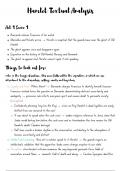
Act 1 Scene 1
Barnardo relieves Francisco of his watch
Marcellus and Horatio arrive → Horatio is sceptical that the guards have seen the ghost of Old
Hamlet
The ghost appears once and disappears again
Exposition on the history of Old Hamlet, Norway and Denmark
The ghost re-appears but Horatio cannot cajole it into speaking
Things to look out for:
note: in the tragic structure, this scene falls within the exposition, in which we are
introduced to the characters, setting, events and key ideas
Loyalty and trust: 'Who's there? → Barnardo charges Francisco to identify himself, however
Francisco instead turns the question on Barnardo, demonstrating distrust, uncertainty and
ambiguity → poisonous rule infects everyone's spirit and causes doubt to permeate society
(corruption)
Confederate phrasing 'long live the King' → ironic as King Hamlet is dead, loyalties are easily
shifted from one monarch to the next
'It was about to speak when the cock crew' → makes religious reference to Jesus' claim that
Judas would betray him before the cock crew and so foreshadows the true reason for Old
Hamlet's death: Claudius' betrayal.
Half lines create a broken rhythm in the conversation, contributing to the atmosphere of
tension, uncertainty and distrust
Intellect and reasoning: 'thou art a scholar, speak to it, Horatio' → the guards' require an
intellectual's validation that the apparition 'bodes some strange eruption to our state'
Corruption: structuralist criticism examines the way keywords generate force fields of
association around them → semantic field of death and decay → Caroline Spurgeon identifies
, the number of images of sickness and disease in the text and sees them as 'descriptive of the
unwholesome condition of Denmark morally'
''Tis bitter cold and I am sick at heart' '
sick almost to doomsday with eclipse'
'martial stalk'
'usurp't this time of night'
Revenge: the ghost's appearance is typical of the supernatural elements that were common to
Elizabethan revenge tragedies so would provide the audience with a sense of what to expect
from the rest of the play
Indicates 'something is rotten in the state of Denmark' → King Hamlet hasn't passed into the
afterlife easily, foreshadows the revelation of his suspicious death
Wearing 'armour' → aggressive, predatory image → the ghost's appearance portends
violence
Language surrounding the ghost is full of dichotomies, contributing to the sense of confusion
and disjoint → Horatio calls it a 'guilty thing' but Marcellus labels it 'majestical' → this
ambiguity / internal conflict over the morality of the ghost subverts the revenge tragedy
trope → main difference between Hamlet and revenge tragedy genre is that Hamlet's
obstacles are internal
Act 1 scene 2
Claudius addresses the court
He gives Laertes leave to go to Paris but entreats Hamlet to stay rather than returning to
Wittenberg
Hamlet's 'O that this too too sallied flesh would melt, thaw and resolve itself into a dew' speech
Horatio, Marcellus and Barnardo arrive
Horatio informs Hamlet that they have seen his father's ghost
Hamlet agrees to join them on their watch tonight should the ghost appear again
Things to look out for:
, Corruption: Claudius's use of antithesis 'with dirge in marriage and mirth in funeral' establishes
him as emotionally insincere. His conflicting assertions also hint at his possession of a dual
persona → builds his characterisation as a 'smiling damned villain'
Denmark as an 'unweeded garden' growing 'things rank and gross in nature'
'To post with such dexterity to incestuous sheets' → Hamlet uses recurrent imagery of
incest to describe Claudius and Gertrude's relationship, another symbol of purity corrupted;
the sanctity of marriage violated and desecrated by Claudius' cancerous influence
'Flourish of trumpets; seems inappropriate given the recent death of the King → contrast
of foreboding atmosphere of 1.1 with brightly lit, convivial tone of 1.2
Power: Shakespeare introduces Claudius's character during a display of power → a worthy
adversary and 'mighty opposite' to Hamlet, as well as an efficient ruler and "good and gentle King"
(G. Wilson Knight) who deals with emotive subjects pragmatically
He speaks in blank verse, a tone and style reserved for educated characters which indicates
forethought in the assembly and content of his speech
Dispatches Cornelius and Voltemand to deliver letter to old Norway, granting them 'no further
personal power' → Claudius draws attention to the exchange of power because it highlights
his uncontested control over affairs of state
Claudius' condescending reprisal of Hamlet's grief is another calculated move, designed to
assert his power → 'tis sweet and commendable' belittles Hamlet while appearing to express
care and affection. However his cold, sterile formality of address betrays a falseness that
undermines any pretence
Humour: Polonius's convoluted speech is often played for laughs by actors, but his influence over
his children has darker undertones of control and restriction. Gregory Doran (2009) RSC
production, Oliver Ford-Davies actually mouths Laertes' request to return to Paris as his son
speaks it → having spoon-fed Laertes his lines, Polonius can be sure that the appeal will not
offend Claudius nor damage his own position in court
Richard Vardy → "power and politics evidently trump family values in Claudius' Denmark"
Isolation and entrapment: Hamlet's grief serves to highlight his separation from the rest of the
court from whom he is philosophically differentiated by his views on death and remarriage
His 'nighted colour' emphasises his 'otherness' → chimes discordantly with the indulgence and
luxury of Claudius' court, demonstrated by the jubilant 'flourish of trumpets' (quite out of key
with the scene on the battlements which has just passed)
Act 1 Scene 1
Barnardo relieves Francisco of his watch
Marcellus and Horatio arrive → Horatio is sceptical that the guards have seen the ghost of Old
Hamlet
The ghost appears once and disappears again
Exposition on the history of Old Hamlet, Norway and Denmark
The ghost re-appears but Horatio cannot cajole it into speaking
Things to look out for:
note: in the tragic structure, this scene falls within the exposition, in which we are
introduced to the characters, setting, events and key ideas
Loyalty and trust: 'Who's there? → Barnardo charges Francisco to identify himself, however
Francisco instead turns the question on Barnardo, demonstrating distrust, uncertainty and
ambiguity → poisonous rule infects everyone's spirit and causes doubt to permeate society
(corruption)
Confederate phrasing 'long live the King' → ironic as King Hamlet is dead, loyalties are easily
shifted from one monarch to the next
'It was about to speak when the cock crew' → makes religious reference to Jesus' claim that
Judas would betray him before the cock crew and so foreshadows the true reason for Old
Hamlet's death: Claudius' betrayal.
Half lines create a broken rhythm in the conversation, contributing to the atmosphere of
tension, uncertainty and distrust
Intellect and reasoning: 'thou art a scholar, speak to it, Horatio' → the guards' require an
intellectual's validation that the apparition 'bodes some strange eruption to our state'
Corruption: structuralist criticism examines the way keywords generate force fields of
association around them → semantic field of death and decay → Caroline Spurgeon identifies
, the number of images of sickness and disease in the text and sees them as 'descriptive of the
unwholesome condition of Denmark morally'
''Tis bitter cold and I am sick at heart' '
sick almost to doomsday with eclipse'
'martial stalk'
'usurp't this time of night'
Revenge: the ghost's appearance is typical of the supernatural elements that were common to
Elizabethan revenge tragedies so would provide the audience with a sense of what to expect
from the rest of the play
Indicates 'something is rotten in the state of Denmark' → King Hamlet hasn't passed into the
afterlife easily, foreshadows the revelation of his suspicious death
Wearing 'armour' → aggressive, predatory image → the ghost's appearance portends
violence
Language surrounding the ghost is full of dichotomies, contributing to the sense of confusion
and disjoint → Horatio calls it a 'guilty thing' but Marcellus labels it 'majestical' → this
ambiguity / internal conflict over the morality of the ghost subverts the revenge tragedy
trope → main difference between Hamlet and revenge tragedy genre is that Hamlet's
obstacles are internal
Act 1 scene 2
Claudius addresses the court
He gives Laertes leave to go to Paris but entreats Hamlet to stay rather than returning to
Wittenberg
Hamlet's 'O that this too too sallied flesh would melt, thaw and resolve itself into a dew' speech
Horatio, Marcellus and Barnardo arrive
Horatio informs Hamlet that they have seen his father's ghost
Hamlet agrees to join them on their watch tonight should the ghost appear again
Things to look out for:
, Corruption: Claudius's use of antithesis 'with dirge in marriage and mirth in funeral' establishes
him as emotionally insincere. His conflicting assertions also hint at his possession of a dual
persona → builds his characterisation as a 'smiling damned villain'
Denmark as an 'unweeded garden' growing 'things rank and gross in nature'
'To post with such dexterity to incestuous sheets' → Hamlet uses recurrent imagery of
incest to describe Claudius and Gertrude's relationship, another symbol of purity corrupted;
the sanctity of marriage violated and desecrated by Claudius' cancerous influence
'Flourish of trumpets; seems inappropriate given the recent death of the King → contrast
of foreboding atmosphere of 1.1 with brightly lit, convivial tone of 1.2
Power: Shakespeare introduces Claudius's character during a display of power → a worthy
adversary and 'mighty opposite' to Hamlet, as well as an efficient ruler and "good and gentle King"
(G. Wilson Knight) who deals with emotive subjects pragmatically
He speaks in blank verse, a tone and style reserved for educated characters which indicates
forethought in the assembly and content of his speech
Dispatches Cornelius and Voltemand to deliver letter to old Norway, granting them 'no further
personal power' → Claudius draws attention to the exchange of power because it highlights
his uncontested control over affairs of state
Claudius' condescending reprisal of Hamlet's grief is another calculated move, designed to
assert his power → 'tis sweet and commendable' belittles Hamlet while appearing to express
care and affection. However his cold, sterile formality of address betrays a falseness that
undermines any pretence
Humour: Polonius's convoluted speech is often played for laughs by actors, but his influence over
his children has darker undertones of control and restriction. Gregory Doran (2009) RSC
production, Oliver Ford-Davies actually mouths Laertes' request to return to Paris as his son
speaks it → having spoon-fed Laertes his lines, Polonius can be sure that the appeal will not
offend Claudius nor damage his own position in court
Richard Vardy → "power and politics evidently trump family values in Claudius' Denmark"
Isolation and entrapment: Hamlet's grief serves to highlight his separation from the rest of the
court from whom he is philosophically differentiated by his views on death and remarriage
His 'nighted colour' emphasises his 'otherness' → chimes discordantly with the indulgence and
luxury of Claudius' court, demonstrated by the jubilant 'flourish of trumpets' (quite out of key
with the scene on the battlements which has just passed)