

Physics Revision
Energy
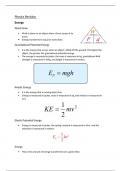
Work Done
Work is done on an object when a force causes it to
move.
Energy transferred is equal to work done.
Gravitational Potential Energy
It is the energy that occurs when an object s lifted off the ground. The higher the
object, the greater the gravitational potential energy.
The energy is measured in joules, the mass is measures in kg, gravitational field
strength is measured in N/kg, and height is measured in meters.
Kinetic Energy
It is the energy that a moving object has.
Energy is measured in joules, mass is measured in kg, and velocity is measured in
m/s.
Elastic Potential Energy
Energy is measured in joules, the spring constant is measured in N/m, and the
extension is measured in meters.
Energy
This is the amount of energy transferred over a given time.
, The equation can also be written as work done equals power times time.
Efficiency
This answer is written as a percentage or as a decimal.
Specific Heat Capacity
The specific heat capacity is the amount of energy required to raise the temperature
of a 1kg object by 1 degree.
The energy supplied is equal to the specific heat capacity (j/kg/degrees) times mass
(kg) times change in temperature (degrees).
If the SHC is low, the material will heat up quickly.
If the SHC is high, the material will heat up slowly.
Thermal Conductivity
Conduction is how heat travels through a solid.
A conductor is a material (metal – copper) that lets heat pass through easily.
An insulator is a material (wool, wood, rubber) that doesn’t allow heat energy
through easily.
Thermal conductivity is the rate of heat energy transferred.
Something with high thermal conductivity transfers more heat per second through
conduction.
Electricity
Key Terms
Potential difference is sometimes called voltage. It is the energy supplied by the
battery. It is measured in volts (V).
Current is the rate of flow of charge, flowing from positive to negative. It is measured
in amperes – amps (A).
Resistance opposes the flow of charges and is measured un ohms.
, Current
Current (A) is equal to charge (coulombs) divided by time (s).
It is the rate of flow of charge.
Potential Difference
Potential difference (V) is equal to energy (J) divided by charge (coulombs).
It is the amount of energy supplied.
Resistance
Resistance (ohms) is equal to the voltage (V) divided by the current (A).
Resistance is anything that opposes the flow of charge.
OHMS LAW – the relationship between voltage, current and resistance.
The greater the resistance, the smaller the current for a constant potential
difference.
Series Circuits
A series circuit only has one route for the current to flow, as the components are
arranged one after the other.
In a series circuit, the current stays the same (As = A1 = A2), but the potential
difference (V) splits between the components (Vs = V1 +V2).
The total resistance is calculated by adding the resistance of all the components
together (Rt = R1 + R2 + …).
The value of the potential difference depends on the resistance.
The total resistance increases.
Parallel Circuits
A parallel circuit has multiple routes for the current (I) to flow, as the components
are arranged in branches.
In a parallel circuit, the current splits between each branch (As = A1 + A2), but the
potential difference (V) stays the same (Vs = V1 = V2).
The amount of current in each branch depends on the resistance of the components.
The total resistance decreases.
Short Circuits
A short circuit is a low resistance connection between two sections of an electrical
circuit.
This allows current to flow along the unintended path.
It can be used to bypass a component.
In an appliance, if the live wire touches the neutral wire, it creates a short circuit.
This allows a very large current to pass between the wires.
Domestic Electricity
Energy
Work Done
Work is done on an object when a force causes it to
move.
Energy transferred is equal to work done.
Gravitational Potential Energy
It is the energy that occurs when an object s lifted off the ground. The higher the
object, the greater the gravitational potential energy.
The energy is measured in joules, the mass is measures in kg, gravitational field
strength is measured in N/kg, and height is measured in meters.
Kinetic Energy
It is the energy that a moving object has.
Energy is measured in joules, mass is measured in kg, and velocity is measured in
m/s.
Elastic Potential Energy
Energy is measured in joules, the spring constant is measured in N/m, and the
extension is measured in meters.
Energy
This is the amount of energy transferred over a given time.
, The equation can also be written as work done equals power times time.
Efficiency
This answer is written as a percentage or as a decimal.
Specific Heat Capacity
The specific heat capacity is the amount of energy required to raise the temperature
of a 1kg object by 1 degree.
The energy supplied is equal to the specific heat capacity (j/kg/degrees) times mass
(kg) times change in temperature (degrees).
If the SHC is low, the material will heat up quickly.
If the SHC is high, the material will heat up slowly.
Thermal Conductivity
Conduction is how heat travels through a solid.
A conductor is a material (metal – copper) that lets heat pass through easily.
An insulator is a material (wool, wood, rubber) that doesn’t allow heat energy
through easily.
Thermal conductivity is the rate of heat energy transferred.
Something with high thermal conductivity transfers more heat per second through
conduction.
Electricity
Key Terms
Potential difference is sometimes called voltage. It is the energy supplied by the
battery. It is measured in volts (V).
Current is the rate of flow of charge, flowing from positive to negative. It is measured
in amperes – amps (A).
Resistance opposes the flow of charges and is measured un ohms.
, Current
Current (A) is equal to charge (coulombs) divided by time (s).
It is the rate of flow of charge.
Potential Difference
Potential difference (V) is equal to energy (J) divided by charge (coulombs).
It is the amount of energy supplied.
Resistance
Resistance (ohms) is equal to the voltage (V) divided by the current (A).
Resistance is anything that opposes the flow of charge.
OHMS LAW – the relationship between voltage, current and resistance.
The greater the resistance, the smaller the current for a constant potential
difference.
Series Circuits
A series circuit only has one route for the current to flow, as the components are
arranged one after the other.
In a series circuit, the current stays the same (As = A1 = A2), but the potential
difference (V) splits between the components (Vs = V1 +V2).
The total resistance is calculated by adding the resistance of all the components
together (Rt = R1 + R2 + …).
The value of the potential difference depends on the resistance.
The total resistance increases.
Parallel Circuits
A parallel circuit has multiple routes for the current (I) to flow, as the components
are arranged in branches.
In a parallel circuit, the current splits between each branch (As = A1 + A2), but the
potential difference (V) stays the same (Vs = V1 = V2).
The amount of current in each branch depends on the resistance of the components.
The total resistance decreases.
Short Circuits
A short circuit is a low resistance connection between two sections of an electrical
circuit.
This allows current to flow along the unintended path.
It can be used to bypass a component.
In an appliance, if the live wire touches the neutral wire, it creates a short circuit.
This allows a very large current to pass between the wires.
Domestic Electricity


