

Biological Rhythms
Lecture Notes
The Neural Control of Sleep and Wakefulness
Lesions:
Post mortem studies (sleep
sickness in WW2) suggested:
Posterior hypothalamus =
excessive sleep
Anterior hypothalamus =
sleeplessness
Brain stem control of sleep and
wakefulness:
Study conducted in cats to
isolate areas of the brain
which may be involved in
sleep and wakefulness
(Bremner, 1937)
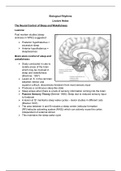
Lesion at ‘A’ in the cat brain
between inferior and
superior colliculi, disconnects forebrain from most sensory input
Produces a continuous sleep like state
Sleep arises when there is a lack of sensory information coming into the brain
Passive Sensory Theory (Bremer 1936): Sleep due to reduced sensory input
to forebrain
A lesion at ‘B’ maintains sleep wake cycles – lesion studies in different cats
(Bremer 1937)
The area between A and B includes a sleep centre (reticular formation
(RF)/reticular activating system (RAS)) which can actively rouse the cortex
independent of external stimuli
This maintains the sleep-wake cycle
Lecture Notes
The Neural Control of Sleep and Wakefulness
Lesions:
Post mortem studies (sleep
sickness in WW2) suggested:
Posterior hypothalamus =
excessive sleep
Anterior hypothalamus =
sleeplessness
Brain stem control of sleep and
wakefulness:
Study conducted in cats to
isolate areas of the brain
which may be involved in
sleep and wakefulness
(Bremner, 1937)
Lesion at ‘A’ in the cat brain
between inferior and
superior colliculi, disconnects forebrain from most sensory input
Produces a continuous sleep like state
Sleep arises when there is a lack of sensory information coming into the brain
Passive Sensory Theory (Bremer 1936): Sleep due to reduced sensory input
to forebrain
A lesion at ‘B’ maintains sleep wake cycles – lesion studies in different cats
(Bremer 1937)
The area between A and B includes a sleep centre (reticular formation
(RF)/reticular activating system (RAS)) which can actively rouse the cortex
independent of external stimuli
This maintains the sleep-wake cycle


