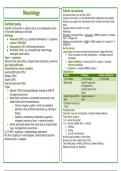
Febrile convulsions
Neurology Are seizures that occur w/ fever (38oC)
Usually occurs early in a viral infection when temperature rises rapidly
Seizures are usually brief, lasting less than 5 minutes (commonly clonic-
Cerebral palsy tonic)
Disorder of movement + posture due to a non-progression lesion Typically children 6 month 5 years
in the motor pathways in the brain Aetiology
Aetiology Excitatory neurotransmitter = Glutamate NMDA receptors increase
Antenatal (90%) e.g. cerebral malformations + congenital Ca2+ triggers AP
Inhibitory neurotransmitter = GABA GABA receptors increase Cl-
infection (TORCHES)
inhibits AP
Intrapartum (10%) birth asphyxia/trauma During seizure
Postnatal (10%) e.g. intraventricular haemorrhage, Large groups of neurones activate simultaneously- triggered by fever
meningitis, head trauma 1. Fever increases core body temperature = increases neuronal
Signs + symptoms excitability
Abnormal tone early infancy, delayed motor milestones, abnormal 2. Hyperventilation reduces [CO2] acidotic = increases
gait, feeding difficulties neuronal excitability
Associated non-motor problems 3. Cytokines = enhance NMDA receptors
Learning difficulties (50%) Classification
Epilepsy (30%) Simple Complex Status epilepticus
Squints (30%) <15 minutes 15-30 minutes > 30 minutes
Hearing impairment (20%) Whole body Specific body parts
Types (corresponds to
specific parts of the
Spastic (70%) hemi/quad/diplegia- damage to UMN
brain)
increased muscle tone
Doesn’t repeat within Repeat seizures in
Dyskinetic involuntary, uncontrolled movements- more 24hr 24hr
evident with active movement/stress Complete recovery by
o Chorea: irregular, sudden + brief non-repetitive 1 hour
o Athetosis: slow, writhing movements e.g. fanning of Postictal state
fingers Confusion, may not recall episode, residual arm/leg weakness
o Dystonia: simultaneous contraction go agonist + Tonic-clonic seizure
antagonist muscles of trunk + proximal muscles Tonic muscle tense/rigid
Ataxic genetically determined, when due to acquired brain Clonic muscles rapidly relax + contract
injury (cerebellum/its connections) 1. Stiffness
2. Jerking
Ix CT/ MRI + audiology + ophthalmology assessment
3. Loss of consciousness
Mx Rx for spasticity = oral diazepam, oral/intrathecal baclofen Mx Not usually needed = self-limiting
Anticonvulsant + analgesia During: lie on side +keep track of time
Concerning signs: vomiting, stiff neck, trouble breathing
Antipyretic drugs e.g. Ibuprofen
Neurology Are seizures that occur w/ fever (38oC)
Usually occurs early in a viral infection when temperature rises rapidly
Seizures are usually brief, lasting less than 5 minutes (commonly clonic-
Cerebral palsy tonic)
Disorder of movement + posture due to a non-progression lesion Typically children 6 month 5 years
in the motor pathways in the brain Aetiology
Aetiology Excitatory neurotransmitter = Glutamate NMDA receptors increase
Antenatal (90%) e.g. cerebral malformations + congenital Ca2+ triggers AP
Inhibitory neurotransmitter = GABA GABA receptors increase Cl-
infection (TORCHES)
inhibits AP
Intrapartum (10%) birth asphyxia/trauma During seizure
Postnatal (10%) e.g. intraventricular haemorrhage, Large groups of neurones activate simultaneously- triggered by fever
meningitis, head trauma 1. Fever increases core body temperature = increases neuronal
Signs + symptoms excitability
Abnormal tone early infancy, delayed motor milestones, abnormal 2. Hyperventilation reduces [CO2] acidotic = increases
gait, feeding difficulties neuronal excitability
Associated non-motor problems 3. Cytokines = enhance NMDA receptors
Learning difficulties (50%) Classification
Epilepsy (30%) Simple Complex Status epilepticus
Squints (30%) <15 minutes 15-30 minutes > 30 minutes
Hearing impairment (20%) Whole body Specific body parts
Types (corresponds to
specific parts of the
Spastic (70%) hemi/quad/diplegia- damage to UMN
brain)
increased muscle tone
Doesn’t repeat within Repeat seizures in
Dyskinetic involuntary, uncontrolled movements- more 24hr 24hr
evident with active movement/stress Complete recovery by
o Chorea: irregular, sudden + brief non-repetitive 1 hour
o Athetosis: slow, writhing movements e.g. fanning of Postictal state
fingers Confusion, may not recall episode, residual arm/leg weakness
o Dystonia: simultaneous contraction go agonist + Tonic-clonic seizure
antagonist muscles of trunk + proximal muscles Tonic muscle tense/rigid
Ataxic genetically determined, when due to acquired brain Clonic muscles rapidly relax + contract
injury (cerebellum/its connections) 1. Stiffness
2. Jerking
Ix CT/ MRI + audiology + ophthalmology assessment
3. Loss of consciousness
Mx Rx for spasticity = oral diazepam, oral/intrathecal baclofen Mx Not usually needed = self-limiting
Anticonvulsant + analgesia During: lie on side +keep track of time
Concerning signs: vomiting, stiff neck, trouble breathing
Antipyretic drugs e.g. Ibuprofen