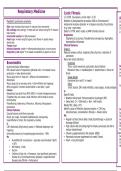
Respiratory Medicine Cystic Fibrosis
1 in 2500, Caucasians, carrier rate 1 in 25 As
Paediatric pulmonary anatomy Deletion in phenylalanine at position 508 on Chromosome 7 Ch
Autosomal recessive disorder increases viscosity of secretions air
Ribs more horizontal than adults reduced chest movement (e.g. lung + pancreas)
Rib cartilage more springy chest wall can retract during RD reduced Ch
Defect in CTFR, which codes a cAMP chloride channel 2p
tidal volume
Intercostal muscles not fully developed Organisms
Head larger when lying flat supine, neck flexion partial airway Staphylococcus aureus, Pseudomonas aeruginosa, Aspergillus,
obstruction Haemophilus influenzae
Tongue larger Clinical features
Internal diameter smaller inflammation/obstruction is more severe Airways
Respiratory rate higher increased susceptibility to agents in the air Reduced airway surface, impaired ciliary function, retention of
secretions
Recurrent chest infections
Bronchiolitis Intestines
Acute bronchiolar inflammation Thick, viscid meconium, pancreatic ducts blocked Ae
RSV causes fusion of respiratory epithelial cells increased mucus Meconium ileus + malabsorption + steatorrhoea + failure to Ge
production + leaky blood vessels: thrive Inv
Mucus plug forms traps air + diffuses into bloodstream = Sweat glands En
Atelectasis Excessive Na+ and Cl- in sweat
Mucus plug acts as one-way valve = Over-inflation (air-trapping) Other
90% are aged 1-9 months (bronchiolitis is rare after 1 year) Th
Short stature, DM, male infertility, nasal polyps, rectal prolapse
Causes Ix
Respiratory Syncytial Virus (RSV) (80%) + Human metapneumovirus Specific tests
(Together they can cause a dual infection, which leads to severe Newborn blood spot: Immunoreactive trysinogen (IRT)
bronchiolitis) Sweat test: Cl- > 50mmol/L + Na+ >60 mmol/L
Parainfluenza, Adenovirus, Rhinovirus, Influenza, Mycoplasma
Bloods FBC, U&Es, LFTs
pneumonia
Identify cause of infection Sputum analysis + CXR (e.g. Sig
Clinical features
Coryzal features (mild fever) precede: bronchiectasis, consolidation, fibrosis) + blood culture Sy
Sharp, dry cough, increased breathlessness, tachypnoea, Mx Sig
hyperinflation of chest, fine inspiratory crackles Regular (at least twice daily) chest physiotherapy + postural Ix
Ix drainage (flutter) Sp
CXR- Atelectasis (High density areas) + flattened diaphragm (air High calorie diet (including high fat intake- previously low fat to FE
trapping) reduce steatorrhoea) FV
Immunofluorescence of nasopharyngeal secretions – ?RSV Vitamin supplementation (fat soluble- ADEK) Capac
Mx Pancreatic enzyme supplement w/ meals (Creon) As
Humidified O2 via head box + typically recommended if SpO2 Heart + lung transplant Blo
< 92% CX
NG feeding – fluids PE
Suction
Children @ high risk = Premature, have significant pulmonary
disease (e.g. bronchopulmonary dysplasia, congenital heart
disease) give RSV Ab = Palivizamub
1 in 2500, Caucasians, carrier rate 1 in 25 As
Paediatric pulmonary anatomy Deletion in phenylalanine at position 508 on Chromosome 7 Ch
Autosomal recessive disorder increases viscosity of secretions air
Ribs more horizontal than adults reduced chest movement (e.g. lung + pancreas)
Rib cartilage more springy chest wall can retract during RD reduced Ch
Defect in CTFR, which codes a cAMP chloride channel 2p
tidal volume
Intercostal muscles not fully developed Organisms
Head larger when lying flat supine, neck flexion partial airway Staphylococcus aureus, Pseudomonas aeruginosa, Aspergillus,
obstruction Haemophilus influenzae
Tongue larger Clinical features
Internal diameter smaller inflammation/obstruction is more severe Airways
Respiratory rate higher increased susceptibility to agents in the air Reduced airway surface, impaired ciliary function, retention of
secretions
Recurrent chest infections
Bronchiolitis Intestines
Acute bronchiolar inflammation Thick, viscid meconium, pancreatic ducts blocked Ae
RSV causes fusion of respiratory epithelial cells increased mucus Meconium ileus + malabsorption + steatorrhoea + failure to Ge
production + leaky blood vessels: thrive Inv
Mucus plug forms traps air + diffuses into bloodstream = Sweat glands En
Atelectasis Excessive Na+ and Cl- in sweat
Mucus plug acts as one-way valve = Over-inflation (air-trapping) Other
90% are aged 1-9 months (bronchiolitis is rare after 1 year) Th
Short stature, DM, male infertility, nasal polyps, rectal prolapse
Causes Ix
Respiratory Syncytial Virus (RSV) (80%) + Human metapneumovirus Specific tests
(Together they can cause a dual infection, which leads to severe Newborn blood spot: Immunoreactive trysinogen (IRT)
bronchiolitis) Sweat test: Cl- > 50mmol/L + Na+ >60 mmol/L
Parainfluenza, Adenovirus, Rhinovirus, Influenza, Mycoplasma
Bloods FBC, U&Es, LFTs
pneumonia
Identify cause of infection Sputum analysis + CXR (e.g. Sig
Clinical features
Coryzal features (mild fever) precede: bronchiectasis, consolidation, fibrosis) + blood culture Sy
Sharp, dry cough, increased breathlessness, tachypnoea, Mx Sig
hyperinflation of chest, fine inspiratory crackles Regular (at least twice daily) chest physiotherapy + postural Ix
Ix drainage (flutter) Sp
CXR- Atelectasis (High density areas) + flattened diaphragm (air High calorie diet (including high fat intake- previously low fat to FE
trapping) reduce steatorrhoea) FV
Immunofluorescence of nasopharyngeal secretions – ?RSV Vitamin supplementation (fat soluble- ADEK) Capac
Mx Pancreatic enzyme supplement w/ meals (Creon) As
Humidified O2 via head box + typically recommended if SpO2 Heart + lung transplant Blo
< 92% CX
NG feeding – fluids PE
Suction
Children @ high risk = Premature, have significant pulmonary
disease (e.g. bronchopulmonary dysplasia, congenital heart
disease) give RSV Ab = Palivizamub