
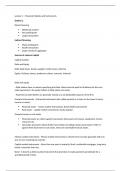
Lecture 1 – Financial Markets and Instruments
Outline 2
Direct financing
Wholesale market
Few participants
Large transactions
Indirect financing
Many participants
Small transactions
Larger market in aggregate
Sources of external capital
Capital markets
Debt and Equity
Debt: Bank loans, bonds, supplier credit, leases, informal
Equity: Ordinary shares, preference shares, warrants, informal
Debt and equity
- Debt holders have a contract specifying that their claims must be paid in full before the firm can
make payments to its equity holders ie debt claims are senior
- Payments to debt holders are generally viewed as a tax-deductible expense of the firm
Financial instruments - A financial instrument (also called security) is a claim on the issuer’s future
income or assets.
Financial assets – money market instruments, bonds (debt instruments)
Real assets – capital market instruments, stocks (equity)
Financial assets vs real assets
Financial assets are claims against real assets. Real assets are houses, equipment, human
resources etc.
Generally, borrowers obtain funds from lenders by selling newly issued claims (“IOU’s”)
against their (borrower’s) real assets. IOUs are essentially financial assets.
Money market instruments - Money market instruments is shorter-term security generally with one
year or less remaining to maturity
Capital market instruments - More than one year to maturity. Stock, residential mortgages, long-term
bonds, consumer loans etc.
Bond - A bond is a debt security/instrument that promises to make payments periodically for a
specified period of time
Outline 2
Direct financing
Wholesale market
Few participants
Large transactions
Indirect financing
Many participants
Small transactions
Larger market in aggregate
Sources of external capital
Capital markets
Debt and Equity
Debt: Bank loans, bonds, supplier credit, leases, informal
Equity: Ordinary shares, preference shares, warrants, informal
Debt and equity
- Debt holders have a contract specifying that their claims must be paid in full before the firm can
make payments to its equity holders ie debt claims are senior
- Payments to debt holders are generally viewed as a tax-deductible expense of the firm
Financial instruments - A financial instrument (also called security) is a claim on the issuer’s future
income or assets.
Financial assets – money market instruments, bonds (debt instruments)
Real assets – capital market instruments, stocks (equity)
Financial assets vs real assets
Financial assets are claims against real assets. Real assets are houses, equipment, human
resources etc.
Generally, borrowers obtain funds from lenders by selling newly issued claims (“IOU’s”)
against their (borrower’s) real assets. IOUs are essentially financial assets.
Money market instruments - Money market instruments is shorter-term security generally with one
year or less remaining to maturity
Capital market instruments - More than one year to maturity. Stock, residential mortgages, long-term
bonds, consumer loans etc.
Bond - A bond is a debt security/instrument that promises to make payments periodically for a
specified period of time


