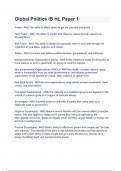
Global Politics IB HL Paper 1
Power - ANS-The ability to affect others to get the outcome one wants
Hard Power - ANS-The ability to control and influence others through coercive or
physical force.
Soft Power - ANS-The ability to attract and persuade other to your side through the
projection of your ideas, cultures, and values.
States - ANS-Countries with defined political borders, governments, and militaries.
Intergovernmental Organizations (IGOs) - ANS-Entity created by treaty, involving two or
more nations, to work in good faith, on issues of common interest.
Non-governmental Organizations (NGOs) - ANS-Non-profit, voluntary citizens' group
which is independent from any state government or international government
organization. It can operate on a local, state, regional, or global level.
Non-state Actors - ANS-Terrorist organizations, drug cartels, protest movements, trade
unions, and corporations.
Concerted Relationships - ANS-The capacity of a mobilized group to act together in the
pursuit of common goals or in support of common values.
Sovereignty - ANS-Supreme power or authority; It comes from being seen as a
legitimate state or government.
Negative Sovereignty - ANS-Nations cannot interfere with the internal affairs of another
nation. This only applies to states and it comes from being recognized by the
international community. States are legally equal and they cannot disturb or change the
territory of another state.
Positive Sovereignty - ANS-States' ability to effectively govern their people and "be their
own masters." The aspects of this point to the substantive problem-solving capacity of
states and to their ability to make mingle and genuinely discretionary choices on a
range of political, legal, and socioeconomic issues.
, Responsible Sovereignty - ANS-States maintain their sovereignty by being responsible
global actors. If states are not exercising proper responsibility for their citizens, for
global resources, and for global threats, then the global community may intervene.
Pooled Sovereignty - ANS-States share decision-making powers in IGOs for the
purpose of more efficient cooperation.
Legitimacy - ANS-It means that an actor or action is considered acceptable
(credibility/reputation); Countries' actions are deemed fit for the world.
Anarchy - ANS-No higher power/authority in the international world that can dictate what
a country can do and what they can't do. There is no way to control a state--security
dilemma.
National Interest - ANS-Each nation/country has individual interests that will only benefit
themselves and could potentially harm other countries (Realist POV).
Realism - ANS-The belief that hard power is more important than soft power, that states
can only work together if there are tangible benefits, and that sovereignty is still strong
because violations of it can be retaliated with military (hard--coercive) power.
Liberalism - ANS-The belief that that majority of the world's problems can be solved
through cooperation.
Constructivism - ANS-Based on international cooperation but recognizes that
perceptions countries have of each other can affect their relations. International
relations are historically and socially constructed, rather than inevitable consequences
of human nature.
Interdependence - ANS-The mutual reliance between and among groups,
organizations, geographic areas, and/or states for access to resources that sustain
living arrangements.
Human Rights - ANS-Basic claims and entitlements that one should be able to exercise
simply by virtue of being a human being. Many contemporary thinkers argue they are
essential for lobbing a life of dignity, are inalienable, and should be accepted a universal
(Universality, Equality, Inalienability, Indivisibility, and Interdependence).
Negative Rights - ANS-They relate to the rights that governments promise to not
interfere with (civil rights).
Power - ANS-The ability to affect others to get the outcome one wants
Hard Power - ANS-The ability to control and influence others through coercive or
physical force.
Soft Power - ANS-The ability to attract and persuade other to your side through the
projection of your ideas, cultures, and values.
States - ANS-Countries with defined political borders, governments, and militaries.
Intergovernmental Organizations (IGOs) - ANS-Entity created by treaty, involving two or
more nations, to work in good faith, on issues of common interest.
Non-governmental Organizations (NGOs) - ANS-Non-profit, voluntary citizens' group
which is independent from any state government or international government
organization. It can operate on a local, state, regional, or global level.
Non-state Actors - ANS-Terrorist organizations, drug cartels, protest movements, trade
unions, and corporations.
Concerted Relationships - ANS-The capacity of a mobilized group to act together in the
pursuit of common goals or in support of common values.
Sovereignty - ANS-Supreme power or authority; It comes from being seen as a
legitimate state or government.
Negative Sovereignty - ANS-Nations cannot interfere with the internal affairs of another
nation. This only applies to states and it comes from being recognized by the
international community. States are legally equal and they cannot disturb or change the
territory of another state.
Positive Sovereignty - ANS-States' ability to effectively govern their people and "be their
own masters." The aspects of this point to the substantive problem-solving capacity of
states and to their ability to make mingle and genuinely discretionary choices on a
range of political, legal, and socioeconomic issues.
, Responsible Sovereignty - ANS-States maintain their sovereignty by being responsible
global actors. If states are not exercising proper responsibility for their citizens, for
global resources, and for global threats, then the global community may intervene.
Pooled Sovereignty - ANS-States share decision-making powers in IGOs for the
purpose of more efficient cooperation.
Legitimacy - ANS-It means that an actor or action is considered acceptable
(credibility/reputation); Countries' actions are deemed fit for the world.
Anarchy - ANS-No higher power/authority in the international world that can dictate what
a country can do and what they can't do. There is no way to control a state--security
dilemma.
National Interest - ANS-Each nation/country has individual interests that will only benefit
themselves and could potentially harm other countries (Realist POV).
Realism - ANS-The belief that hard power is more important than soft power, that states
can only work together if there are tangible benefits, and that sovereignty is still strong
because violations of it can be retaliated with military (hard--coercive) power.
Liberalism - ANS-The belief that that majority of the world's problems can be solved
through cooperation.
Constructivism - ANS-Based on international cooperation but recognizes that
perceptions countries have of each other can affect their relations. International
relations are historically and socially constructed, rather than inevitable consequences
of human nature.
Interdependence - ANS-The mutual reliance between and among groups,
organizations, geographic areas, and/or states for access to resources that sustain
living arrangements.
Human Rights - ANS-Basic claims and entitlements that one should be able to exercise
simply by virtue of being a human being. Many contemporary thinkers argue they are
essential for lobbing a life of dignity, are inalienable, and should be accepted a universal
(Universality, Equality, Inalienability, Indivisibility, and Interdependence).
Negative Rights - ANS-They relate to the rights that governments promise to not
interfere with (civil rights).