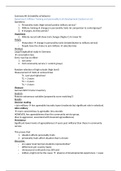
Summary #6 (in)stability of behavior
Experiment: Military Training and personality trait development (Jackson et al.)
Questions:
1. Personality traits (high-school) predict military service?
2. Military training changes in personality traits (in comparison to controlgroup)?
3. If changes, do they persist?
Hypothesis
2. Miliraty recruit will show trait changes (higher C/A; lower N)
Pitfalls
- Maturation change in personality traits (misattribution to military service)
- People have the choice to join military selection bias
Method
Large/longitudinal study in Germany
conscription law;
Every man has to either
1. Join army
2. Civil community service (= control group)
Random selection of high schools (high level)
Measurement of traits at various times
T1. Last year highschool
T2. + 2 years
T3. + 2 years
T4. + 2 years
Measure
German NEO 5 factor inventory
Analysis
Remove extraneous variables (propensity score matching?)
Results
Decision making
= join military less agreeable/neurotic/open (moderate but significant role in selection)
After military
more conscientious & agreeable, less neurotic
HOWEVER, less agreeableness than the community service group.
(due to aggression; associated with lessened agreeableness)
Persistence
Significant lower levels of agreeableness (4 years post military) than those in community
service.
This proves that
1. situation affects personality traits
2. personality traits affect situation that is chosen
discussion
- are upper level German students representative?
- Differences per country (laws)
- Unmeasured confounds may still exist
- military might not be the cause absence of developmental experiences = cause
, situationism
= situational variables influence behavior (behavior is a function of situational forces
B=f(S))
(debate = evoked by Mischels criticism of trait theories)
Helson
Women who are part of a women’s movement
+ self-acceptance, dominance, empathy, assertiveness
= socio-cultural factors influence personality (trait) change.
Srivastana
Nurturing experience (age 30-50; parental age) + agreeableness (alters tendencies)
+ evidence that personality develops as a result of interaction with social environment
The person-situation controversy
= is there enough consistency in behavior to support traits as center of a personality theory?
Mischel
People discriminate between different
situations
Actions in situation vary according to
- Opportunity
- Rules
- Constraints
- Norms
People’s behavior is inconsistent per situation
Strong situation
situation in which one cannot express personal traits, everyone behaves similarly
(e.g., army)
Weak situation
situation in which it is easy to show personality
(e.g., dinner with friends)
Strong personality
more consistent
Weak personality
more subject to change
Hartshorne & may ( summer camp cheating vs. exam cheating experiment)
variation in behavior from 1 situation to another low cross situational consistency
Personality paradox & person vs. situation debate
observation that a human being’s personality tends to remain the same over time, while
their behavior can change in different situations.
similar situations? similar/consistent behavior
Experiment: Military Training and personality trait development (Jackson et al.)
Questions:
1. Personality traits (high-school) predict military service?
2. Military training changes in personality traits (in comparison to controlgroup)?
3. If changes, do they persist?
Hypothesis
2. Miliraty recruit will show trait changes (higher C/A; lower N)
Pitfalls
- Maturation change in personality traits (misattribution to military service)
- People have the choice to join military selection bias
Method
Large/longitudinal study in Germany
conscription law;
Every man has to either
1. Join army
2. Civil community service (= control group)
Random selection of high schools (high level)
Measurement of traits at various times
T1. Last year highschool
T2. + 2 years
T3. + 2 years
T4. + 2 years
Measure
German NEO 5 factor inventory
Analysis
Remove extraneous variables (propensity score matching?)
Results
Decision making
= join military less agreeable/neurotic/open (moderate but significant role in selection)
After military
more conscientious & agreeable, less neurotic
HOWEVER, less agreeableness than the community service group.
(due to aggression; associated with lessened agreeableness)
Persistence
Significant lower levels of agreeableness (4 years post military) than those in community
service.
This proves that
1. situation affects personality traits
2. personality traits affect situation that is chosen
discussion
- are upper level German students representative?
- Differences per country (laws)
- Unmeasured confounds may still exist
- military might not be the cause absence of developmental experiences = cause
, situationism
= situational variables influence behavior (behavior is a function of situational forces
B=f(S))
(debate = evoked by Mischels criticism of trait theories)
Helson
Women who are part of a women’s movement
+ self-acceptance, dominance, empathy, assertiveness
= socio-cultural factors influence personality (trait) change.
Srivastana
Nurturing experience (age 30-50; parental age) + agreeableness (alters tendencies)
+ evidence that personality develops as a result of interaction with social environment
The person-situation controversy
= is there enough consistency in behavior to support traits as center of a personality theory?
Mischel
People discriminate between different
situations
Actions in situation vary according to
- Opportunity
- Rules
- Constraints
- Norms
People’s behavior is inconsistent per situation
Strong situation
situation in which one cannot express personal traits, everyone behaves similarly
(e.g., army)
Weak situation
situation in which it is easy to show personality
(e.g., dinner with friends)
Strong personality
more consistent
Weak personality
more subject to change
Hartshorne & may ( summer camp cheating vs. exam cheating experiment)
variation in behavior from 1 situation to another low cross situational consistency
Personality paradox & person vs. situation debate
observation that a human being’s personality tends to remain the same over time, while
their behavior can change in different situations.
similar situations? similar/consistent behavior