Objectives:
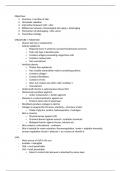
1. Function + structure of kidney
2. Impact of aging on kidney function + structure
3. Chronic kidney disease
4. Acute kidney injury causes + consequences
5. Kidney + diabetes
6. Klotho
7. Treatment of chronic kidney disease with anti-aging therapies
KIDNEY STRUCTURE + FUNCTION:
- Functions = filtration, absorption, excretion of toxic substances, balance acid:base,
hormonal control, glucose reabsorption, gluconeogenesis + electrolyte balance
- Inner kidney = medulla
- Outer kidney = cortex
- Kidney is made up of nephrons
- Within each nephron = glomerulus, proximal convoluted tubules, distal convoluted
tubule + collecting duct
- Glomerulus filters the blood before entering the convoluted tubules
- Glomerular filtration rate = rate that plasma is filtered by the glomeruli
o Important factor for measuring kidney function
o Approx. 125ml of plasma/min in healthy individuals
o Blood is filtered by glomerulus 60 times per day
AGING OF KIDNEY FUNCTION/STRUCTURE:
- Incidence of nephrosclerosis increases with age
o Hardening of renal arteries + arterioles
o Does not necessarily decrease the function on its own – many other
influences
- Other factors that contribute to kidney function decline:
o Genetics
o Gender + race
o CpG methylation
Methylation of cysteine changes activity of DNA segment without
changing sequence
CpG islands = sequences of cysteine + guanine
CpG islands methylation causes genes to be silenced
o Chromatin conformation
o Oxidative stress
o SNPs
Single nucleotide polymorphisms
o Chronic inflammation
- Glomerular filtration rate is approx. the same in men and women of same age
- Kidney weight reaches a peak at 40 years old + declines
- Cortex of kidney becomes atrophic
o Causes tubular changes
- Increased incidence of fibrosis + contraction with age
o Surface of kidney becomes granular
, - Tubular changes + fibrosis lead to decreased Na reabsorption, K excretion + urinary
concentration
- Vascular tone changes with age
o Increased sympathetic tone that causes vasoconstriction
Associated with chronic + end-stage renal diseases
o Less sensitive to natural vasodilators (natriuretic peptide, nitric oxide)
- Less nitric oxide is produced with age
o Important for mediating sympathetic effects (renin secretion, blood flow, Na
absorption)
o Important for inhibiting Na reabsorption when enough is reabsorbed
- Scarring and stress on nephrons cause them to die/be destroyed
- Remaining nephrons are put under greater stress
- Increased stress on remaining nephrons = scarring on nephrons
o Cycle is known as Brenner Hyperfiltration Hypothesis
CHRONIC KIDNEY DISEASE:
- Affects 1 in 10
- Asymptomatic so most are diagnosed late
- Caused by other diseases as a secondary disease
o T2DM, hypertension, glomerulonephritis
- >1 million people undiagnosed
- 45,000 premature deaths caused by CKD
- Lack of screening, understanding + early intervention schemes
- Measures of kidney function: albuminuria + GFR
o Albuminuria shows how much albumin is urine indicative of leaky renal
vessels
Severely increased albumin kidney disease
o Poor GFR = kidney disease/failure
- Someone with late stage CKD will have 1/3 GFR compared to normal
o Corresponds with loss of nephrons
- Having albuminuria + impaired GFR increases mortality by 47% Afrikarian et al.
- Body will attempt to counteract early CKD symptoms by increasing FGF-23 secretion
to increase renal phosphate secretion
o Early CKD sign is hyperphosphatemia (too much phosphate in blood)
o FGF-23 is secreted from osteocytes
o FGF-23 suppresses parathyroid hormone + increases phosphate secretion
o Parathyroid hormone + FGF-23 levels are increased in CKD suggests patient
parathyroid glands are resistant to FGF-23
o Uremic (inability to filter blood) phenotype of CKD is related to osteoporosis,
muscle wastage, depression, frailty + cognitive impairments
o Pathogenesis includes chronic low grade inflammaging, telomere/cell
senescence + ROS
Inflammaging results in impaired B/T cells, phagocytic ability + Klotho
Inflammaging signals release of cytokines SASP exacerbation +
chronic uremic inflammation
Accumulated AGEs in CKD ROS + mitochondrial dysfunction
- Early CKD reduces lifespan by 6 years Wen et al.
1. Function + structure of kidney
2. Impact of aging on kidney function + structure
3. Chronic kidney disease
4. Acute kidney injury causes + consequences
5. Kidney + diabetes
6. Klotho
7. Treatment of chronic kidney disease with anti-aging therapies
KIDNEY STRUCTURE + FUNCTION:
- Functions = filtration, absorption, excretion of toxic substances, balance acid:base,
hormonal control, glucose reabsorption, gluconeogenesis + electrolyte balance
- Inner kidney = medulla
- Outer kidney = cortex
- Kidney is made up of nephrons
- Within each nephron = glomerulus, proximal convoluted tubules, distal convoluted
tubule + collecting duct
- Glomerulus filters the blood before entering the convoluted tubules
- Glomerular filtration rate = rate that plasma is filtered by the glomeruli
o Important factor for measuring kidney function
o Approx. 125ml of plasma/min in healthy individuals
o Blood is filtered by glomerulus 60 times per day
AGING OF KIDNEY FUNCTION/STRUCTURE:
- Incidence of nephrosclerosis increases with age
o Hardening of renal arteries + arterioles
o Does not necessarily decrease the function on its own – many other
influences
- Other factors that contribute to kidney function decline:
o Genetics
o Gender + race
o CpG methylation
Methylation of cysteine changes activity of DNA segment without
changing sequence
CpG islands = sequences of cysteine + guanine
CpG islands methylation causes genes to be silenced
o Chromatin conformation
o Oxidative stress
o SNPs
Single nucleotide polymorphisms
o Chronic inflammation
- Glomerular filtration rate is approx. the same in men and women of same age
- Kidney weight reaches a peak at 40 years old + declines
- Cortex of kidney becomes atrophic
o Causes tubular changes
- Increased incidence of fibrosis + contraction with age
o Surface of kidney becomes granular
, - Tubular changes + fibrosis lead to decreased Na reabsorption, K excretion + urinary
concentration
- Vascular tone changes with age
o Increased sympathetic tone that causes vasoconstriction
Associated with chronic + end-stage renal diseases
o Less sensitive to natural vasodilators (natriuretic peptide, nitric oxide)
- Less nitric oxide is produced with age
o Important for mediating sympathetic effects (renin secretion, blood flow, Na
absorption)
o Important for inhibiting Na reabsorption when enough is reabsorbed
- Scarring and stress on nephrons cause them to die/be destroyed
- Remaining nephrons are put under greater stress
- Increased stress on remaining nephrons = scarring on nephrons
o Cycle is known as Brenner Hyperfiltration Hypothesis
CHRONIC KIDNEY DISEASE:
- Affects 1 in 10
- Asymptomatic so most are diagnosed late
- Caused by other diseases as a secondary disease
o T2DM, hypertension, glomerulonephritis
- >1 million people undiagnosed
- 45,000 premature deaths caused by CKD
- Lack of screening, understanding + early intervention schemes
- Measures of kidney function: albuminuria + GFR
o Albuminuria shows how much albumin is urine indicative of leaky renal
vessels
Severely increased albumin kidney disease
o Poor GFR = kidney disease/failure
- Someone with late stage CKD will have 1/3 GFR compared to normal
o Corresponds with loss of nephrons
- Having albuminuria + impaired GFR increases mortality by 47% Afrikarian et al.
- Body will attempt to counteract early CKD symptoms by increasing FGF-23 secretion
to increase renal phosphate secretion
o Early CKD sign is hyperphosphatemia (too much phosphate in blood)
o FGF-23 is secreted from osteocytes
o FGF-23 suppresses parathyroid hormone + increases phosphate secretion
o Parathyroid hormone + FGF-23 levels are increased in CKD suggests patient
parathyroid glands are resistant to FGF-23
o Uremic (inability to filter blood) phenotype of CKD is related to osteoporosis,
muscle wastage, depression, frailty + cognitive impairments
o Pathogenesis includes chronic low grade inflammaging, telomere/cell
senescence + ROS
Inflammaging results in impaired B/T cells, phagocytic ability + Klotho
Inflammaging signals release of cytokines SASP exacerbation +
chronic uremic inflammation
Accumulated AGEs in CKD ROS + mitochondrial dysfunction
- Early CKD reduces lifespan by 6 years Wen et al.