Chemistry
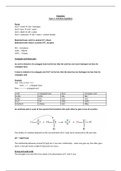
Topic 3: Kinetics
Rate of Reaction is the change in concentration of a reactant or product per unit of time.
change∈concentration of reactant∨ product
Rate= take place ¿
time for the change ¿
Reactions are fastest at the start and get slower as the reactants concentration drops.
The steeper the curve the faster the rate
Reactions start off quickly because of likelihood of collisions
Reactions slow down with time as there are fewer reactants
to collide
Rate Equation
The rate equation is an expression showing how the rate of reaction is linked to the concentration of
the reactants. Rate is equal to the rate constant (k) multiplied by the concentration of each reactant
raised to certain whole powers (called orders).
A general rate equation for the general reaction A + B C + D
Rate = k[A]m [B]n
[A] = concentration of reactant A in moldm -3
[B] = concentration of reactant B in moldm -3
m = order of reaction with respect to A
n = order of reaction with respect to B
k = the rate constant that links the rate of reaction with the concentrations of the reactants. Its
units are dependent on the rate equation.
The order of a reaction with respect to a particular reactant is the power to which the
concentration of this reactant is raised in the rate equation.
The overall order is m + n i.e. the sum of the individual orders
Units of rate constants Second order: Rate k[A]2
Example k = Rate / [A]2
Zero order: Rate = k[A]0 = k = moldm-3 s-1 / (moldm-3)2
Therefore, units of k = moldm-3 s-1 = mol-1dm3 s-1
First order: Rate = k[A] Third order: Rate =k[A]2[B]
k = Rate / [A] k = Rate / [A]2 [B]
= moldm-3 s-1 / moldm-3 = moldm-3 s-1 / (moldm-3)3
= s-1 = mol-2dm6 s-1
Topic 3: Kinetics
Rate of Reaction is the change in concentration of a reactant or product per unit of time.
change∈concentration of reactant∨ product
Rate= take place ¿
time for the change ¿
Reactions are fastest at the start and get slower as the reactants concentration drops.
The steeper the curve the faster the rate
Reactions start off quickly because of likelihood of collisions
Reactions slow down with time as there are fewer reactants
to collide
Rate Equation
The rate equation is an expression showing how the rate of reaction is linked to the concentration of
the reactants. Rate is equal to the rate constant (k) multiplied by the concentration of each reactant
raised to certain whole powers (called orders).
A general rate equation for the general reaction A + B C + D
Rate = k[A]m [B]n
[A] = concentration of reactant A in moldm -3
[B] = concentration of reactant B in moldm -3
m = order of reaction with respect to A
n = order of reaction with respect to B
k = the rate constant that links the rate of reaction with the concentrations of the reactants. Its
units are dependent on the rate equation.
The order of a reaction with respect to a particular reactant is the power to which the
concentration of this reactant is raised in the rate equation.
The overall order is m + n i.e. the sum of the individual orders
Units of rate constants Second order: Rate k[A]2
Example k = Rate / [A]2
Zero order: Rate = k[A]0 = k = moldm-3 s-1 / (moldm-3)2
Therefore, units of k = moldm-3 s-1 = mol-1dm3 s-1
First order: Rate = k[A] Third order: Rate =k[A]2[B]
k = Rate / [A] k = Rate / [A]2 [B]
= moldm-3 s-1 / moldm-3 = moldm-3 s-1 / (moldm-3)3
= s-1 = mol-2dm6 s-1