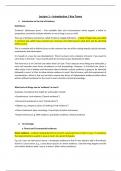
Lecture 1 – Introduction / Key Terms
1. Introduction to the law of Evidence
Definitions:
‘Evidence’ (dictionary term) – ‘the available facts and circumstances which support a belief or
proposition, and which indicate whether or not a thing is true or valid’
The Law of Evidence (sometimes called ‘Evidence’) (legal definition) – a body of legal rules, grounded
in common law, which have evolved over centuries and which govern what facts will be admitted
before courts.
This is a module with a definite focus on the common law: we will be relying heavily judicial rationale,
commentary and observation.
It is based on a case by case development. There has been some statutory intrusion, if you want to
call it that, in the field - most recently with the Criminal Justice (Scotland) Act 2016.
The main focus is on Criminal Law rather than Civil Law. That is because most things are admissible, a
court will consider most forms of evidence in civil proceedings. However, in Criminal Law, there is
often quite a lot of debate and discussion about whether certain evidence is going to be admitted
(allowed) in court. Is it fair to allow certain evidence in court? And of course, with the requirement of
corroboration, which is that we currently require two forms of independent evidence before there
will be sufficient evidence for the court to even consider criminal proceedings.
What sorts of things can be ‘evidence’ in court?
Examples of evidence that might be ‘admissible’ include:
• Eyewitnesses ‘oral evidence (“parole evidence”)
• Documents produced in court (“productions”)
• Objects e.g. weapons, pieces of clothing (“real evidence”)
• Police statements (also recordings / transcripts of police interviews)
• Expert testimony e.g. DNA evidence; psychiatric evidence, medical evidence
2. Terminology
a. Direct and Circumstantial evidence:
Direct evidence – evidence leading directly to proof of a particular fact or facts in issue. It is evidence
that leads directly to a point in issue in court, to a point of dispute.
E.g. Let's say I see John punch Janice. I would give evidence of that if I was asked to add in the witness
stand in a court action, e.g., a case about assault. It's direct evidence. I saw the thing happen and the
court either believes what I say or it doesn't (that's direct evidence).
1. Introduction to the law of Evidence
Definitions:
‘Evidence’ (dictionary term) – ‘the available facts and circumstances which support a belief or
proposition, and which indicate whether or not a thing is true or valid’
The Law of Evidence (sometimes called ‘Evidence’) (legal definition) – a body of legal rules, grounded
in common law, which have evolved over centuries and which govern what facts will be admitted
before courts.
This is a module with a definite focus on the common law: we will be relying heavily judicial rationale,
commentary and observation.
It is based on a case by case development. There has been some statutory intrusion, if you want to
call it that, in the field - most recently with the Criminal Justice (Scotland) Act 2016.
The main focus is on Criminal Law rather than Civil Law. That is because most things are admissible, a
court will consider most forms of evidence in civil proceedings. However, in Criminal Law, there is
often quite a lot of debate and discussion about whether certain evidence is going to be admitted
(allowed) in court. Is it fair to allow certain evidence in court? And of course, with the requirement of
corroboration, which is that we currently require two forms of independent evidence before there
will be sufficient evidence for the court to even consider criminal proceedings.
What sorts of things can be ‘evidence’ in court?
Examples of evidence that might be ‘admissible’ include:
• Eyewitnesses ‘oral evidence (“parole evidence”)
• Documents produced in court (“productions”)
• Objects e.g. weapons, pieces of clothing (“real evidence”)
• Police statements (also recordings / transcripts of police interviews)
• Expert testimony e.g. DNA evidence; psychiatric evidence, medical evidence
2. Terminology
a. Direct and Circumstantial evidence:
Direct evidence – evidence leading directly to proof of a particular fact or facts in issue. It is evidence
that leads directly to a point in issue in court, to a point of dispute.
E.g. Let's say I see John punch Janice. I would give evidence of that if I was asked to add in the witness
stand in a court action, e.g., a case about assault. It's direct evidence. I saw the thing happen and the
court either believes what I say or it doesn't (that's direct evidence).