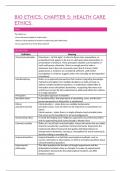
BIO ETHICS: CHAPTER 5: HEALTH CARE
ETHICS
AIMS
DEFINITIONS
Definition Meaning
Prima facie principles Prima facie = ‘at first sight’: it refers to those rules, assumptions, or
propositions that appear to be true or valid upon initial examination or
presentation of evidence. These principles establish a presumption of
truth until proven otherwise. (there is enough proof to make a
statement, but it does not necessarily mean that it IS true). Initial
appearances or evidence are considered sufficient, until further
investigation or evidence suggests other wise (schuldig tot het tegendeel
is bewezen)
Interdisciplinary Refers to an approach/perspective that involves integrating knowledge,
methods and insights from multiple disciplines or fields of study, to
address complex problems/questions. It emphasizes collaboration &
interaction across disciplinary boundaries, recognizing that many real-
world issues cannot be fully understood or addressed within the confines
of a single discipline
Principlism A principled approach in bioethics
Narrative ethics In narrative ethics; the importance of storytelling, voice, and the first-
person perspective in doing ethics is emphasized
Ethical Moral pluralism = states there are multiple fundamental
pluralism/monism principles/values, none of which can be reduced to or prioritized over
others
Moral monism = states there is a single ultimate moral principle/value
that serves as the foundation for all moral judgements
Decolonizing ethics It entails developing more indigenous approaches to professional ethics
and not approaching local issues through a Western lens
Common morality Refers to a set of basic moral principles, values and norms that are widely
shared & accepted by a particular society/community. Represents the
fundamental ethical framework that guides individual behavior &
interpersonal interactions, serving as a foundation for moral reasoning &
decision-making in everyday life
Empirical bioethics Empirical bioethics is a field that used empirical methods, such as
surveys, interviews or observations, to inform normative questions about
relevant bioethical questions
Experimental This often questions the function of thought experiments and the
philosophy philosophical intuitions they are thought to invoke. Eg experimental
philosophers demonstrate that philosophical intuitions can differ
between cultures
, Paternalism Refers to a behavioral/policy approach in which individuals/institutions
exert control or make decisions on behalf of other for their perceived
benefit or well-being, often without their full consent or input
Nudging Nudging refers to practices intent on influencing the patient’s decision
Informed This means that research participants should be accurately informed
consent/assent about the research’s purpose, methods, risks, benefits and alternatives
Beneficence You should do good (eg try cure patients)
Non-maleficence You should not cause harm (eg don’t give a medicine that can causes
bigger problems)
Autonomy Respecting one’s choices & enabling them to make informed choices by
providing objective and complete information
Justice Treat patients fairly (eg doctors should not discriminated based on
gender or race)
Triage See later
Ageism Discrimination based on age
Ableism Ableism refers to discrimination, prejudice or bias against individuals
with disabilities, based on the belief that people with disabilities are
inferior to those without
Eugenics Eugenics = social and political philosophy that advocates for the
improvement of human species, through selective breeding and
controlled reproduction
Tuskegee Syphilis Aimed to study the natural development of syphilis. The men with
Experiment syphilis were not told that they were part of an experiment, or that they
had syphilis. They were told they were treated for ‘bad blood’. The
participants did not receive any treatment
Bikini medicine Women are underrepresented in clinical trials, unless the clinical trials
investigate reproductive organs, so it focuses on what is covered by a
bikini
Precautionary States that if an action or policy has a suspected risk of causing harm to
principle the public or environment, in absence of scientific consensus, the burden
of proof that it is not harmful falls on those taking an action that may or
may not be a risk
QUESTION 1: NAME AND CRITICALLY DISCUSS THE 4 PRINCIPLES OF BIOMEDICAL ETHICS
FORMULATED BY BEAUCHAMP AND CHILDRESS
- Beauchamp & Childress believed that utilitarianism & deontology were inadequate
frameworks to effectively deal with the complexities that arise in medical decision making.
That is why they proposed 4 prima facie principles that make up the core of much
contemporary bioethical reasoning and theorizing
They suggest that their principles accord to a ‘common morality’
1. Non-maleficence (utilitarian)
a. You should not cause harm
b. Application: do not give children that might be effective for their complaints, but
causes bigger problems
2. Beneficence (utilitarian)
a. You should do good
b. Application: try to cure patients
ETHICS
AIMS
DEFINITIONS
Definition Meaning
Prima facie principles Prima facie = ‘at first sight’: it refers to those rules, assumptions, or
propositions that appear to be true or valid upon initial examination or
presentation of evidence. These principles establish a presumption of
truth until proven otherwise. (there is enough proof to make a
statement, but it does not necessarily mean that it IS true). Initial
appearances or evidence are considered sufficient, until further
investigation or evidence suggests other wise (schuldig tot het tegendeel
is bewezen)
Interdisciplinary Refers to an approach/perspective that involves integrating knowledge,
methods and insights from multiple disciplines or fields of study, to
address complex problems/questions. It emphasizes collaboration &
interaction across disciplinary boundaries, recognizing that many real-
world issues cannot be fully understood or addressed within the confines
of a single discipline
Principlism A principled approach in bioethics
Narrative ethics In narrative ethics; the importance of storytelling, voice, and the first-
person perspective in doing ethics is emphasized
Ethical Moral pluralism = states there are multiple fundamental
pluralism/monism principles/values, none of which can be reduced to or prioritized over
others
Moral monism = states there is a single ultimate moral principle/value
that serves as the foundation for all moral judgements
Decolonizing ethics It entails developing more indigenous approaches to professional ethics
and not approaching local issues through a Western lens
Common morality Refers to a set of basic moral principles, values and norms that are widely
shared & accepted by a particular society/community. Represents the
fundamental ethical framework that guides individual behavior &
interpersonal interactions, serving as a foundation for moral reasoning &
decision-making in everyday life
Empirical bioethics Empirical bioethics is a field that used empirical methods, such as
surveys, interviews or observations, to inform normative questions about
relevant bioethical questions
Experimental This often questions the function of thought experiments and the
philosophy philosophical intuitions they are thought to invoke. Eg experimental
philosophers demonstrate that philosophical intuitions can differ
between cultures
, Paternalism Refers to a behavioral/policy approach in which individuals/institutions
exert control or make decisions on behalf of other for their perceived
benefit or well-being, often without their full consent or input
Nudging Nudging refers to practices intent on influencing the patient’s decision
Informed This means that research participants should be accurately informed
consent/assent about the research’s purpose, methods, risks, benefits and alternatives
Beneficence You should do good (eg try cure patients)
Non-maleficence You should not cause harm (eg don’t give a medicine that can causes
bigger problems)
Autonomy Respecting one’s choices & enabling them to make informed choices by
providing objective and complete information
Justice Treat patients fairly (eg doctors should not discriminated based on
gender or race)
Triage See later
Ageism Discrimination based on age
Ableism Ableism refers to discrimination, prejudice or bias against individuals
with disabilities, based on the belief that people with disabilities are
inferior to those without
Eugenics Eugenics = social and political philosophy that advocates for the
improvement of human species, through selective breeding and
controlled reproduction
Tuskegee Syphilis Aimed to study the natural development of syphilis. The men with
Experiment syphilis were not told that they were part of an experiment, or that they
had syphilis. They were told they were treated for ‘bad blood’. The
participants did not receive any treatment
Bikini medicine Women are underrepresented in clinical trials, unless the clinical trials
investigate reproductive organs, so it focuses on what is covered by a
bikini
Precautionary States that if an action or policy has a suspected risk of causing harm to
principle the public or environment, in absence of scientific consensus, the burden
of proof that it is not harmful falls on those taking an action that may or
may not be a risk
QUESTION 1: NAME AND CRITICALLY DISCUSS THE 4 PRINCIPLES OF BIOMEDICAL ETHICS
FORMULATED BY BEAUCHAMP AND CHILDRESS
- Beauchamp & Childress believed that utilitarianism & deontology were inadequate
frameworks to effectively deal with the complexities that arise in medical decision making.
That is why they proposed 4 prima facie principles that make up the core of much
contemporary bioethical reasoning and theorizing
They suggest that their principles accord to a ‘common morality’
1. Non-maleficence (utilitarian)
a. You should not cause harm
b. Application: do not give children that might be effective for their complaints, but
causes bigger problems
2. Beneficence (utilitarian)
a. You should do good
b. Application: try to cure patients