Part 1
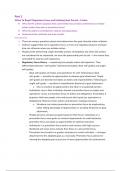
When To Begin? Regulatory Focus and Initiating Goal Pursuit - Freitas
● Why did the authors propose that a prevention focus fosters preferences to initiate
action earlier than does a promotion focus?
● Why the authors controlled for valence and expectancy.
● Understand the methods and main results.
Introduction
● There are various questions about what determines the goal-directed action initiation.
● Authors suggest that one’s regulatory focus, or how one regulates pleasure and pain,
also can influence when one initiates action.
● People prefer performing single desirable actions immediately, but when the actions
are considered to be sequential, we save the pleasurable part to last → the reason they
controlled for valence and expectancy.
● Regulatory focus theory → explaining how people reduce discrepancies. They
differentiate between “self-guides” (desired end states); ideal self-guides and ought
self-guides.
○ Ideal self-guides are hopes and aspirations for self. Following an ideal
self-guide → sensitive to opportunities to advance goal attainment. Ought
self-guides are desired end states as duties and responsibilities. Following an
ought self-guide → sensitive to impediments (barriers) to goal attainment.
■ One is sensitive to opportunities, the other is to potential barriers.
○ Individuals vary in their inclination toward a promotion focus on hopes and
aspirations versus a prevention focus on duties and obligations. Essentially, it
proposes that how people view and pursue their goals (as aspirations or
obligations) influences their actions and decision-making processes.
■ Situations can induce promotion or prevention focus by emphasizing
either taking advantage of opportunities or avoiding hindrance to goal
attainment.
○ People perceive and pursue goals based on their focus. Individuals in a
prevention focus view goals as minimal requirements to avoid obstacles,
promotion focus see goals as opportunities for optimal outcomes.
○ Individuals in a promotion focus tend to seek actions with high success
likelihood and value more actively than those in a prevention focus.
○ Prevention focus leads to a greater reluctance to switch activities → stronger
attachment to the adopted goal as a necessity. Promotion focus allows for
viewing the adopted goal as just one of many opportunities for achievement.
, ● Prevention Focus: Emphasizes minimal standards to meet, viewing goals as necessities
to avoid obstacles, and there is a pressure to meet that. This mindset leads to quicker
initiation of goal-directed action.
● Promotion Focus: Emphasizes maximum standards one hopes to achieve, seeing goals
as opportunities for optimal outcomes. Individuals in a promotion focus might delay
action, waiting for ideal conditions before acting.
● A prevention focus fosters preferences to initiate action earlier than does a promotion
focus.
Study 1
● Tested whether individual differences in regulatory focus accounted for variability in
participants’ preferences for when to begin a hypothetical task.
● The participants imagined having to write an essay. Researchers expected the chronic
prevention focus individuals to prefer earlier start compared to promotion focus.
● Regulatory focus was assessed by asking questions about ideals and ought self-guides.
People react faster to questions about their regulatory focus type.
● They controlled for valence and expectancy because people prefer to begin single
positively valenced action relatively soon. Therefore, they asked the participants about
how interesting they expected the task to be and for how well they expected to
perform on it → expectancy of interest and success. They thought regulatory focus
would relate to action-initiation preferences when these variables were controlled for.
Method
● Procedure: 64 Yale Uni bachelor students participated for course credit. Completed
questionnaires.
● Materials: 2 materials were used.
○ Self-Guide Strength: Idiographic measure that asks participants to list attributes
describing certain self-representations from their own standpoints. Participants
initially were provided with definitions of their ideal and ought selves.
○ Temporal Preferences: They were asked to “Imagine that you plan to apply for a
fellowship. The deadline to submit applications (including an essay) is 3 months
from now.” Participants next responded to the questions, “When would you
most want to begin writing the essay?” It was an 11-point scale with 1 being
the soonest. “How interested are you in writing the essay?” 10-point scale, 0 not
interested. “How well do you expect to do on the essay?” 10-point scale, 0 is
not well - 9 well.
Results and Discussion: Increases in participants’ ought-self guides were associated with
earlier preferences, increases in participants’ ideal self-guides were associated with later
When To Begin? Regulatory Focus and Initiating Goal Pursuit - Freitas
● Why did the authors propose that a prevention focus fosters preferences to initiate
action earlier than does a promotion focus?
● Why the authors controlled for valence and expectancy.
● Understand the methods and main results.
Introduction
● There are various questions about what determines the goal-directed action initiation.
● Authors suggest that one’s regulatory focus, or how one regulates pleasure and pain,
also can influence when one initiates action.
● People prefer performing single desirable actions immediately, but when the actions
are considered to be sequential, we save the pleasurable part to last → the reason they
controlled for valence and expectancy.
● Regulatory focus theory → explaining how people reduce discrepancies. They
differentiate between “self-guides” (desired end states); ideal self-guides and ought
self-guides.
○ Ideal self-guides are hopes and aspirations for self. Following an ideal
self-guide → sensitive to opportunities to advance goal attainment. Ought
self-guides are desired end states as duties and responsibilities. Following an
ought self-guide → sensitive to impediments (barriers) to goal attainment.
■ One is sensitive to opportunities, the other is to potential barriers.
○ Individuals vary in their inclination toward a promotion focus on hopes and
aspirations versus a prevention focus on duties and obligations. Essentially, it
proposes that how people view and pursue their goals (as aspirations or
obligations) influences their actions and decision-making processes.
■ Situations can induce promotion or prevention focus by emphasizing
either taking advantage of opportunities or avoiding hindrance to goal
attainment.
○ People perceive and pursue goals based on their focus. Individuals in a
prevention focus view goals as minimal requirements to avoid obstacles,
promotion focus see goals as opportunities for optimal outcomes.
○ Individuals in a promotion focus tend to seek actions with high success
likelihood and value more actively than those in a prevention focus.
○ Prevention focus leads to a greater reluctance to switch activities → stronger
attachment to the adopted goal as a necessity. Promotion focus allows for
viewing the adopted goal as just one of many opportunities for achievement.
, ● Prevention Focus: Emphasizes minimal standards to meet, viewing goals as necessities
to avoid obstacles, and there is a pressure to meet that. This mindset leads to quicker
initiation of goal-directed action.
● Promotion Focus: Emphasizes maximum standards one hopes to achieve, seeing goals
as opportunities for optimal outcomes. Individuals in a promotion focus might delay
action, waiting for ideal conditions before acting.
● A prevention focus fosters preferences to initiate action earlier than does a promotion
focus.
Study 1
● Tested whether individual differences in regulatory focus accounted for variability in
participants’ preferences for when to begin a hypothetical task.
● The participants imagined having to write an essay. Researchers expected the chronic
prevention focus individuals to prefer earlier start compared to promotion focus.
● Regulatory focus was assessed by asking questions about ideals and ought self-guides.
People react faster to questions about their regulatory focus type.
● They controlled for valence and expectancy because people prefer to begin single
positively valenced action relatively soon. Therefore, they asked the participants about
how interesting they expected the task to be and for how well they expected to
perform on it → expectancy of interest and success. They thought regulatory focus
would relate to action-initiation preferences when these variables were controlled for.
Method
● Procedure: 64 Yale Uni bachelor students participated for course credit. Completed
questionnaires.
● Materials: 2 materials were used.
○ Self-Guide Strength: Idiographic measure that asks participants to list attributes
describing certain self-representations from their own standpoints. Participants
initially were provided with definitions of their ideal and ought selves.
○ Temporal Preferences: They were asked to “Imagine that you plan to apply for a
fellowship. The deadline to submit applications (including an essay) is 3 months
from now.” Participants next responded to the questions, “When would you
most want to begin writing the essay?” It was an 11-point scale with 1 being
the soonest. “How interested are you in writing the essay?” 10-point scale, 0 not
interested. “How well do you expect to do on the essay?” 10-point scale, 0 is
not well - 9 well.
Results and Discussion: Increases in participants’ ought-self guides were associated with
earlier preferences, increases in participants’ ideal self-guides were associated with later