4.1 sexual reproduction in humans
Male reproductive system
Structure Function
Scrotum External sac of skin containing the testes
Testes Produce testosterone & contain around 1000 seminiferous tubules
Seminiferous tubules Produce spermatozoa by spermatogenesis
Epididymis Where Spermatozoa are stored & mature to become fully mobile
Seminal vesicles Secrete mucus and fluid to the vas deferens - mixes with
spermatozoa during ejaculation
Secretions maintain sperm mobility, provides nutrients (e.g.
fructose), alkali to neutralise acidity from from urine in the urethra
or vaginal tract
Prostate gland Produces prostate fluid - alkaline secretion to neutralise acidity of
urine & contains zinc ions
Penis Specialised organ adapted to transfer semen to the vagina during
sexual intercourse.
Ejaculation and semen (seminal and prostate fluids +
spermatozoa) leave the penis by the urethra
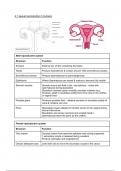
Female reproductive system
Structure Function
Two ovaries Oocytes mature from germinal epithelial cells during oogenesis
1 secondary oocyte is released during ovulation
Produce oestrogen and progesterone
Oviduct (fallopian tube) Lined with cilia to move the secondary oocyte to the uterus
, Uterus The perimetrium (thin outer layer)
Myometrium (muscle layer)
Endometrium (innermost layer), contains a mucous membrane
which has a good supply of blood, this layer is shed each month
during the menstrual cycle if an embryo fails to implant
Contains the developing foetus until birth
Cervix Narrow ring of connective tissue and muscle that acts as a barrier
between the uterus and outside environment
During pregnancy, a mucous plug forms in the cervix to prevent
entry of pathogens
Vagina Has a muscular wall and opens at the vulva
Semen is deposited into the vagina during sexual intercourse
Foetus passes out from the uterus, through the vagina during birth
Gametogenesis
● The production of haploid gametes through a series of mitotic and meiotic divisions in
the testes and ovaries
Spermatogenesis - the production of sperm
● Cells become more mature as you move towards the centre
1. Diploid germinal epithelial cells divide by mitosis to produce diploid spermatogonia /
spermatogonium
2. Spermatogonia divide by mitosis to become primary spermatocytes (2n)
3. Primary spermatocytes divide by meiosis I to produce secondary spermatocytes (n)
4. Secondary spermatocytes undergo meiosis II to produce spermatids (n)
5. Spermatids differentiate and mature into spermatozoa / spermatozoon(n)
● Sertoli cells provide spermatozoa with nutrients & and protection from male’s immune
system
● Interstitial cells secrete testosterone which stimulates spermatogenesis
Male reproductive system
Structure Function
Scrotum External sac of skin containing the testes
Testes Produce testosterone & contain around 1000 seminiferous tubules
Seminiferous tubules Produce spermatozoa by spermatogenesis
Epididymis Where Spermatozoa are stored & mature to become fully mobile
Seminal vesicles Secrete mucus and fluid to the vas deferens - mixes with
spermatozoa during ejaculation
Secretions maintain sperm mobility, provides nutrients (e.g.
fructose), alkali to neutralise acidity from from urine in the urethra
or vaginal tract
Prostate gland Produces prostate fluid - alkaline secretion to neutralise acidity of
urine & contains zinc ions
Penis Specialised organ adapted to transfer semen to the vagina during
sexual intercourse.
Ejaculation and semen (seminal and prostate fluids +
spermatozoa) leave the penis by the urethra
Female reproductive system
Structure Function
Two ovaries Oocytes mature from germinal epithelial cells during oogenesis
1 secondary oocyte is released during ovulation
Produce oestrogen and progesterone
Oviduct (fallopian tube) Lined with cilia to move the secondary oocyte to the uterus
, Uterus The perimetrium (thin outer layer)
Myometrium (muscle layer)
Endometrium (innermost layer), contains a mucous membrane
which has a good supply of blood, this layer is shed each month
during the menstrual cycle if an embryo fails to implant
Contains the developing foetus until birth
Cervix Narrow ring of connective tissue and muscle that acts as a barrier
between the uterus and outside environment
During pregnancy, a mucous plug forms in the cervix to prevent
entry of pathogens
Vagina Has a muscular wall and opens at the vulva
Semen is deposited into the vagina during sexual intercourse
Foetus passes out from the uterus, through the vagina during birth
Gametogenesis
● The production of haploid gametes through a series of mitotic and meiotic divisions in
the testes and ovaries
Spermatogenesis - the production of sperm
● Cells become more mature as you move towards the centre
1. Diploid germinal epithelial cells divide by mitosis to produce diploid spermatogonia /
spermatogonium
2. Spermatogonia divide by mitosis to become primary spermatocytes (2n)
3. Primary spermatocytes divide by meiosis I to produce secondary spermatocytes (n)
4. Secondary spermatocytes undergo meiosis II to produce spermatids (n)
5. Spermatids differentiate and mature into spermatozoa / spermatozoon(n)
● Sertoli cells provide spermatozoa with nutrients & and protection from male’s immune
system
● Interstitial cells secrete testosterone which stimulates spermatogenesis