3.7 Homeostasis and the kidney
Homeostasis
● The maintenance of an internal environment within tolerable limits, by negative feedback
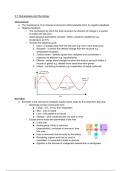
● Negative feedback
○ The mechanism by which the body reverses the direction of change in a system
to restore the set point
○ Keeps physical parameters constant / within a dynamic equilibrium e.g.
temperature at 37℃
○ Involves the following cycle;
1. Input - a change away from the set point e.g. rise in core body temp
2. Receptor - a sensor that detects change from the set point e.g.
temperature receptors
3. Control centre - detects signals from receptors and coordinates a
response via effectors e.g. hypothalamus
4. Effector - brings about changes to return the body to set point (either a
muscle or gland) e.g. release more sweat from skin glands
5. Output - corrective procedure e.g. evaporation of sweat cools skin
Excretion
● Excretion is the removal of metabolic waste (waste made by the body) from the body
○ Mammals excrete compounds from;
■ Lungs - CO 2 & H2O from respiration
■ Skin - urea in sweat
■ Liver - bile pigments in faeces
■ Kidneys - urea, creatinine and uric acid in urine
○ Excess amino acids are deaminated in the liver
■ In the liver
■ Amine group (-NH2) is removed
(deamination), converted to ammonia, then
into urea
■ Urea is removed from the body by the kidney
■ Remaining organic acid can be used in
respiration or converted to lipids or glucose
■ Egestion is the removal of undigested material from a cell/system
, The kidney
● 2 main functions
○ Excretion of nitrogenous waste from the body e.g. urea
○ Osmoregulation - the control of the water potential of body fluids e.g. blood
● Humans have 2 kidneys
○ The renal artery supplies blood containing O2, & waste
○ Filtered blood returns to the general circulation via the renal vein
○ Each kidney has 1 million nephrons, which are 30mm long
■ Nephrons are the functional units of the kidney
■ Processes occurring in the nephron;
● Ultrafiltration
● Selective reabsorption
● Osmoregulation
○ Capillary network surround the convoluted tubules and loop of Henle - allow
substances to be absorbed into blood
■ Capillaries surrounding the loop of Henle are called ‘vasa recta’
○ Urine
■ Is made up of excess water and solutes (inc. urea)
■ Drains into the collecting duct and pelvis, which empty into the ureter
■ Each ureter connects to the bladder
Homeostasis
● The maintenance of an internal environment within tolerable limits, by negative feedback
● Negative feedback
○ The mechanism by which the body reverses the direction of change in a system
to restore the set point
○ Keeps physical parameters constant / within a dynamic equilibrium e.g.
temperature at 37℃
○ Involves the following cycle;
1. Input - a change away from the set point e.g. rise in core body temp
2. Receptor - a sensor that detects change from the set point e.g.
temperature receptors
3. Control centre - detects signals from receptors and coordinates a
response via effectors e.g. hypothalamus
4. Effector - brings about changes to return the body to set point (either a
muscle or gland) e.g. release more sweat from skin glands
5. Output - corrective procedure e.g. evaporation of sweat cools skin
Excretion
● Excretion is the removal of metabolic waste (waste made by the body) from the body
○ Mammals excrete compounds from;
■ Lungs - CO 2 & H2O from respiration
■ Skin - urea in sweat
■ Liver - bile pigments in faeces
■ Kidneys - urea, creatinine and uric acid in urine
○ Excess amino acids are deaminated in the liver
■ In the liver
■ Amine group (-NH2) is removed
(deamination), converted to ammonia, then
into urea
■ Urea is removed from the body by the kidney
■ Remaining organic acid can be used in
respiration or converted to lipids or glucose
■ Egestion is the removal of undigested material from a cell/system
, The kidney
● 2 main functions
○ Excretion of nitrogenous waste from the body e.g. urea
○ Osmoregulation - the control of the water potential of body fluids e.g. blood
● Humans have 2 kidneys
○ The renal artery supplies blood containing O2, & waste
○ Filtered blood returns to the general circulation via the renal vein
○ Each kidney has 1 million nephrons, which are 30mm long
■ Nephrons are the functional units of the kidney
■ Processes occurring in the nephron;
● Ultrafiltration
● Selective reabsorption
● Osmoregulation
○ Capillary network surround the convoluted tubules and loop of Henle - allow
substances to be absorbed into blood
■ Capillaries surrounding the loop of Henle are called ‘vasa recta’
○ Urine
■ Is made up of excess water and solutes (inc. urea)
■ Drains into the collecting duct and pelvis, which empty into the ureter
■ Each ureter connects to the bladder