Certification exam for WGU pathophysiology D236 final test
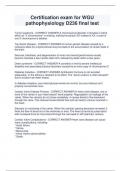
Certification exam for WGU pathophysiology D236 final test Turner syndrome - CORRECT ANSWER-A chromosomal disorder in females in which either an *X chromosome* is missing, making the person XO instead of XX, or part of one X chromosome is deleted. Tay-Sachs Disease - CORRECT ANSWER-A human genetic disease caused by a recessive allele for a dysfunctional enzyme leads to the accumulation of certain lipids in the brain. Seizures, blindness, and degeneration of motor and mental performance usually become manifest a few months after birth, followed by death within a few years. Down syndrome - CORRECT ANSWER-A condition of mild to severe intellectual disability and associated physical disorders caused by an extra copy of chromosome 21 Diabetes Insipidus - CORRECT ANSWER-Antidiuretic hormone is not secreted adequately, or the kidney is resistant to its effect. The *serum sodium is often elevated* due to excess free water losses. In diabetes insipidus, your blood glucose levels are normal, but your kidneys can't properly concentrate urine. Cardiac Valve Disease Process - CORRECT ANSWER-In heart valve disease, one or more of the valves in your heart doesn't work properly. Regurgitation (or leakage of the valve). When the valve(s) do not close completely, it causes blood to flow backward through the valve. This reduces forward blood flow and can lead to volume overload in the heart. Stenosis (or narrowing of the valve). When the valve(s) opening becomes narrowed, it limits the flow of blood out of the ventricles or atria. The heart is forced to pump blood with increased force to move blood through the narrowed or stiff (stenotic) valve(s). Cardiac Valve Complications - CORRECT ANSWER-Heart valve disease can cause many complications, including: * Heart failure. * Stroke. * Blood clots. * Heart rhythm abnormalities. * Death. Respiratory Illness from bats - CORRECT ANSWER-*Viral hemorrhagic fevers* are spread by contact with infected animals or insects. The viruses that cause viral hemorrhagic fevers live in a variety of animal and insect hosts. Most commonly, the hosts include mosquitoes, ticks, rodents, or bats. Some viral hemorrhagic fevers can also be spread from person to person. Anemia - CORRECT ANSWER-Different types of anemia include: Anemia due to vitamin B12 deficiency Anemia due to folate (folic acid) deficienc
Written for
- Institution
- Pathophysiology
- Module
- Pathophysiology
Document information
- Uploaded on
- May 29, 2024
- Number of pages
- 16
- Written in
- 2023/2024
- Type
- Exam (elaborations)
- Contains
- Questions & answers
Subjects
-
turner syndrome
-
tay sachs disease
-
certification exam for wgu pathophysiology d236 fi

Also available in package deal