C10 Using Resources
Ceramics, Composites and Polymers
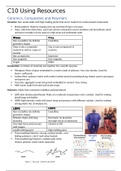
Ceramics: Non-metal solids with high melting points that aren’t made from carbon-based compounds.
Bricks/pottery: Made by shaping wet clay and then firing in a furnace
Glass: soda-lime (limestone, sand and calcium carbonate) used in windows and borosilicate (sand
and boron trioxide) can be used at a high temp and withstands acids
Glass Clay
Non-crystalline (no definite Crystalline
geometric shape)
Glass is also a composite Clay is main component in
material as well as a type of ceramics
ceramic
Not as expensive Expensive
Non-magnetic Non-magnetic
Fragile Brittle
Composites: A mixture of materials put together for a specific purpose
Fibreglass: fibres of glass embedded in a matrix made of polymer. Has a low density. Used for
boats/ surfboards.
Carbon fibre: polymer matrix with carbon reinforcement (nanotubes/long chains) used in aerospace
and sports cars.
Concrete: aggregate (sand and gravel) embedded in cement. Very strong.
MDF wood: made from old used wood scraps
Polymers: Made from monomers (addition polymerisation)
LDPE (low density polyethene): Made at a moderate temperature and a catalyst. Used for making
plastic bags and bottles
HDPE (high density): made with lower temp and pressure with different catalyst. Used for making
strong plastic ties, drainpipes etc.
LDPE HDPE
Non-crystalline (no definite Crystalline
geometric shape)
Polymer chains with long Not much/ no branches
branches (stronger forces of attraction)
Very high temp and pressure Catalyst at 50C
with oxygen
LowER melting point High melting point
Thermosetting Polymers: strong covalent bonds, cross
linking polymers + don’t melt when heated.
Thermosoftening Polymers: melted easily when
heated, polymer chains easily separated.
Ceramics, Composites and Polymers
Ceramics: Non-metal solids with high melting points that aren’t made from carbon-based compounds.
Bricks/pottery: Made by shaping wet clay and then firing in a furnace
Glass: soda-lime (limestone, sand and calcium carbonate) used in windows and borosilicate (sand
and boron trioxide) can be used at a high temp and withstands acids
Glass Clay
Non-crystalline (no definite Crystalline
geometric shape)
Glass is also a composite Clay is main component in
material as well as a type of ceramics
ceramic
Not as expensive Expensive
Non-magnetic Non-magnetic
Fragile Brittle
Composites: A mixture of materials put together for a specific purpose
Fibreglass: fibres of glass embedded in a matrix made of polymer. Has a low density. Used for
boats/ surfboards.
Carbon fibre: polymer matrix with carbon reinforcement (nanotubes/long chains) used in aerospace
and sports cars.
Concrete: aggregate (sand and gravel) embedded in cement. Very strong.
MDF wood: made from old used wood scraps
Polymers: Made from monomers (addition polymerisation)
LDPE (low density polyethene): Made at a moderate temperature and a catalyst. Used for making
plastic bags and bottles
HDPE (high density): made with lower temp and pressure with different catalyst. Used for making
strong plastic ties, drainpipes etc.
LDPE HDPE
Non-crystalline (no definite Crystalline
geometric shape)
Polymer chains with long Not much/ no branches
branches (stronger forces of attraction)
Very high temp and pressure Catalyst at 50C
with oxygen
LowER melting point High melting point
Thermosetting Polymers: strong covalent bonds, cross
linking polymers + don’t melt when heated.
Thermosoftening Polymers: melted easily when
heated, polymer chains easily separated.