PTCB PRACTICE TESTS 2024
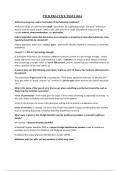
PTCB PRACTICE TESTS 2024 Antitussive drugs are used to treat which of the following conditions? Antitussive drugs are used to treat cough – specifically, by suppressing cough .The word "antitussive" derives from the word "tussis", which is the Latin word for a cough. Examples of antitussive drugs include codeine, dextromethorphan, and pholcodine. Federal legislation states that pharmacies must complete an inventory of controlled substances. How regularly should this be conducted? Federal legislation states that – every 2 years – pharmacies should complete an inventory of controlled substances. Convert 1 : 7,500 to a percentage strength. If, during the PTCB exam, you are given a ratio and asked to convert it to percentage strength - simply divide 100 by the ratio value.( 100 divided by 7,500 ) = 0.013%It’s as simple as that! Always remember that 'percentage strength' refers to 'out of 100 percent', and this should help you remember what to do when a question of this kind comes up. A patient gives you the following prescription: iii gtts ou ud x 7d. How is this medicine administered to the patient? The prescription iii gtts ou ud x 7d is translated as: Three drops, applied to both eyes, as directed, for 7 days. gtts refers to "drops" and the "ou" confirms it's for the eyes rather than the ears (which would be "au"). What is the name of the type of error that occurs when something is performed incorrectly, such as dispensing the medicine incorrectly? “Error of commission” is the name given to a type of error when something is performed incorrectly - in this case, where a medicine was incorrectly dispensed to the patient. Errors of commission can occur in the pharmacy setting and contribute to medication errors. Errors of omission, in contrast, are errors that involve the patient missing something that they needed, such as not being dispensed a medicine that they should have received. What name is given to the 10-digit identifier used by healthcare providers to transmit healthcare details? NPI number = National Provider Identifier A National Provider Identifier (NPI) is a unique 10-digit identification number issued to healthcare providers by the Centers for Medicare and Medicaid Services (CMS). It replaced the unique physician identification number (UPIN). Medicines with the suffix -pril are members of which drug class? ACE inhibitors include perindopril, ramipril, and lisinopril (note that all ACE inhibitors have the suffix pril). ACE inhibitors are used to treat conditions such as hypertension and heart failure. Common side effects include a persistent dry cough, hypotension, and elevated potassium levels. Due to the sulfur component of captopril, this particular ACE inhibitor can cause patient's to develop a metallic taste. Before use, for how long should a laminar air flow hood be turned on? Laminar air flow hoods must be turned on 30-minutes before they are used. Class III FDA drug recalls is interpreted as which of these? Class III recalls are considered the “least serious”. Class II recalls are considered “intermediate level threat”, whereas Class I recalls are classified as the “most severe threat” level. When a medication is dispensed, which of these is a flat fee that the patient must pay to the pharmacy? Co-pay (co-payment) is the name given to the flat fee the patient pays to the pharmacy when thei
Written for
- Institution
- PTCB PRACTICE
- Module
- PTCB PRACTICE
Document information
- Uploaded on
- May 28, 2024
- Number of pages
- 3
- Written in
- 2023/2024
- Type
- Exam (elaborations)
- Contains
- Questions & answers
Subjects
-
ptcb practice tests 2024

Also available in package deal