Monday 6th December 2021 LEC 172
Deformation – 2
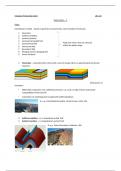
Folds:
Classification of folds – based on geometry and symmetry, and orientation of fold axis:
1. Monocline
2. Antiform/anticline
3. Synform/syncline
4. Symmetrical/upright fold
Folds form when rocks are stressed
5. Asymmetrical fold
within the plastic range.
6. Overturned fold
7. Recumbent fold
8. Plunging and non-plunging fold
9. Dome and basin
1. Monocline - a step-like fold in strata with a zone of steeper dip in an approximately horizontal
sequence.
Mechanisms of
formation:
• differential compaction over underlying structure, e.g., fault, at edge of basin and greater
compactibility of the basin fill
• reactivation of underlying fault coupled with uplift/subsidence
e.g., East Kaibab Monocline, Grand Canyon, Utah, USA
2. Antiform/anticline - an ‘n-shaped/up-arched’ fold
3. Synform/syncline - a ‘u-shaped/down-arched’ fold
e.g., Calico Mountains, California, USA
, 4. Symmetrical/upright fold - axial plane is vertical and each limb dips at the same angle
Dip and strike symbols used on geologic maps
Either: Long line indicates strike orientation; short line indicates dip direction,
with angle of dip in degrees.
Or: Arrow indicates dip direction, with angle of dip in degrees.
5. Asymmetrical fold - axial plane is inclined and limbs dip at different angles
6. Overturned fold - one limb has been rotated so much that it is now upside down; common in
mountain ranges
7. Recumbent fold - axial plane is horizontal; common in mountain ranges formed by compression at
convergent plate boundaries
Deformation – 2
Folds:
Classification of folds – based on geometry and symmetry, and orientation of fold axis:
1. Monocline
2. Antiform/anticline
3. Synform/syncline
4. Symmetrical/upright fold
Folds form when rocks are stressed
5. Asymmetrical fold
within the plastic range.
6. Overturned fold
7. Recumbent fold
8. Plunging and non-plunging fold
9. Dome and basin
1. Monocline - a step-like fold in strata with a zone of steeper dip in an approximately horizontal
sequence.
Mechanisms of
formation:
• differential compaction over underlying structure, e.g., fault, at edge of basin and greater
compactibility of the basin fill
• reactivation of underlying fault coupled with uplift/subsidence
e.g., East Kaibab Monocline, Grand Canyon, Utah, USA
2. Antiform/anticline - an ‘n-shaped/up-arched’ fold
3. Synform/syncline - a ‘u-shaped/down-arched’ fold
e.g., Calico Mountains, California, USA
, 4. Symmetrical/upright fold - axial plane is vertical and each limb dips at the same angle
Dip and strike symbols used on geologic maps
Either: Long line indicates strike orientation; short line indicates dip direction,
with angle of dip in degrees.
Or: Arrow indicates dip direction, with angle of dip in degrees.
5. Asymmetrical fold - axial plane is inclined and limbs dip at different angles
6. Overturned fold - one limb has been rotated so much that it is now upside down; common in
mountain ranges
7. Recumbent fold - axial plane is horizontal; common in mountain ranges formed by compression at
convergent plate boundaries