Thursday 18th November 2021 LEC 172
Foundations of Geology
Principle of Uniformitarianism = “The present is the key to the past.”
i.e., Present day geologic processes have operated throughout geologic time, and therefore, additionally; “The
present is the key to the future,” as the laws of physics, chemistry and biology that governed geologic
processes in the past are the same as those that govern processes now and in the future.
Classification of Rocks:
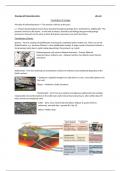
Igneous – form by cooling and solidification of previously completely/partly molten rock. These can be sub-
divided further, e.g., Intrusive (Plutonic) = slow solidification/cooling large crystals vs Extrusive/Volcanic =
fast growing crystals due to rapid cooling (quenching), fine grained, e.g., basalt.
Polished igneous rock surface (Plutonic/Intrusive) - Granite. Different
minerals/colours visible by eye – feldspars (white), mica (black), quartz (brown,
colourless)
Sedimentary - form by hardening and cementation of layers of sediment (unconsolidated) deposited at the
Earth’s surface.
< Sandstone, originally thought to be laid down in a river. Cross-beds (planes w/in
the rock).
Others – Mudstone, Chalk, Limestone
Metamorphic - form from pre-existing rocks (igneous/sedimentary/pre-existing
metamorphic) by transformations in the solid state under intense heat and pressure, often within deep Mt
belts, and do not completely melt!
Schist – shiny, mica minerals (brown flakes), feldspar & quartz (white &
colourless), also pink dots = garnets (Fe, Mg, Si).
Others: Marble, Slate,
Foundations of Geology
Principle of Uniformitarianism = “The present is the key to the past.”
i.e., Present day geologic processes have operated throughout geologic time, and therefore, additionally; “The
present is the key to the future,” as the laws of physics, chemistry and biology that governed geologic
processes in the past are the same as those that govern processes now and in the future.
Classification of Rocks:
Igneous – form by cooling and solidification of previously completely/partly molten rock. These can be sub-
divided further, e.g., Intrusive (Plutonic) = slow solidification/cooling large crystals vs Extrusive/Volcanic =
fast growing crystals due to rapid cooling (quenching), fine grained, e.g., basalt.
Polished igneous rock surface (Plutonic/Intrusive) - Granite. Different
minerals/colours visible by eye – feldspars (white), mica (black), quartz (brown,
colourless)
Sedimentary - form by hardening and cementation of layers of sediment (unconsolidated) deposited at the
Earth’s surface.
< Sandstone, originally thought to be laid down in a river. Cross-beds (planes w/in
the rock).
Others – Mudstone, Chalk, Limestone
Metamorphic - form from pre-existing rocks (igneous/sedimentary/pre-existing
metamorphic) by transformations in the solid state under intense heat and pressure, often within deep Mt
belts, and do not completely melt!
Schist – shiny, mica minerals (brown flakes), feldspar & quartz (white &
colourless), also pink dots = garnets (Fe, Mg, Si).
Others: Marble, Slate,