Quantum Physics-2024
Blackbody Radiation - ✔️✔️- Radiation properties are independent of the material. The
maximum of the distribution shifts to smaller wavelengths as the temperature is
increased. The total power radiated increases with the temperature. One of the
outstanding exceptions that classical physics could not explain, dubbed the "ultraviolet
catastrophe" by Paul Ehrenfest.
Blackbody - ✔️✔️- Has the ideal property that it absorbs all the radiation falling on it
and reflects none.
Discovery of the Electron - ✔️✔️- J.J. Thomson observed that monoatomic gases
could be ionized by x rays/cathode rays, thus implying the atom itself must have
charged constituents that can be separated. These individual parts could be deflected
by an electric field as if they were negatively charged.
Crossed-Field Experiment - ✔️✔️- Performed by J.J. Thomson, attempting to
determine anything about electrons. He realized he could determine their q/m ratio by
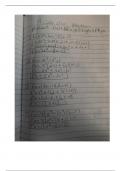
finding their velocity through derivations of the equations pictured and r=(mv)/(qB).
Millikan oil-drop experiment - ✔️✔️- Robert Milikan discovered the charge and
subsequent mass of the electron by balancing charged, aerosolized drops of oil with an
electric field, so that mg = qE of the drop. Thus, solving for q gave him the charge of the
drop. It was noted that each drop was an integer multiple of a certain minimum charge
value.
, Thomson's atomic model - ✔️✔️- Referred to as "plum-pudding model" or the "raisin-
cake model" because of the resemblance. Thomson hypothesized the atom was a
spherical cloud of positive charge with negative electrons embedded in them.
Rutherford's atomic model - ✔️✔️- Known as the "nuclear model of the atom".
Rutherford hypothesized that electrons orbit a small (massive compared to electron)
nucleus. This came about through his observation that some alpha particles were
reflected at large angles or backwards when going through thin metal foils, believing this
to be caused by the alpha particle approaching close to the nucleus and being deflected
the opposite way due to their like charges.
Electron volt - ✔️✔️- 1 eV = 1.60 E-19 J. Derived by determining electron kinetic
energy starting from rest across a a parallel plate capacitor. In other words, 1 electron
volt is the kindetic energy gained by an electron (or proton) if it accelerates through a
potential difference of 1 volt.
Mass spectrometer - ✔️✔️- Device used for measuring the charge-to-mass ratio of
atomic ions.
Isotope - ✔️✔️- Nucleus with same Z-value, but different masses (Different # of
neutrons)
Mass number - ✔️✔️- Represented by A, A = Z (protons) + N (neutrons). Not the same
as atomic mass, though it is approximately the mass in atomic mass units.
Planck's radiation law - ✔️✔️- Derived by Max Planck to explain blackbody radiation.
Planck's constant - ✔️✔️- Represented by the variable h, determined from the equation
E = hf. Its value is 6.6261 E-34 J*s.
Blackbody Radiation - ✔️✔️- Radiation properties are independent of the material. The
maximum of the distribution shifts to smaller wavelengths as the temperature is
increased. The total power radiated increases with the temperature. One of the
outstanding exceptions that classical physics could not explain, dubbed the "ultraviolet
catastrophe" by Paul Ehrenfest.
Blackbody - ✔️✔️- Has the ideal property that it absorbs all the radiation falling on it
and reflects none.
Discovery of the Electron - ✔️✔️- J.J. Thomson observed that monoatomic gases
could be ionized by x rays/cathode rays, thus implying the atom itself must have
charged constituents that can be separated. These individual parts could be deflected
by an electric field as if they were negatively charged.
Crossed-Field Experiment - ✔️✔️- Performed by J.J. Thomson, attempting to
determine anything about electrons. He realized he could determine their q/m ratio by
finding their velocity through derivations of the equations pictured and r=(mv)/(qB).
Millikan oil-drop experiment - ✔️✔️- Robert Milikan discovered the charge and
subsequent mass of the electron by balancing charged, aerosolized drops of oil with an
electric field, so that mg = qE of the drop. Thus, solving for q gave him the charge of the
drop. It was noted that each drop was an integer multiple of a certain minimum charge
value.
, Thomson's atomic model - ✔️✔️- Referred to as "plum-pudding model" or the "raisin-
cake model" because of the resemblance. Thomson hypothesized the atom was a
spherical cloud of positive charge with negative electrons embedded in them.
Rutherford's atomic model - ✔️✔️- Known as the "nuclear model of the atom".
Rutherford hypothesized that electrons orbit a small (massive compared to electron)
nucleus. This came about through his observation that some alpha particles were
reflected at large angles or backwards when going through thin metal foils, believing this
to be caused by the alpha particle approaching close to the nucleus and being deflected
the opposite way due to their like charges.
Electron volt - ✔️✔️- 1 eV = 1.60 E-19 J. Derived by determining electron kinetic
energy starting from rest across a a parallel plate capacitor. In other words, 1 electron
volt is the kindetic energy gained by an electron (or proton) if it accelerates through a
potential difference of 1 volt.
Mass spectrometer - ✔️✔️- Device used for measuring the charge-to-mass ratio of
atomic ions.
Isotope - ✔️✔️- Nucleus with same Z-value, but different masses (Different # of
neutrons)
Mass number - ✔️✔️- Represented by A, A = Z (protons) + N (neutrons). Not the same
as atomic mass, though it is approximately the mass in atomic mass units.
Planck's radiation law - ✔️✔️- Derived by Max Planck to explain blackbody radiation.
Planck's constant - ✔️✔️- Represented by the variable h, determined from the equation
E = hf. Its value is 6.6261 E-34 J*s.