WGU D169 - Study Guide 2024
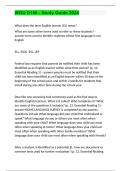
What does the term English learner (EL) mean? What are some other terms used to refer to these students? - answer-term used to identify students whose first language is not English ELL, ESOL, ESL, LEP Federal law requires that parents be notified their child has been identified as an English learner within what time period? (p. 12, Essential Reading 1) - answer-parents must be notified that their child has been identified as an English learner within 30 days of the beginning of the school year, and within 2 weeks for students that enroll during any other time during the school year Describe one screening tool commonly used as the first step to identify English learners. What is it called? Who completes it? What are some of the questions it includes? (p. 12, Essential Reading 1) - answer-HOME LANGUAGE SURVEY is completed by the parents. Questions include What language did your child first understand or speak? What language do you or others use most often when speaking with your child? What language does your child use most often when speaking at home? What language does your child use most often when speaking with other family members? What language does your child use most often when speaking with friends? After a student is identified as a potential EL, how are placement or screener tests used for further evaluation? (p. 12, Essential Reading 2) - answer-ELP tests must assess the proficiency of students in all four language domains (i.e., speaking, listening, reading, and writing). After the student completes the assessment, parents or guardians must receive in a timely manner information about the student's ELP level and program options, and an opportunity to opt out of the EL program or particular EL services in the program. What is the purpose of Title III of the Every Student Succeeds Act or ESSA (2015) as it relates to the education for ELs. (p. 12, Essential Reading 2, Page 35) - answer-PRIMARY PURPOSE IS FUNDING AND IDENTIFICATION OF EL LEARNERS to determine whether students are eligible for English language instruction services If a student is identified as EL and is diagnosed with a disability but the parent declines disability-related services, what is the school still required to provide? (p. 14, Essential Reading 1, Page 2) - answer-Should parents decline disability-related services under IDEA and Section 504, the SEA and LEA remain obligated to provide appropriate language assistance services to ELs. If a student is identified as EL and is diagnosed with a disability but the parent opts out of the EL programs and services, what is the school still required to provide? (p. 14, Essential Reading 1, Page 2) - answer-If parents opt out of specific EL programs and services, but have consented to the provision of disability related services, the LEA remains obligated to provide such services as required in the IEP or Section 504 plan, and to conduct ELP monitoring and/or provide language assistance as appropriate (FAPE) What are some ways we can overcome the overidentification and under-identification of ELs in special education? (p. 14, Essential Video) - answer-Be culturally and linguistically responsive. Consider native literacy and language. Need more supports and services to address their language needs. Other factors including cultural bias, teacher misunderstanding of child development across cultures, and lack of teacher understanding of the second-language acquisition process Describe the 6 key principles for teaching ELs. (p. 16, Essential Reading 1) - answer-a. Instruction focuses on providing ELs with opportunities to engage in discipline-specific practices, which are designed to build conceptual understanding and language competence in tandem b. Instruction leverages ELs' home language(s), cultural assets, and prior knowledge c. Standards-aligned instruction for ELs is rigorous, grade-level appropriate, and provides deliberate and appropriate scaffolds d. Instruction moves ELs forward by taking into account their English proficiency level(s) and prior schooling experiences. e. Instruction fosters ELs' autonomy by equipping them with the strategies necessary to comprehend and use language in a variety of academic settings f. Diagnostic tools and formative assessment practices are employed to measure students' content knowledge, academic language competence, and participation in disciplinary practices. 1. List the important components of the Individuals with Disabilities Education Act (IDEA). (p. 18, Essential Reading 1) - answer-a. Legal rights for people with disabilities b. An Individualized Education Program (IEP) for eligible K-12 students c. Special education and related services to meet a student's unique needs d. Accommodations (like audiobooks or extra time) for K-12 students e. A requirement that public schools find and evaluate — at no cost to families — kids who may have a disability f. Education funding for schools g. A free appropriate public education (FAPE) in the least restrictive environment (LRE) for students h. Procedural safeguards that protect families' rights (like access to school records) i. Due process (or an impartial hearing) for resolving disputes between families and schools 1. List the important components of Section 504 of the Rehabilitation Act. (p. 18, Essential Reading 1) - answer-a. Legal rights for people with disabilities b. A 504 plan for eligible K-12 students c. Accommodations (like audiobooks or extra time) for K-12 students d. Accommodations for college students e. A free appropriate public education (FAPE) in the least restrictive environment (LRE) for students f. Procedural safeguards that protect families' rights (like access to school records) g. Due process (or an impartial hearing) for resolving disputes between families and schools h. Freedom from discrimination at private schools (including colleges and universities) that get federal funding 1. List the important components of the Americans with Disabilities Act (ADA). (p. 18, Essential Reading 1) - answer-a. Legal rights for people with disabilities b. Reasonable accommodations in workplaces (with 15 or more employees) c. Freedom from discrimination at private schools (including colleges and universities) that get federal funding d. Freedom from discrimination in workplaces (with 15 or more employees) e. Access to places that offer goods and services to the public, like restaurants and websites Explain the term "Least Restrictive Environment (LRE)". (p. 18, Essential Reading 2) - answer-LRE requires that students with disabilities be educated with their chronologically aged peers to the greatest extent possible, and that typically means in the general education classroom. Under LRE, students with disabilities who are in general education classrooms are provided with supports and services that meet their needs as much as possible. Students with disabilities are to participate fully, both academically and socially. In addition, the general education teacher is expected to differentiate the methods used to provide services so all students benefit from instruction. Students with disabilities are to be educated in the general education classroom until all available methods to meet their needs in this environment are tried and deemed unsuccessful. Who is covered by the Americans with Disabilities Act (ADA). (p. 18, Essential Reading 3) - answer-People of all ages who have a physical or mental disability that substantially limits a major life activity. Who is covered by Section 504 of the Rehabilitation Act. (p. 18, Essential Reading 4) - answer-Students of all ages who have a physical or mental disability that substantially limits a major life activity. That can include reading, learning, and concentrating Who is covered by the Individuals with Disabilities Education Act (IDEA). (p. 18, Essential Reading 5) - answer-Kids from birth through high school (or age 21). But a child must have a disability in one of 13 categories in the law and need special education to make progress in school. Not all kids who struggle in school will qualify. What are 4 common LRE scenarios? (p. 21, Essential Reading 1) - answer-a. General education classroom with support b. Partial mainstream/inclusion classroom c. Special education class d. Specialized program outside of the school district Describe the term "Manifestation Determination" as it relates to behaviors of students with IEPs or 504 Plans. (p. 22, Essential Reading 1) - answer-A manifestation determination is when the IEP team looks at whether a child's disability, which can include learning and thinking differences, causes or directly contributes to misbehavior. In other words, is the behavior a "manifestation," or symptom, of the child's learning and thinking differences? If so, more protections apply. What are the 3 possible results of a manifestation determination? (p. 22, Essential Reading 1) - answer-a. Yes, the misbehavior was caused by the child's disability b. Yes, the misbehavior happened because some aspect of the IEP wasn't followed c. No, the behavior wasn't caused by the child's disability What are the 13 specific categories of disabilities identified by IDEA? (p. 27, Essential Reading 1) - answer-1) Autism Spectrum Disorder 2)Intellectual Disability 3)Hearing Impairment 4)Deafness 5)Speech or Language Impairment 6)Visual Impairment (including blindness) 7)Emotional Disturbance (including anxiety and depression) 8)Orthopedic Impairment 9)Traumatic Brain injury 10) Other health impairment (including ADHD) 11)Specific Learning Disability (dyslexia, dysgraphia, auditory processing) 12)Deaf-Blindness 13)Multiple Disabilities What is the most common disability category under IDEA? (p. 27, Essential Reading 2) - answer-Specific Learning Disability (SLD) What are some signs that a student might have a specific learning disability? (p. 28, Essential Reading 2) - answer-a. may have trouble learning the alphabet, rhyming words, or connecting letters to their sounds; b. may make many mistakes when reading aloud, and repeat and pause often; c. may not understand what he or she reads; d. may have real trouble with spelling; e. may have very messy handwriting or hold a pencil awkwardly; f. may struggle to express ideas in writing; g. may learn language late and have a limited vocabulary; h. may have trouble remembering the sounds that letters make or hearing slight differences between words; i. may have trouble understanding jokes, comic strips, and sarcasm; j. may have trouble following directions; k. may mispronounce words or use a wrong word that sounds similar; l. may have trouble organizing what he or she wants to say or not be able to think of the word he or she needs for writing or conversation; m. may not follow the social rules of conversation, such as taking turns, and may stand too close to the listener; n. may confuse math symbols and misread n What are the 2 requirements that determine if a student is eligible for an IEP? (p. 30, Essential Reading 2) - answer-a. A child has one or more of the 13 disabilities listed in IDEA. The law lists specific challenges, like learning disabilities, ADHD, autism, and others. b. The disability must affect the child's educational performance and/or ability to learn and benefit from the general education curriculum. The child must need specialized instruction to make progress in school. What are the 2 requirements that determine if a student is eligible for a 504 Plan? (p. 30, Essential Reading 2) - answer-a. A child has any disability. Section 504 covers a wide range of different struggles in school. b. The disability must interfere with the child's ability to learn in a general education classroom. c. Section 504 has a broader definition of a disability than IDEA. (It says a disability must substantially limit one or more basic life activities. This can include learning, reading, communicating, and thinking.) That's why a child who doesn't qualify for an IEP might still be able to get a 504 plan. How might being labeled gifted and talented affect a student's social and emotional development? (p. 31, Essential Video) - answer-a. No room for mistakes, wasn't supposed to ask questions because they should know everything, try to act like things were effortless when they weren't, struggling wasn't an option, they didn't want people to find out they were "special" or "smart", perfectionism, self doubt tied to grades if they weren't performing at the top all the time. (adults) b. The Kids feel it unfair to labeled and it should be inclusive so that no one is left out or made to feel better or worse than anyone else, if you weren't labeled they would have asked more questions and felt valued for who they were without the pressure. Describe some of the cognitive, creative, affective, and behavioral traits that gifted students may exhibit. (p. 31, Essential Reading 2) - answer-a. COGNITIVE: Keen power of abstraction, Interest in problem-solving and applying concepts, Voracious and early reader, Large vocabulary, Intellectual curiosity, Power of critical thinking, skepticism, self-criticism, Persistent, goal-directed behavior, Independence in work and study, Diversity of interests and abilities b. CREATIVE: Creativeness and inventiveness, Keen sense of humor, Ability for fantasy, Openness to stimuli, wide interests, Intuitiveness, Flexibility, Independence in attitude and social behavior, Self-acceptance and unconcern for social norms, Radicalism, Aesthetic and moral commitment to self-selected work c. AFFECTIVE: unusual emotional depth and intensity, Sensitivity or empathy to the feelings of others, High expectations of self and others, often leading to feelings of frustration, Heightened self-awareness, accompanied by feelings of being different, Easily wounded, need for emotional support, Need for consistency between abstract values and personal actions, A What does the term "twice exceptional student" mean? (p. 32, Essential Reading 3) - answer-A twice-exceptional (or 2e) student is formally identified as having a learning disability, emotional disorder, communication disorder, physical disability AND is formally identified as gifted in one or more areas including: intellectual ability, specific academic ability, or is recognized for extraordinary talent in creative and/or artistic, psychomotor areas or leadership. Many of these students' gifts are masked by complicating factors What are some of the screening tools that may be used during the screening or selection phase for gifted students? (p. 33, Essential Reading 1) - answer-a. OBJECTIVE - tests and assessments like IQ or Achievement tests. Grades, state and Standardized tests b. SUBJECTIVE - Teacher Observations & Ratings: Learning & Motivation Scales. Teachers may make observations and use rating scales or checklists for students who exhibit a certain trait or characteristic during instruction. Portfolios and Performances, Case studies may include data, observations, and growth demonstrated in various settings Describe some characteristics of an effective learning community, such as a differentiated classroom? (p. 35, Essential Reading 1) - answer-a. Everyone feels welcome and contributes to everyone else feeling welcome. b. Mutual respect is non-negotiable c. Students feel safe in the classroom d. There is a pervasive expectation of growth e. The teacher teaches for success f. Fairness is evident g. Teacher and students collaborate for mutual growth and success h. Scaffolding i. Teacher sets the tone and continuously coach students to be contributing members of a group. j. Flexible grouping (Whole class, individualized, teacher/student conferences, small groups) Describe some instructional arrangements that can used in a differentiated classroom? (p. 35, Essential Reading 1) - answer-a. Whole Class - Pre-assessment, content/skill intro, teaching/modeling, troubleshooting, planning, discussing, sharing, wrap-up/closure b. Individual or Personalized - Reading/listening, sense making, practice/skill application, homework, skill/interest, product/performance tasks, Independent inquiry, Formative/summative assessments c. Teacher/Student Conferences - formative assessments, goal setting/planning, guidance/mentoring, troubleshooting d. Small Group (2,3,4 ) - sense making, teaching/modeling skills, shared reading, planning/task execution, group inquiry List some strategies teachers can use in differentiated classrooms. (p. 35, Essential Reading 2) - answer-the strategies described were pre-assessment and formative assessment, interest centers and learning centers, small-group instruction, interest-based resources, alternating similar-readiness and mixed-readiness working groups, tiered lessons, student choice, student discussion and problem-solving groups, options for varied modes of expression, front-loading vocabulary, differentiated home-work, reading materials at varied levels of complexity, peer reading partners (reading buddies), and peer reviews Describe MTSS. (p. 36) - answer-Multitiered Systems of Supports - frameworks designed to support students' behavioral, social, and emotional needs. Tier 1, Tier 2, Tier 3 interventions. Explain the 3 tiers of support within an MTSS framework. (p. 37, Essential Reading 2) - answer-a. TIER 1 Every student has access to Universal supports (whole group) b. TIER 2 Some students also receive Targeted supports (small group) c.TIER 3 Few students also receive Intensive supports (individualized) Describe some instructional interventions to support inclusive education (p. 38, Essential Reading 1) - answer-a. Academic Inclusion - Understanding by Design, Universal Design for Learning, Differentiated Instruction. b. Social/Emotional Inclusion - system of peer supports, Circle of Friends, Addressing perceptions of disability, Self-determination skills. c. Physical Inclusion - equitable access to all facilities, services, and activities List some strategies that can help students stay on task - answer-Visual cues, timers, checklists, smooth transitions, clear directions, redirection, ask what works for them List some positive behavioral interventions to help reduce challenging behaviors. (p. 39, Essential Reading 1) - answer-a. Clear Routines and expectations b. Stop, Relax, and Think c. Pre-Arranged signals d. Proximity control e. Planned response method f. Discipline Privately g. Find opportunities for the child to help others h. Positive phrasing i. State the behavior you want to see j. Behavior shaping k. Tangible, token, and activity reinforcers Explain the difference between PBIS and traditional discipline - answer-a. PBIS are positive behavior intervention strategies that teach students about behavior expectations and strategies to prevent negative behavior to improve school safety and promote positive behavior b. Traditional discipline relies and focuses on punishment without learning skills they need to improve their behavior. List the 4 components of effective feedback - answer-a. Goal directed b. constructive c. immediate d. Respectful and positive Describe the 5 challenges ELs may face in a school setting. (p. 42, Essential Reading 1) - answer-a. Little or no formal schooling b. High levels of mobility in moving between schools (especially in the case of students from migrant farmworker families) c. Lack of access to effective, consistent language instruction, as in the case of students who have experienced bilingual education during one year and then English immersion in another d. Limited practice developing and using academic language e. Personal responsibilities that occupy hours during or outside of school, such as caring for siblings, working one or more jobs, and translating for families What are the two most common disability categories in which ELs with disabilities are often classified? (p. 42, Essential Reading 2) - answer-SLD and Speech/Language Impairment Define the term "Zone of Proximal Development"? (p. 43, Essential Video 1) - answer-The difference between what a student can do without help and what a student can do with help. Describe some of the stress-related culture shocks that newcomers may experience. (p. 45, Essential Reading 1) - answer-a. Cultural fatigue. ELLs feel that they do not want to participate, observe, or enjoy particular school events, such as an open house or school fair b. Language shock. ELLs realize how limited they are in their English language abilities and that learning the language is not an easy task c. Role shock. ELLs might experience stress when they begin to see that their position in their school and social life has drastically changed. For example, they might have been accustomed to assuming leadership responsibilities, getting good grades, and having multiple friendships in their home country—conditions they have to work harder at in their new context given their newcomer status and lack of linguistic skills and cultural knowledge d. Education shock. ELLs experience this form of shock when they begin to adjust to life in an academic environment that is so very different from their own Describe some strategies a teacher can use to welcome newcomers in the classroom. (p. 47, Essential Reading 1) - answer-a. Learn how to pronounce students' names correctly b. Build relationships with students (one on one support) c. Identify students' strengths and interests d. Ensure that students have information about activities and clubs e. Invite students' cultures into the classroom f. Learn more about the resources available in students' home languages (interpreter services) g. Ensure your students see themselves reflected in the classroom What does the term "implicit bias" mean, and what are some types of biases that students may encounter on a regular basis ? (p. 47, Essential Reading 4) - answer-a. refers to attitudes or stereotypes that affect our understanding, actions, and decisions in an unconscious way, making them difficult to control. b. Gender and sexual orientation, disability, income, religious affiliation, and language are also areas of constant attack for some students Describe some of the steps that can lead to successful co-teaching. (p. 50, Essential Reading 2) - answer-a. RESPECT EACH OTHER b. CLEARLY DEFINE ROLES AND RESPONSIBILITIES c. BE FLEXIBLE d. PLAN TOGETHER Describe the 6 common co-teaching models. (p. 51, Essential Reading 1) - answer-a. One Teach, One Observe b. One Teach, One Assist c. Parallel Teaching d. Station Teaching e. Alternative Teaching f. Team Teaching In co-teaching, what are some ways the general education teacher and the special education teacher work together when planning lessons? (p. 52, Essential Video 1) - answer-a. meeting together to plan b. create agenda c. respect and communicate List some of the benefits of co-teaching for students with special education needs. (p. 52, Essential Reading 2) - answer-a. Students are more likely to engage with co-teaching b. allows for varied groups c. allows for shared ideas that lead to enrichment and differentiation d. It creates fun and effective learning opportunities for students List some of the disadvantages of co-teaching environments for all students. (p. 52, Essential Reading 2) - answer-a. Students in the generalized curriculum may fall behind in some situations. b. Co-teaching can alter student expectations in the classroom c. Both teachers are forced to carry and support all of the workload. d. Distractions and classroom noise What is Universal Design for Learning (UDL)? (p. 58, Essential Video 1) - answer-An approach to curriculum that minimizes barriers and maximizes learning for all students. Learning opportunities for all Describe the 3 areas of variability in learning (engagement, representation, action & expression) that teachers must address in UDL? (p. 58, Essential Reading 1) - answer-a. Engagement (the why of learning, which aligns with affective networks): interest, effort and persistence, and self regulation b. Representation (the what of learning, which aligns with recognition networks): perception, language and symbols, and comprehension c. Action & Expression (the how of learning, which aligns with strategic networks): physical action, expression and communication, and executive function List some suggestions for providing multiple means of engagement. (p. 58, Essential Video 2) - answer-a. Offer both group and individual work b. Design engagement online and face to face c. Allow them to choose topics d. Integrate podcasts/video/video conferencing options for lectures List some suggestions for providing multiple means of representation. (p. 58, Essential Video 2) - answer-a. Offer text, visual, and aural information b. Provide rubrics, instructions and examples c. Record class sessions d. Make it easy for students to adjust font sizes and background colors through technology. e. Provide options for engaging with texts, such as text-to-speech, audiobooks, or partner reading List some suggestions for providing multiple means of action and expression. (p. 58, Essential Video 2) - answer-a. Offer students multiple ways to present b. Provide opportunities for feedback and revision c. Increase low stakes assignments d. Provide calendars and checklists to help students track the subtasks for meeting a learning goal How does UDL support the learning of all students, including students with disabilities and students who are gifted? (p. 59, Essential Video 1) - answer-Teachers can effectively instruct a diverse group of learners. They do this by building in flexibility in the ways learners can access information and in the ways students can demonstrate their knowledge Describe the 3 initial steps for applying UDL in a classroom. (p. 59, Essential Reading 2) - answer-a. define appropriate goals that allow for multiple means of attainment b. assess diverse learner needs c. evaluate barriers that may exist within the current curriculum. List some examples of UDL that a teacher can use to meet the needs of every student in a classroom. (p. 59, Essential Reading 3) - answer-a. Posted lesson goals b. Assignment options c. Flexible work spaces d. Regular feedback e. Digital and audio text What is Differentiated Instruction? (p. 60, Essential Reading 1) - answer-tailoring instruction to meet individual needs Describe the 4 elements of a lesson that a teacher can differentiate. (p. 60, Essential Reading 1) - answer-a. Content - what the student needs to learn or how the student will get access to the information; b. Process - activities in which the student engages in order to make sense of or master the content; c. Products - culminating projects that ask the student to rehearse, apply, and extend what he or she has learned in a unit; and d. Learning environment - the way the classroom works and feels. Explain the term "explicit instruction". (p. 62, Essential Reading 1) - answer-Explicit instruction is characterized by a series of supports or scaffolds, whereby students are guided through the learning process with clear statements about the purpose and rationale for learning the new skill, clear explanations and demonstrations of the instructional target, and supported, practice with feedback until independent mastery has been achieved Describe the 6 core teaching functions of explicit instruction. (p. 62, Essential Reading 1) - answer-1. Review a. Review homework and relevant previous learning. b. Review prerequisite skills and knowledge. 2. Presentation a. State lesson goals. b. Present new material in small steps. c. Model procedures. d. Provide examples and non-examples. e. Use clear language. f. Avoid digressions. 3. Guided practice a. Require high frequency of responses. b. Ensure high rates of success. c. Provide timely feedback, clues, and prompts. d. Have students continue practice until they are fluent. 4. Corrections and feedback a. Reteach when necessary. 5. Independent practice a. Monitor initial practice attempts. b. Have students continue practice until skills are automatic. 6. Weekly and monthly reviews Describe some aspects of inappropriate instruction for gifted learners. (p. 65, Essential Reading 1) - answer-a. Asking them to do things they already know how to do b. Asking to do "more of the same stuff faster." c. When it cuts them loose from peers and the teacher for long periods of time. d. When it is structured around "filling time." e. When the spend substantial time in the role of tutor or "junior teacher." f. When it is rooted in novel, "enriching" or piecemeal learning experiences. List 6 strategies for challenging gifted learners. (p. 65, Essential Reading 2) - answer-a. Offer the Most Difficult First b. Pre-Test for Volunteers c. Prepare to Take It Up d. Speak to Student Interests e. Enable Gifted Students to Work Together f. Plan for Tiered Learning Explain how curriculum compacting can benefit gifted students. (p. 66, Essential Reading 1) - answer-helps maximize their learning time by eliminating content they know or understand and helps them leap forward into experiences that include desirable content goals for them in increasing complexity, challenge, problem solving, and real-world applications of the course objectives List some types of acceleration for gifted students. (p. 66, Essential Reading 4) - answer-a. Early Admission to K or 1st grade b. Grade-Skipping c. Continuous Progress d. Self-paced instruction e. Content based acceleration f. Combined classes g. Curriculum compacting h. Telescope curriculum i. Mentoring j. Extracurricular programs k. Distance learning or online learning courses l. Concurrent/Dual Enrollment m. Advanced Placement n. International Baccalaureate program o. Accelerated/honors high school or residential high school on a college campus p. Early entrance into middle school, high school, or college q. Acceleration in college r. Early graduation from HS or college Describe the 3 hallmarks of systematically designed instruction. (p. 67, Essential Video 1) - answer-a. Set clear, specific, challenging and measurable goals for students b. Organize and sequence lessons logically to target broader goals. c. Support students in organizing new knowledge by providing scaffolds and structures for learning. Explain the term "task analysis". (p. 67, Essential Reading 1) - answer-Breaks complex skills into smaller, more manageable chunks How does formative assessment differ from summative assessment? (p. 70, Essential Reading 2) - answer-a. to monitor student learning and provide ongoing feedback to staff and students b. to evaluate student learning at the end of an instructional unit by comparing it against some standard or benchmark. List examples for the 4 categories of assessment accommodations. (p. 70, Essential Reading 3) - answer-a. Timing/scheduling accommodations -Extended time to complete tests -Untimed testing sessions b. Setting accommodations -In a small group, in a separate location -individually, in a separate location c. Presentation accommodations -Large print editions of tests -Directions read aloud by test administrator d. Response accommodations -Student marks answers in test booklets -Student marks answers by machine What is progress monitoring? (p. 71, Essential Reading 1) - answer-requires instructors to identify progress goals, determine students' current levels of performance, and work out how quickly students must progress to meet these goals within a set period of time, usually by the end of the school year What are some reasons exit tickets can be a valuable informal assessment? (p. 72, Essential Video 1) - answer-a. allow the teacher to check for understanding b. can guide your instruction c. can assist the teacher in organizing small groups based on need What are some ways teachers can use assessment data to inform instruction? (p. 72, Essential Reading 1) - answer-a. Differentiate instruction by student readiness b. Set academic goals c. Evaluate programs and target professional development. Describe some of the best practices for providing students with meaningful feedback. (p. 74, Essential Reading 1) - answer-a. BE AS SPECIFIC AS POSSIBLE b. THE SOONER THE BETTER c. ADDRESS THE LEARNER'S ADVANCEMENT TOWARD A GOAL d. Present the feedback carefully e. Involve learners in the process Why are performance-based assessments a valuable tool for assessing the learning of gifted students? (p. 75, Essential Reading 1) - answer-Challenging performance tasks allow gifted learners to reveal their considerable intellectual capacity and energy Describe how the term "culture" differs from "cultural identity". (p. 80, Essential Reading 2) - answer-a. Culture is a set of values, beliefs and behaviors shared by a group of people. b. Cultural identity is the unique way in which an individual person weaves together aspects of the multiple overlapping cultures to which he or she belongs Explain how cultural disconnect can impact the teacher-student relationship. (p. 81, Essential Reading 1) - answer-Cultural disconnect can occur when individuals from different cultures interact. Schools in which the cultural backgrounds of teachers differ significantly from their students because of ethnic, racial, linguistic, social, religious, or economic reasons are especially vulnerable to cultural disconnect. Conflict can arise. Describe the 5 equity literacy principles that can enhance equity pedagogy. (p. 82, Essential Reading 1) - answer-a. Direct Confrontation Principle - "How is racism operating here?" b. Redistribution Principle - The idea here is to intimately examine how institutional policies and practices provide some students more access and opportunity than others c. Prioritization Principle - The only way to redistribute access and opportunity is to prioritize the interests of students of color d. Equity Ideology Principle - Equity is a lens and an ideological commitment. No strategy can help us cultivate equitable schools if we're unwilling to understand how racism operates e. FixInjusticeNotKids Principle - Effective equity efforts focus not on fixing students of color, but on eliminating racist conditions Explain the term "equity pedagogy". (p. 82, Essential Reading 2) - answer-has been defined as "teaching strategies and classroom environments that help students from diverse racial, ethnic, and cultural groups attain the knowledge, skills, and attitudes needed to function effectively within, and create and perpetuate, a just, humane, and democratic society" Describe 6 practices teachers can use to create a more equitable classroom. (p. 83, Essential Reading 2) - answer-a. Know every child - get to know each student as a unique and layered individual b. Become a warm demander - expect a great deal of their students, convince them of their own brilliance, and help them to reach their potential in a disciplined and structured environment c. Practice lean-in assessment - start to piece together his or her learning story. How does she approach tasks? What are his strengths as a learner What does she struggle with? d. Flex your routines - Be willing to flex or set aside your well-laid plans to individualize instruction e. Make it safe to fail - Teach students that failure is just another form of data f. View culture as a resource - don't be culture-blind Describe 6 strategies teachers should implement to create an equitable classroom climate. (p. 85, Essential Reading 2) - answer-a. acknowledge their own biases and inequitable actions b. examine curriculum and learning materials for bias c. make an effort to learn about their students' cultural backgrounds d. build caring, cooperative classroom environments e. build relationships with families and communities f. identify curricular bias by looking for these practices: Invisibility, stereotyping, imbalance/selectivity, fragmentation/isolation, linguistic bias. Describe 7 characteristics of culturally responsive teaching. (p. 85, Essential Reading 3) - answer-a. Positive perspectives on parents and families b. Communication of high expectations c. Learning within the context of culture d. Student-centered instruction e. Culturally mediated instruction f. Reshaping the curriculum g. Teacher as facilitator Describe the 5 hypotheses of Stephen Krashen's theory of second language acquisition. (p. 90, Essential Reading 1) the Acquisition-Learning hypothesis - answer-a. the Acquisition-Learning hypothesis; The 'acquired system' or 'acquisition' is the product of a subconscious process very similar to the process children undergo when they acquire their first language. The "learned system" or "learning" is the product of formal instruction and it comprises a conscious process which results in conscious knowledge 'about' the language, for example knowledge of grammar rules Monitor Hypothesis (Krashen) (p. 90, Essential Reading 1) - answer-the Monitor hypothesis; The practical result of learned grammar when the EL has sufficient time and knows the rule and, therefore, can focus on form and think about correctness. Monitor acts in a planning, editing and correcting function when three specific conditions are met. The second language learner has sufficient time at their disposal. They focus on form or think about correctness. They know the rule Input Hypothesis (Krashen)(p. 90, Essential Reading 1) - answer-a. the Input hypothesis; The learner improves and progresses when they receive second language 'input' that is one step beyond his/her current stage of linguistic competence Input is that the learner improves and progresses along the 'natural order' when he/she receives second language 'input' that is one step beyond his/her current stage of linguistic competence the Affective Filter hypothesis(Krashen)(p. 90, Essential Reading 1) - answer-the Affective Filter hypothesis; Students' emotional or affective state can impact their availability for language learning.·-Affective Filter recognizes that variables play a role in second language acquisition, such as motivation, self-confidence, anxiety and personality traits. Learners with high motivation, self-confidence, a low level of anxiety are better equipped for success in second language acquisition. Low motivation, low self-esteem, anxiety can form a 'mental block'.- In summary, when the filter is "full", it hinders language acquisition. "You can't learn if you are stressed" Natural Order Hypothesis (Krashen)(p. 90, Essential Reading 1) - answer-a. the Natural Order hypothesis There is a natural order with respect to which elements of language are learned at what time.-Natural Order suggests that the acquisition of grammatical structures follows a natural order which is predictable. For a given language, some grammatical structures tend to be acquired early while others late.-In summary, children learning their first language acquire grammatical structures in a pre-determined, 'natural' order, and some are acquired earlier than others Describe the 6 stages of second-language acquisition. (p. 90, Essential Reading 2) - answer-a. Pre-production This is also called "the silent period," when the student takes in the new language but does not speak it. This period often lasts six weeks or longer, depending on the individual. b. Early production The individual begins to speak using short words and sentences, but the emphasis is still on listening and absorbing the new language. There will be many errors in the early production stage. c. Speech Emergent Speech becomes more frequent, words and sentences are longer, but the individual still relies heavily on context clues and familiar topics. Vocabulary continues to increase and errors begin to decrease, especially in common or repeated interactions. d. Beginning Fluency Speech is fairly fluent in social situations with minimal errors. New contexts and academic language are challenging and the individual will struggle to express themselves due to gaps in vocabulary and appropriate phrases. e. Intermediate Fluency Communicating in the second language is fluent, espe According to Jim Cummins's theories, what is the difference between BICS and CALP. (p. 91, Essential Video 1) - answer-a. BICS is Social language- Examples: How are you? What did you do this weekend? b. CALP is Academic language, can take 5- 7 years to develop, helps students succeed in content classes English Immersion(p. 92, Essential Reading 2) - answer-English is the language of instruction Small class sizes allow for more interaction and targeting of instruction Students are in an all-EL classroom where they receive English and content instruction Often used by schools to serve a student population with many different languages ELs are in socially isolated classrooms without much interaction with other students Content instruction runs the risk of being not as academically rigorous as ones delivered to non-ELs by content specialists English as a Second Language (ESL)(pull out/pull in (POPI))(p. 92, Essential Reading 2) - answer-English is the language of instruction ELs are pulled out of content classes for a period of time to receive language instruction Pull-out causes students to miss out on content instruction Small class sizes allow for more interaction and targeting of instruction Language specialists push into the content class to provide assistance to ELs Often used by schools to serve a student population with many different languages Sheltered Immersion(p. 92, Essential Reading 2) - answer-Focus on integrating language and content instruction Goals are to develop mastery of academic language and facilitate engagement with grade-level content ELs learn alongside their English-proficient peers English is the language of instruction but use of home languages is encouraged and allowed Content and language specialists co-plan and co-teach to deliver content and develop academic language Transitional Bilingualism(p. 92, Essential Reading 2) - answer-a. Focus on English language proficiency Goal is to prepare students for English-only classes English and home language are used during instruction Home language instruction gradually phased out when ELs develop English proficiency Teachers must be proficient in both languages Often used by schools with a large group of students speaking the same language. Dual Language(p. 92, Essential Reading 2) - answer-Focus on developing biliterate, bilingual students Asset-model of language acquisition while retaining and extending proficiency in home language All students learn in one language during one part of the day or particular classes and then switch later in the day Often used by schools with a large group students speaking the same language What is the WIDA Consortium? (p. 93) - answer-an organization that develops and maintains English language proficiency standards used by a majority of states across the United States List the 6 WIDA language proficiency levels. (p. 93, Essential Reading 3) - answer-a. Level 1 ENTERING b. Level 2 EMERGING c. Level 3 DEVELOPING d. Level 4 EXPANDING e. Level 5 BRIDGING f. Level 6 REACHING Describe the 4 recommended practices and strategies that can be effective for ELs. (p. 94, Essential Reading 1) - answer-a. Teach a set of academic vocabulary words intensively across several days using a variety of instructional activities b. Integrate oral and written English language instruction into content-area teaching c. Provide regular, structured opportunities to develop written language skills. d. Provide small-group instructional intervention to students struggling in areas of literacy and English language development List some examples of linguistic accommodations that can be useful when teaching ELs. (p. 96, Essential Reading 1) - answer-a. Sentence stems b. Paragraph Frames c. Word Banks d. Alternate texts e. Reduce answer choices f. Reword questions and answer choices g. Chunk Matching questions h. Reduce the number of questions Describe each of the following strategies for family engagement (p. 101, Essential Reading 3): - answer-a. Individual - Working one-on-one with parents, Student- or staff-only spaces within the school b. Collective - Working with all parents to advocate for the children within the school. Creating family-dedicated spaces within the school c. Unilateral - School staff are the "experts" in student improvement. School or district-based decisions on school improvement and parent programming d. Relational - Parents drawing their collective expertise together to make change. Family-based, family-led leadership and programming What are the 3 major factors that influence parental involvement in their children's education? (p. 103, Essential Reading 2) - answer-a. Personal motivators. b. Perceptions of invitations to be involved. c. Life context variables Describe some school-oriented and home-oriented barriers that may prevent parental involvement in school activities? (p. 103, Essential Reading 3) - answer-a. Unwelcoming school environment b. Previous negative experiences with education c. Perceptions of a school's lack of cultural sensitivity d. Different styles of interpersonal communication Describe some school strategies that may encourage parental involvement in school activities? (p. 103, Essential Learning 3) - answer-a. Printed and electronic correspondence. b. Communications about children c. Staff attitude and behavior d. School environment e. General and cultural activities and resources What are some tips for building two-way communication with parents? (p. 104, Essential Reading 2) - answer-a. In Person communication b. Technology Based Communication c. Written communication According to the Individuals with Disabilities Education Act (IDEA), what is "due process"? (p. 105, Essential Reading 2) - answer-Due process is a formal way to resolve disputes with a school about your child's education According to IDEA, list the individuals who must be members of the IEP team. (p. 107, Essential Video 1) - answer-a. Parent(s) b. Gen Ed Teacher c. SpEd Teacher d. LEA rep e. Assessment Interpreter f. Child Advocate g. Student, where appropriate What option is allowed by law if an IEP team member cannot attend the IEP meeting? (p. 107, Essential Video 1) - answer-a. Law has option for being excused from IEP meeting b. Requires written documentation with parental consent c. Teacher must provide written feedback for sharing List the main content that must be included in an IEP. (p. 108, Essential Reading 2) - answer-Current performance, annual goals, SpEd/Related Services, Participation with nondisabled children, Participation in state/district wide tests, dates/places, transition service needs, needed transition services, age of majority, measuring progress. Describe 5 strategies for teachers to use when working with paraprofessionals. (p. 109, Essential Reading 2) - answer-a. Clarify each other's roles b. Involve them in the decision making c. Provide ongoing PD d. Offer detailed instructions/feedback e. Continuously evaluate practice What are the 10 guiding principles of collaborative advocacy? (p. 110, Essential Reading 3) - answer-a. Dignity b. Child centered c. Empowerment d. Collaboration e. Relationship Building f. Professionalism g. Community Liaison h. Integrity i. Privacy/Confidentiality List some non-verbal signs of active listening. (p. 111, Essential Reading 2) - answer-Smile, Eye contact, posture, mirroring, distraction List some verbal signs of active listening. (p. 111, Essential Reading 2) - answer-Remembering, Questioning, Reflection, Clarification, Summarization CONTENT Examples of differentiating content at the elementary level include the following: - answer-Using reading materials at varying readability levels; Putting text materials on tape; Using spelling or vocabulary lists at readiness levels of students; Presenting ideas through both auditory and visual means; Using reading buddies; and Meeting with small groups to re-teach an idea or skill for struggling learners, or to extend the thinking or skills of advanced learners. PROCESS Examples of differentiating process or activities at the elementary level include the following: - answer-Using tiered activities through which all learners work with the same important understandings and skills, but proceed with different levels of support, challenge, or complexity; Providing interest centers that encourage students to explore subsets of the class topic of particular interest to them; Developing personal agendas (task lists written by the teacher and containing both in-common work for the whole class and work that addresses individual needs of learners) to be completed either during specified agenda time or as students complete other work early; Offering manipulatives or other hands-on supports for students who need them; and Varying the length of time a student may take to complete a task in order to provide additional support for a struggling learner or to encourage an advanced learner to pursue a topic in greater depth. PRODUCTS Examples of differentiating products at the elementary level include the following: - answer-Giving students options of how to express required learning (e.g., create a puppet show, write a letter, or develop a mural with labels); Using rubrics that match and extend students' varied skills levels; Allowing students to work alone or in small groups on their products; and Encouraging students to create their own product assignments as long as the assignments contain required elements. LEARNING ENVIRONMENT Examples of differentiating learning environment at the elementary level include: - answer-Making sure there are places in the room to work quietly and without distraction, as well as places that invite student collaboration; Providing materials that reflect a variety of cultures and home settings; Setting out clear guidelines for independent work that matches individual needs; Developing routines that allow students to get help when teachers are busy with other students and cannot help them immediately; and Helping students understand that some learners need to move around to learn, while others do better sitting quietly
Written for
- Institution
- Wgu d
- Module
- Wgu d
Document information
- Uploaded on
- May 13, 2024
- Number of pages
- 43
- Written in
- 2023/2024
- Type
- Exam (elaborations)
- Contains
- Questions & answers
Subjects
-
wgu d169 study guide 2024

Also available in package deal