

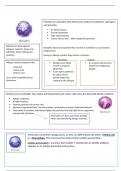
Function of a basophil: they defend your body from allergens, pathogens
and parasites.
Bi- lobed nucleus
Secrete histamines
Type of granulocyte
Coarse, dense, blue – black cytoplasmic granules
Defend your body against:
Basophils attack any organism they see that is unfamiliar to your body by
allergens, bacteria, fungi, viral
phagocytosis.
infections, blood clotting and
parasites. During an allergic reaction they release 2 enzymes:
Histamine Heparin
Allergic reaction symptoms like: Enlarges your blood An enzyme that prevents
vessels to improve blood from clotting too
- Itchy skin
blood flow quickly.
- Runny nose
It also opens pathways
- Watery eyes
for other cells to
occur when basophil releases quickly target and
histamines. respond to the allergen
Function of an eosinophil: they attack and kill parasites and cancer cells; they also help with allergic reactions.
Allergic responses
Bi-lobed nucleus
Destroy parasites and cancer cells
Nucleus is segmented into 2 (or more) lobes connected by a barely visible thin filament
They attack in numbers and release highly toxic proteins that help fight micro- organisms,
and parasitic infections.
Eosinophil can also cause tissue damage
when activated during allergic reactions.
Monocytes can perform phagocytosis, or they can differentiate into either a Dentric cell
or a Macrophage. This is because they both perform antigen presentation.
Antigen presentation = a process that enables T- lymphocytes to identify antigenic
epitopes on an antigen presenting cells surface.
Function of a monocyte: they release cytokines in order to signal and
recruit other cells to an area with pathogens.
and parasites.
Bi- lobed nucleus
Secrete histamines
Type of granulocyte
Coarse, dense, blue – black cytoplasmic granules
Defend your body against:
Basophils attack any organism they see that is unfamiliar to your body by
allergens, bacteria, fungi, viral
phagocytosis.
infections, blood clotting and
parasites. During an allergic reaction they release 2 enzymes:
Histamine Heparin
Allergic reaction symptoms like: Enlarges your blood An enzyme that prevents
vessels to improve blood from clotting too
- Itchy skin
blood flow quickly.
- Runny nose
It also opens pathways
- Watery eyes
for other cells to
occur when basophil releases quickly target and
histamines. respond to the allergen
Function of an eosinophil: they attack and kill parasites and cancer cells; they also help with allergic reactions.
Allergic responses
Bi-lobed nucleus
Destroy parasites and cancer cells
Nucleus is segmented into 2 (or more) lobes connected by a barely visible thin filament
They attack in numbers and release highly toxic proteins that help fight micro- organisms,
and parasitic infections.
Eosinophil can also cause tissue damage
when activated during allergic reactions.
Monocytes can perform phagocytosis, or they can differentiate into either a Dentric cell
or a Macrophage. This is because they both perform antigen presentation.
Antigen presentation = a process that enables T- lymphocytes to identify antigenic
epitopes on an antigen presenting cells surface.
Function of a monocyte: they release cytokines in order to signal and
recruit other cells to an area with pathogens.


