
1. FERTILISATION, IMPLANTING AND DEVELOPMENT OF FERTILISED OVUM. PLACENTA (shorter)
Fertilisation
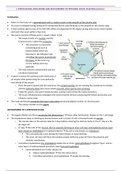
Refers to the fusion of a spermatozoon with a mature ovum in the ampulla of the uterine tube
An ovum is released during ovulation & transported by the tubal fimbriae to the ampulla of the uterine tube
A few hundred sperms (out of the 200-300 million are deposited in the vagina during intercourse) travel rapidly
and reach the ovum within a few mins
The sperm consists of three parts 1. Head 2. Neck 3.Tail
o The head consists of a nucleus and the
foremost part is called the acrosome
The acrosome is a lysosome
containing acids such as
hyaluronidase which are
liberated in the fallopian tube
and allow the sperm to penetrate
the layers of the ovum e.g.
corona radiata and zona
pellucida
o The neck contains mitochondria and the
tail allows movement
A sperm reaches the oolemma (cell membrane of
an oocyte) after penetrating the zona pellucida
and radiata of the oocyte
o Once the sperm penetrates the oolemma, the cortical reaction occurs causing the membrane to harden
and the oolemma block also occurs which prevents other sperms from entering
o Inside the oocyte, the sperm sheds its outer coating+ tail forming the male pronucleus
o The ovum simultaneously undergoes the second meiotic division producing the female pronucleus and
releases a polar body
The male and female pronuclei then fuse in the centre producing diploid number of chromosomes
o This entity is known as the zygote
DEVELOPMENT OF A FERTILISED OVUM
The zygote divides via mitosis producing two blastomeres ( 30 hours after fertilisation ) known as the 2-cell stage
The blastomeres keep on dividing by binary division until a cluster of cells is formed known as morula
o The morula stays in the uterine tube for 3 days before entering the uterine cavity on the 4th day as a 16-
64 stage cell
o 5th day the cells of the morula start to separate forming an inner cell mass embryoblasts and an outer
layer known as trophoblast (or trophoectoderm) the cell is now known as a blastocyst
The zona pellucida is lost during this event known as zona hatching
The inner cell mass will form the embryo proper while the outer will form the placenta and
amniotic membranes
o Just before implantation the trophoblasts divide into an inner cytotrophoblasts/Langhans’ layer and an
outer layer of multinucleated syncytium called syncytiotrophoblast
Cytotrophoblasts are further divide into
Villous cytotrophoblasts line the villous stems
Interstitial extravillous cytotrophoblasts invade the decidua
Fertilisation
Refers to the fusion of a spermatozoon with a mature ovum in the ampulla of the uterine tube
An ovum is released during ovulation & transported by the tubal fimbriae to the ampulla of the uterine tube
A few hundred sperms (out of the 200-300 million are deposited in the vagina during intercourse) travel rapidly
and reach the ovum within a few mins
The sperm consists of three parts 1. Head 2. Neck 3.Tail
o The head consists of a nucleus and the
foremost part is called the acrosome
The acrosome is a lysosome
containing acids such as
hyaluronidase which are
liberated in the fallopian tube
and allow the sperm to penetrate
the layers of the ovum e.g.
corona radiata and zona
pellucida
o The neck contains mitochondria and the
tail allows movement
A sperm reaches the oolemma (cell membrane of
an oocyte) after penetrating the zona pellucida
and radiata of the oocyte
o Once the sperm penetrates the oolemma, the cortical reaction occurs causing the membrane to harden
and the oolemma block also occurs which prevents other sperms from entering
o Inside the oocyte, the sperm sheds its outer coating+ tail forming the male pronucleus
o The ovum simultaneously undergoes the second meiotic division producing the female pronucleus and
releases a polar body
The male and female pronuclei then fuse in the centre producing diploid number of chromosomes
o This entity is known as the zygote
DEVELOPMENT OF A FERTILISED OVUM
The zygote divides via mitosis producing two blastomeres ( 30 hours after fertilisation ) known as the 2-cell stage
The blastomeres keep on dividing by binary division until a cluster of cells is formed known as morula
o The morula stays in the uterine tube for 3 days before entering the uterine cavity on the 4th day as a 16-
64 stage cell
o 5th day the cells of the morula start to separate forming an inner cell mass embryoblasts and an outer
layer known as trophoblast (or trophoectoderm) the cell is now known as a blastocyst
The zona pellucida is lost during this event known as zona hatching
The inner cell mass will form the embryo proper while the outer will form the placenta and
amniotic membranes
o Just before implantation the trophoblasts divide into an inner cytotrophoblasts/Langhans’ layer and an
outer layer of multinucleated syncytium called syncytiotrophoblast
Cytotrophoblasts are further divide into
Villous cytotrophoblasts line the villous stems
Interstitial extravillous cytotrophoblasts invade the decidua


