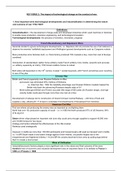
KEY ISSUE 2: The impact of technological change on the conduct of war.
1. How important were technological developments and industrialisation in determining the nature
and outcome of war 1792-1945?
Definitions:
Industrialisation = the development of large-scale and developed industries which used machines in factories
to enable mass production, precision engineering, and technological innovation
Technological developments: the process of invention, innovation, progress
French Revolutionary and Napoleonic Wars.
Generals tended to ignore technological developments, i.e. Napoleon did not promote the use of air balloons to
observe his enemies’ battlefield deployment and Wellington ignored developments such as Congreve rockets
More productive arms factories built, i.e. Paris factory produced 700 muskets a day, more than rest of Europe
combined
Introduction of standardised, lighter horse artillery made French artillery more mobile, powerful and accurate
i.e. artillery superiority at Valmy 1792 forced coalition forces to retreat
th
Both sides still depended on the 18 century musket + socket bayonets, with French sometimes even reverting
to use of the pike
Crimean War
British and French superiority over Russian flintlocks in rifles
- percussion cap eliminated 25% misfires of flintlocks.
- i.e. Inkerman Nov. 1854 the reliability advantage over Russian flintlock muskets helped the
British hold back the advancing Russians despite odds of 9:1
- Minié bullet gave British and French accurate rifle range of 600 yards (5x Russian range), and high
velocity bullet could pass through more than one man at a time.
Development of railways led to construction of Grand Crimean Central Railway → 240 tons of food and
supplies a day, allowing B + F troops to undertake 6 bombardments of Sevastopol from trenches
American Civil War
First war where out-producing the enemy was as important as out-fighting them
North had over 10x productive capacity of south - i.e. In 1860 the North produced 97% of US firearms, 94%
of its pig iron
Steam driven ships played an important role (one ship could carry enough supplies to support 40,000 men
and 18,000 horses for two days).
strategy and tactics reflected the effectiveness of the rifle-musket
Railways used strategically
However no battle sw more than 100,000 participants and horses/cavalry still used as transport and in battle
i.e. 1st BR Stuart made a bold sabre charge against Union infantry, successful largely due to the
inexperienced and frightened infantry + At 2nd BR his cavalry deceived Union army by pulling logs behind
them to create a dust screen
Wars of Unification
Industrial/economic factors played a more significant role in the nature and final outcome of the wars.
Austria’s lack of economic and industrial development was an important factor in its defeats to France in
1859 and Prussia in 1866
1. How important were technological developments and industrialisation in determining the nature
and outcome of war 1792-1945?
Definitions:
Industrialisation = the development of large-scale and developed industries which used machines in factories
to enable mass production, precision engineering, and technological innovation
Technological developments: the process of invention, innovation, progress
French Revolutionary and Napoleonic Wars.
Generals tended to ignore technological developments, i.e. Napoleon did not promote the use of air balloons to
observe his enemies’ battlefield deployment and Wellington ignored developments such as Congreve rockets
More productive arms factories built, i.e. Paris factory produced 700 muskets a day, more than rest of Europe
combined
Introduction of standardised, lighter horse artillery made French artillery more mobile, powerful and accurate
i.e. artillery superiority at Valmy 1792 forced coalition forces to retreat
th
Both sides still depended on the 18 century musket + socket bayonets, with French sometimes even reverting
to use of the pike
Crimean War
British and French superiority over Russian flintlocks in rifles
- percussion cap eliminated 25% misfires of flintlocks.
- i.e. Inkerman Nov. 1854 the reliability advantage over Russian flintlock muskets helped the
British hold back the advancing Russians despite odds of 9:1
- Minié bullet gave British and French accurate rifle range of 600 yards (5x Russian range), and high
velocity bullet could pass through more than one man at a time.
Development of railways led to construction of Grand Crimean Central Railway → 240 tons of food and
supplies a day, allowing B + F troops to undertake 6 bombardments of Sevastopol from trenches
American Civil War
First war where out-producing the enemy was as important as out-fighting them
North had over 10x productive capacity of south - i.e. In 1860 the North produced 97% of US firearms, 94%
of its pig iron
Steam driven ships played an important role (one ship could carry enough supplies to support 40,000 men
and 18,000 horses for two days).
strategy and tactics reflected the effectiveness of the rifle-musket
Railways used strategically
However no battle sw more than 100,000 participants and horses/cavalry still used as transport and in battle
i.e. 1st BR Stuart made a bold sabre charge against Union infantry, successful largely due to the
inexperienced and frightened infantry + At 2nd BR his cavalry deceived Union army by pulling logs behind
them to create a dust screen
Wars of Unification
Industrial/economic factors played a more significant role in the nature and final outcome of the wars.
Austria’s lack of economic and industrial development was an important factor in its defeats to France in
1859 and Prussia in 1866