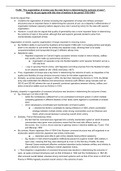
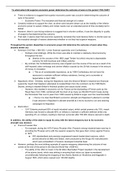
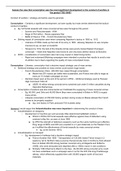
PLAN: "The organisation of armies was the main factor in determining the outcome of wars".
How far do you agree with this view of warfare in the period 1792-1945?
Could be argued that…
● Certainly the organisation of armies (including the organisation of troops and military command
structures) was an important factor in determining the outcome of war, as a disparity in effectiveness of
organisation between opposing nations played a key role in ensuring victory for the side with superior
organisation.
● However, it could also be argued that quality of generalship was a more important factor in determining
the outcome of wars in this period, although that said superior generals tended to arise from
meritocratically organised armies.
Organisation of armies: superior organisation of troops important in ensuring victory
● Eg. Moltke’s ability to surround the Austrians at Konnigratz (1866) with 3 converging armies was largely
down to his decision to sub-divide his armies into separate corps, allowing them to be easily
compartmentalised and transported through 5 different railway lines.
● Napoleonic wars
○ Napoleon expanded on Carnot's highly successful division model (in which infantry, artillery
and cavalry units made up autonomous divisions)
■ organisation of separate corps into flexible bataillon carré (square) formation across a
120 mile front
○ ⇒ key in securing French victory, with Napoleon encircling enemies from this flexible formation
to win decisive battles at Ulm (1805) and Eylau (1807)
● Thus, organisation of troops was a key factor in determining the outcome of wars, as disparities in the
quality and flexibility of troop divisions ensured victory for the better organised army.
● Similarly, as armies became far larger in WWI, the fact that, following the Somme in 1916, the British
army was subdivided into effective and autonomous divisions (with officers using manuals such as
SS143 and SS144) allowed the use of powerful combined operations between infantry, artillery and
tanks at decisive battles such as Amiens in 1918.
Similarly, disparity in organisation of command structures was decisive in determining the outcome of wars.
● Eg. American Civil War (1861-65)
○ whilst the Confederacy suffered from a non-centralized command system in which multiple
competing generals in different theatres of war rarely came together to coordinate on shared
aims
○ Union developed a coordinated and meritocratic command system
■ ⇒ allowed the North to undertake its Spring Offensive of 1864, where coordinated
strategy between multiple armies under strong commanders such as Sherman and
Grant, which proved decisive in ensuring overall Union victory.
● Similarly, French Revolutionary Wars
○ the fact that the command was organised into a strictly meritocratic system in which divisional
commanders were given more autonomy meant that the most able officers (such as
Bernadotte, Ney, Oudinot, Murat) was key in gaining victory in decisive battles eg. Toulon 1793
and Marengo 1800
● By contrast, Russo-Japanese War of 1904-5 the Russian command structure was still organised in an
aristocratic system whilst the Japanese was strictly meritocratic
■ ⇒ Japanese were able to gain victory despite having inferior weaponry.
○ Eg. Muken in 1905 whilst Kuropatikin ineffectively placed his superior model 1900 artillery in
open view, meaning that they were destroyed by 9 am on the first day of battle, the able
General Oyama employed effective combined operation tactics between artillery and infantry to
gain a decisive victory, leading to overall Japanese victory.
● ⇒ Thus disparity in organisation of command structures was decisive in determining the outcome of
wars, as weak command structures such as that of Russia in 1904 and the Confederacy in 1861-65
often ensured overall defeat, whereas strong command systems such as that of the Union in ACW and
France in FRWs regularly ensured overall victory in the outcome of wars.
How far do you agree with this view of warfare in the period 1792-1945?
Could be argued that…
● Certainly the organisation of armies (including the organisation of troops and military command
structures) was an important factor in determining the outcome of war, as a disparity in effectiveness of
organisation between opposing nations played a key role in ensuring victory for the side with superior
organisation.
● However, it could also be argued that quality of generalship was a more important factor in determining
the outcome of wars in this period, although that said superior generals tended to arise from
meritocratically organised armies.
Organisation of armies: superior organisation of troops important in ensuring victory
● Eg. Moltke’s ability to surround the Austrians at Konnigratz (1866) with 3 converging armies was largely
down to his decision to sub-divide his armies into separate corps, allowing them to be easily
compartmentalised and transported through 5 different railway lines.
● Napoleonic wars
○ Napoleon expanded on Carnot's highly successful division model (in which infantry, artillery
and cavalry units made up autonomous divisions)
■ organisation of separate corps into flexible bataillon carré (square) formation across a
120 mile front
○ ⇒ key in securing French victory, with Napoleon encircling enemies from this flexible formation
to win decisive battles at Ulm (1805) and Eylau (1807)
● Thus, organisation of troops was a key factor in determining the outcome of wars, as disparities in the
quality and flexibility of troop divisions ensured victory for the better organised army.
● Similarly, as armies became far larger in WWI, the fact that, following the Somme in 1916, the British
army was subdivided into effective and autonomous divisions (with officers using manuals such as
SS143 and SS144) allowed the use of powerful combined operations between infantry, artillery and
tanks at decisive battles such as Amiens in 1918.
Similarly, disparity in organisation of command structures was decisive in determining the outcome of wars.
● Eg. American Civil War (1861-65)
○ whilst the Confederacy suffered from a non-centralized command system in which multiple
competing generals in different theatres of war rarely came together to coordinate on shared
aims
○ Union developed a coordinated and meritocratic command system
■ ⇒ allowed the North to undertake its Spring Offensive of 1864, where coordinated
strategy between multiple armies under strong commanders such as Sherman and
Grant, which proved decisive in ensuring overall Union victory.
● Similarly, French Revolutionary Wars
○ the fact that the command was organised into a strictly meritocratic system in which divisional
commanders were given more autonomy meant that the most able officers (such as
Bernadotte, Ney, Oudinot, Murat) was key in gaining victory in decisive battles eg. Toulon 1793
and Marengo 1800
● By contrast, Russo-Japanese War of 1904-5 the Russian command structure was still organised in an
aristocratic system whilst the Japanese was strictly meritocratic
■ ⇒ Japanese were able to gain victory despite having inferior weaponry.
○ Eg. Muken in 1905 whilst Kuropatikin ineffectively placed his superior model 1900 artillery in
open view, meaning that they were destroyed by 9 am on the first day of battle, the able
General Oyama employed effective combined operation tactics between artillery and infantry to
gain a decisive victory, leading to overall Japanese victory.
● ⇒ Thus disparity in organisation of command structures was decisive in determining the outcome of
wars, as weak command structures such as that of Russia in 1904 and the Confederacy in 1861-65
often ensured overall defeat, whereas strong command systems such as that of the Union in ACW and
France in FRWs regularly ensured overall victory in the outcome of wars.