

14D
Introduction:
Electrophilic substitution is a method by which an electrophile is able to replace a hydrogen
atom on an aromatic ring in benzene. Halogenation, alkylation, acylation, and nitration are all
examples of common substitutions.
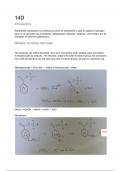
Nitration of methyl benzoate:
The reactants are methyl benzoate, nitric acid, and sulfuric acid, yielding water and methyl
3-nitrobenzoate as products. The reactant contains the ester functional group and a benzene
ring, while the products are the ester and nitro functional groups, as well as a benzene ring.
Methylbenzoate + nitric acid → methyl 3-nitrobenzoate + water
HNO3 + H2SO4 → HSO4- + NO2+ + H2O
Mechanism:
,The nitration of benzene is a chemical reaction in which a nitro group (-NO2) is added into a
benzene ring. This reaction is carried out by treating benzene with a mixture of concentrated
nitric acid (HNO3) and concentrated sulfuric acid (H2SO4) as a catalyst. The sulfuric acid
acts as a dehydrating agent, helping to mKe the nitronium ion (NO2+), which is the
electrophile responsible for attacking the benzene ring.
In the first step of the reaction, the nitronium ion is formed
HNO3 + H2SO4 → NO2+ + HSO4- + H2O
The nitronium ion then attacks the benzene ring, substituting one of the hydrogen atoms
attached to the ring with a nitro group:
C6H6 + NO2+ → C6H5NO2 + H+
This substitution reaction results in the formation of nitrobenzene, with the loss of a proton.
The overall reaction is an example of electrophilic aromatic substitution, where the
electrophile (NO2+) attacks the benzene ring.
The formation of the nitronium ion NO2+ occurs when sulfuric acid and nitric acid combine,
serving as an electron pair acceptor. The nitronium ion accepts a pair of electrons from the
delocalized electrons in the benzene ring, forming a dative covalent bond with the nitrogen
atom. This process generates an unstable positively charged intermediate with a broken ring
of delocalized electrons.
The breaking of the C-H bond by heterolytic fission happens on the carbon attached to the
NO2, which then restores the ring of delocalized electrons. This process the formation of a
benzene ring through the elimination of a hydrogen ion from the intermediate. Consequently,
this results in increased stability as the ring of pi electrons is regenerated. The resulting
hydrogen ion combines with HSO4- to regenerate the catalyst for sulfuric acid.
Conditions for alcohols
The conditions for the nitration of alcohols involve using a mixture of concentrated nitric acid
(HNO3) and concentrated sulfuric acid (H2SO4) as a catalyst.
Concentrated nitric acid is a strong oxidizing agent that provides the nitro group (-NO2)
required for the nitration reaction. nitric acid alone is not good in nitrating aromatic
compounds due to not being an electrophile. Therefore, concentrated sulfuric acid is added
as a catalyst to generate the nitronium ion (NO2+), which is the electrophile responsible for
the nitration of the alcohol.
Risk Assessment:
Hazard Risk Control measure
Methyl benzoate - Acute Toxicity - Keep away from
- Harmful to swallow open flames, hot
, - contaminate sources and ignition
sources.
- Skin protection
(gloves).
- Tightly close
container. (1)
Concentrated HNO3 - Oxidising liquid - Do not breathe
- Corrosive to metals vapours
- Skin corrosion - Avoid substance
- Serious eye damage contact
- Adequate ventilation
(2)
Concentrated H2SO4 - Corrosive to metals - Wear acid resistance
- Skin corrosion protective clothes
- Severe skin burns - Wear goggles
and eye damage (3)
Ethanol - Flammable liquids - Keep away from
- Serious eye irritation heat, hot surfaces,
open flames.
- Ventilation
(4)
Equipment:
● Goggles
● Conical flask
● 2 250cm3 beakers
● A 100cm3 beaker
● 3cm3 pipettes
● Iced cube
● Filter papers
● Small thermometer
● Balance
● 2 test tubes
● 10cm3 measuring cylinder
● 25cm3 measuring cylinder
● Bunsen burner
● Heat proof mat
● Tripod
● Gauze
● Spatula
● Filtration apparatus
Introduction:
Electrophilic substitution is a method by which an electrophile is able to replace a hydrogen
atom on an aromatic ring in benzene. Halogenation, alkylation, acylation, and nitration are all
examples of common substitutions.
Nitration of methyl benzoate:
The reactants are methyl benzoate, nitric acid, and sulfuric acid, yielding water and methyl
3-nitrobenzoate as products. The reactant contains the ester functional group and a benzene
ring, while the products are the ester and nitro functional groups, as well as a benzene ring.
Methylbenzoate + nitric acid → methyl 3-nitrobenzoate + water
HNO3 + H2SO4 → HSO4- + NO2+ + H2O
Mechanism:
,The nitration of benzene is a chemical reaction in which a nitro group (-NO2) is added into a
benzene ring. This reaction is carried out by treating benzene with a mixture of concentrated
nitric acid (HNO3) and concentrated sulfuric acid (H2SO4) as a catalyst. The sulfuric acid
acts as a dehydrating agent, helping to mKe the nitronium ion (NO2+), which is the
electrophile responsible for attacking the benzene ring.
In the first step of the reaction, the nitronium ion is formed
HNO3 + H2SO4 → NO2+ + HSO4- + H2O
The nitronium ion then attacks the benzene ring, substituting one of the hydrogen atoms
attached to the ring with a nitro group:
C6H6 + NO2+ → C6H5NO2 + H+
This substitution reaction results in the formation of nitrobenzene, with the loss of a proton.
The overall reaction is an example of electrophilic aromatic substitution, where the
electrophile (NO2+) attacks the benzene ring.
The formation of the nitronium ion NO2+ occurs when sulfuric acid and nitric acid combine,
serving as an electron pair acceptor. The nitronium ion accepts a pair of electrons from the
delocalized electrons in the benzene ring, forming a dative covalent bond with the nitrogen
atom. This process generates an unstable positively charged intermediate with a broken ring
of delocalized electrons.
The breaking of the C-H bond by heterolytic fission happens on the carbon attached to the
NO2, which then restores the ring of delocalized electrons. This process the formation of a
benzene ring through the elimination of a hydrogen ion from the intermediate. Consequently,
this results in increased stability as the ring of pi electrons is regenerated. The resulting
hydrogen ion combines with HSO4- to regenerate the catalyst for sulfuric acid.
Conditions for alcohols
The conditions for the nitration of alcohols involve using a mixture of concentrated nitric acid
(HNO3) and concentrated sulfuric acid (H2SO4) as a catalyst.
Concentrated nitric acid is a strong oxidizing agent that provides the nitro group (-NO2)
required for the nitration reaction. nitric acid alone is not good in nitrating aromatic
compounds due to not being an electrophile. Therefore, concentrated sulfuric acid is added
as a catalyst to generate the nitronium ion (NO2+), which is the electrophile responsible for
the nitration of the alcohol.
Risk Assessment:
Hazard Risk Control measure
Methyl benzoate - Acute Toxicity - Keep away from
- Harmful to swallow open flames, hot
, - contaminate sources and ignition
sources.
- Skin protection
(gloves).
- Tightly close
container. (1)
Concentrated HNO3 - Oxidising liquid - Do not breathe
- Corrosive to metals vapours
- Skin corrosion - Avoid substance
- Serious eye damage contact
- Adequate ventilation
(2)
Concentrated H2SO4 - Corrosive to metals - Wear acid resistance
- Skin corrosion protective clothes
- Severe skin burns - Wear goggles
and eye damage (3)
Ethanol - Flammable liquids - Keep away from
- Serious eye irritation heat, hot surfaces,
open flames.
- Ventilation
(4)
Equipment:
● Goggles
● Conical flask
● 2 250cm3 beakers
● A 100cm3 beaker
● 3cm3 pipettes
● Iced cube
● Filter papers
● Small thermometer
● Balance
● 2 test tubes
● 10cm3 measuring cylinder
● 25cm3 measuring cylinder
● Bunsen burner
● Heat proof mat
● Tripod
● Gauze
● Spatula
● Filtration apparatus


