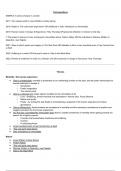
Edexcel Biology GCSE Topic 3 – Genetics
Sexual Reproduction
Both the mother and father produce gametes. Egg cells for the mother,
Sperm cells for the father. These cells are all haploid (half the number of
chromosomes compared to a normal cell).
The male gamete fuses with the female gamete to fertilise it. This creates
a zygote. The zygote has the full number of chromosomes (due to the two
haploid cells). The zygote then divides by mitosis to develop an embryo.
Sexual reproduction means there will be features from both parents,
allowing genetic variation.
Meiosis
Gametes divide by meiosis. Meiosis is another way of allowing genetic
variation, as it doesn’t produce identical cells.
Steps of meiosis:
1) The cell duplicates all the genetic information before duplicating.
2) The chromosome pairs line up in the centre of the cell.
3) The pairs are pulled apart, creating cells that only have one copy of
each chromosome.
4) The chromatids line up in the centre of each of the two daughter
cells
5) They are pulled apart to create 4 haploid daughter cells.
Asexual reproduction
Asexual reproduction only involves 1 parent, so all offspring are
genetically identical to the parent. It happens by mitosis, which produces
genetically identical cells.
The advantages of asexual reproduction are that the reproductive cycle is
much faster than sexual reproduction, allowing for fast population growth.
Another advantage is that organisms can reproduce whenever they deem
it suitable, as there is no wait for a mate. This allows fast colonisation of
an area.
The disadvantages include the lack of genetic variation, where if an
adverse condition, such as disease, was to impact the species, it would be
detrimental for the entire population.
Sexual Reproduction
Both the mother and father produce gametes. Egg cells for the mother,
Sperm cells for the father. These cells are all haploid (half the number of
chromosomes compared to a normal cell).
The male gamete fuses with the female gamete to fertilise it. This creates
a zygote. The zygote has the full number of chromosomes (due to the two
haploid cells). The zygote then divides by mitosis to develop an embryo.
Sexual reproduction means there will be features from both parents,
allowing genetic variation.
Meiosis
Gametes divide by meiosis. Meiosis is another way of allowing genetic
variation, as it doesn’t produce identical cells.
Steps of meiosis:
1) The cell duplicates all the genetic information before duplicating.
2) The chromosome pairs line up in the centre of the cell.
3) The pairs are pulled apart, creating cells that only have one copy of
each chromosome.
4) The chromatids line up in the centre of each of the two daughter
cells
5) They are pulled apart to create 4 haploid daughter cells.
Asexual reproduction
Asexual reproduction only involves 1 parent, so all offspring are
genetically identical to the parent. It happens by mitosis, which produces
genetically identical cells.
The advantages of asexual reproduction are that the reproductive cycle is
much faster than sexual reproduction, allowing for fast population growth.
Another advantage is that organisms can reproduce whenever they deem
it suitable, as there is no wait for a mate. This allows fast colonisation of
an area.
The disadvantages include the lack of genetic variation, where if an
adverse condition, such as disease, was to impact the species, it would be
detrimental for the entire population.