

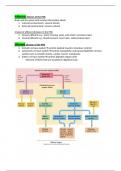
Afferent division of the PNS
Brain and the spinal cord receive information about:
1. Internal environment= visceral stimuli.
2. External environment= sensory stimuli.
2 types of afferent divisions in the PNS
1. Sensory afferent e.g., vision, hearing, taste, and smell= conscious input
2. Visceral afferent e.g., blood pressure, heart rate= subconscious input.
Efferent division of the PNS
1. Somatic nervous systemcontrols skeletal muscles (voluntary control)
2. Autonomic nervous systemcontrols sympathetic and parasympathetic nervous
system such as smooth muscle, cardiac muscle, and glands.
3. Enteric nervous systemcontrols digestive organs only!
- Network of fibres that are localised in digestive track.
, Vision as an example
The part of the brain that controls the vision is in the cortex and localised in the occipital
region.
ü Features of the eyes
- Iris= gives the eyes the colour
- Pupil= round opening through which the light enters the eye.
- Sclera= made of up of connective tissue. Tough outer layer of the eye
ü Structures that protect the eye.
- Eye lids= protects from mechanical issue
- Eyelashes= traps fine particles
- Tears= lubricant and germ-killing fluid
Tears are produced by lacrimal gland and drains into tiny canals and reaches lacrimal
sacs.
The eye is a fluid filled structure.
Has 3 different layers
1. External sclera (outermost layer)
2. Choroid (middle layer which is highly pigmented)
3. Retina (innermost layer) that contains photoreceptors.
The eye contains 2 separate cavities that are separated by analytical lens. (Lens must be
transparent to let the light in)
1. The region between the lens and the retina is filled with vitreous humor (also
transparent) which helps to maintain the spherical shape of the eyeball.
2. Between the lens and the cornea and this is filled with aqueous humor.
Iris muscle is controlled by automimic system to dilate and contract.
Brain and the spinal cord receive information about:
1. Internal environment= visceral stimuli.
2. External environment= sensory stimuli.
2 types of afferent divisions in the PNS
1. Sensory afferent e.g., vision, hearing, taste, and smell= conscious input
2. Visceral afferent e.g., blood pressure, heart rate= subconscious input.
Efferent division of the PNS
1. Somatic nervous systemcontrols skeletal muscles (voluntary control)
2. Autonomic nervous systemcontrols sympathetic and parasympathetic nervous
system such as smooth muscle, cardiac muscle, and glands.
3. Enteric nervous systemcontrols digestive organs only!
- Network of fibres that are localised in digestive track.
, Vision as an example
The part of the brain that controls the vision is in the cortex and localised in the occipital
region.
ü Features of the eyes
- Iris= gives the eyes the colour
- Pupil= round opening through which the light enters the eye.
- Sclera= made of up of connective tissue. Tough outer layer of the eye
ü Structures that protect the eye.
- Eye lids= protects from mechanical issue
- Eyelashes= traps fine particles
- Tears= lubricant and germ-killing fluid
Tears are produced by lacrimal gland and drains into tiny canals and reaches lacrimal
sacs.
The eye is a fluid filled structure.
Has 3 different layers
1. External sclera (outermost layer)
2. Choroid (middle layer which is highly pigmented)
3. Retina (innermost layer) that contains photoreceptors.
The eye contains 2 separate cavities that are separated by analytical lens. (Lens must be
transparent to let the light in)
1. The region between the lens and the retina is filled with vitreous humor (also
transparent) which helps to maintain the spherical shape of the eyeball.
2. Between the lens and the cornea and this is filled with aqueous humor.
Iris muscle is controlled by automimic system to dilate and contract.


