

2 types of synapses
1. Chemical
- No direct contact between pre and post synapse
- Chemical signal released from axon terminals e.g. acetylcholine
- Acts on dendrites and receptor
2. Electrical
- Known as gap junctions.
- Direct contact between cells
- Allows synchronisation e.g., contraction of heart.
- Found in muscles and neurons.
1. Action potential depolarised end terminals of presynaptic membrane
2. Voltage gated Ca2+ channels open and Ca2+ enter the presynaptic neurone.
3. Causes release of vesicles that contains the neurotransmitters via exocytosis.
4. Neurotransmitter travels across synaptic cleft and binds to receptors on post synaptic
neurone.
5. When the neurotransmitter binds to the sodium channels on post synaptic neurone,
it causes the sodium channels to open and release sodium ions which causes it to
depolarise and action potential can then carry on.
6. An EPSP is when only couple of channels open which isn’t enough as it doesn’t reach
the threshold value.
ü What is a EPSP?
An excitatory post synaptic potential is when a single ion channel is opened which isn’t
enough to reach to the threshold potential to trigger a AP.
ü What is ISPS?
An inhibitory post synaptic potential is when a single ion channel such as Cl- which is
negative therefore making the membrane more negative therefore less likely to trigger an
AP.
Temporal Summation
- Constant firing of EPSP’s to reach the threshold value.
Spatial summation
- Different EPSP’s add up together to reach threshold value.
Presynaptic Inhibition
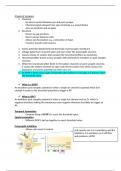
- Allows extra level of control. A+B cancels out as A is excitatory and B is
inhibitory. D is excitatory so it still fires
and produces a EPSP.
1. Chemical
- No direct contact between pre and post synapse
- Chemical signal released from axon terminals e.g. acetylcholine
- Acts on dendrites and receptor
2. Electrical
- Known as gap junctions.
- Direct contact between cells
- Allows synchronisation e.g., contraction of heart.
- Found in muscles and neurons.
1. Action potential depolarised end terminals of presynaptic membrane
2. Voltage gated Ca2+ channels open and Ca2+ enter the presynaptic neurone.
3. Causes release of vesicles that contains the neurotransmitters via exocytosis.
4. Neurotransmitter travels across synaptic cleft and binds to receptors on post synaptic
neurone.
5. When the neurotransmitter binds to the sodium channels on post synaptic neurone,
it causes the sodium channels to open and release sodium ions which causes it to
depolarise and action potential can then carry on.
6. An EPSP is when only couple of channels open which isn’t enough as it doesn’t reach
the threshold value.
ü What is a EPSP?
An excitatory post synaptic potential is when a single ion channel is opened which isn’t
enough to reach to the threshold potential to trigger a AP.
ü What is ISPS?
An inhibitory post synaptic potential is when a single ion channel such as Cl- which is
negative therefore making the membrane more negative therefore less likely to trigger an
AP.
Temporal Summation
- Constant firing of EPSP’s to reach the threshold value.
Spatial summation
- Different EPSP’s add up together to reach threshold value.
Presynaptic Inhibition
- Allows extra level of control. A+B cancels out as A is excitatory and B is
inhibitory. D is excitatory so it still fires
and produces a EPSP.


