

The tricarboxylic acid cycle (Krebs cycle)
Degradation products of carbohydrates, lipids, amino acids are fed into TCA cycle to release
energy.
TCA cycle has both catabolic and anabolic function= amphibolic.
Oxidation= gain of oxygen, loss of H+ and e-
Reduction= Loss of oxygen, Gain of H+ and e-
NAD+ and FAD are key redox co-factors.
Link from glycolysis to TCA cycle is Pyruvate dehydrogenase (PDH).
Pyruvate must be transported into mitochondrial matrix by pyruvate translocase.
CoA links CoA with pyruvate, takes off Co2. Pyruvate is converted into Acetyl CoA.
Acetate group is slightly more oxidised therefore the H+ are taken and NAD+ is reduced to
NADH+, H+
REDOX reaction called oxidative decarboxylation.
The acetate within pyruvate is activated by linking it to coenzyme A which then undergoes
further reactions.
For each acetyl CoA
1. 2 molecules of Co2
, 2. NAD+ and FAD is reduced to NADH and FADH2.
3. 3 NADH and 1 FADH2
4. 1 GTP
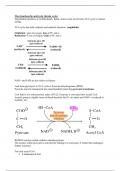
1. Acetyl CoA reacts with oxalacetate (citrate synthase) to produce citrate.
2. Citrate is converted to isocitrate (aconitase) and H2O is released.
3. Isocitrate is converted to a-Ketoglutarate (IDH). NAD+ is reduced to NADH and CO2 is
produced.
4. a-Ketoglutarate is converted into Succinyl-CoA (a-Ketoglutarate dehydrogenase). Co2
comes off and NADH is produced. CoA activates it.
5. Succinyl-CoA is converted to succinate (succinate thiokinase). GTP is produced and
CoA comes off.
6. Succinate is converted to fumarate (succinate dehydrogenase). FADH2 is produced.
7. Fumarate is converted to L-Malate (fumarase).
8. L-Malate is converted finally back oxaloacetate (malate dehydrogenase) and NADH is
produced.
Degradation products of carbohydrates, lipids, amino acids are fed into TCA cycle to release
energy.
TCA cycle has both catabolic and anabolic function= amphibolic.
Oxidation= gain of oxygen, loss of H+ and e-
Reduction= Loss of oxygen, Gain of H+ and e-
NAD+ and FAD are key redox co-factors.
Link from glycolysis to TCA cycle is Pyruvate dehydrogenase (PDH).
Pyruvate must be transported into mitochondrial matrix by pyruvate translocase.
CoA links CoA with pyruvate, takes off Co2. Pyruvate is converted into Acetyl CoA.
Acetate group is slightly more oxidised therefore the H+ are taken and NAD+ is reduced to
NADH+, H+
REDOX reaction called oxidative decarboxylation.
The acetate within pyruvate is activated by linking it to coenzyme A which then undergoes
further reactions.
For each acetyl CoA
1. 2 molecules of Co2
, 2. NAD+ and FAD is reduced to NADH and FADH2.
3. 3 NADH and 1 FADH2
4. 1 GTP
1. Acetyl CoA reacts with oxalacetate (citrate synthase) to produce citrate.
2. Citrate is converted to isocitrate (aconitase) and H2O is released.
3. Isocitrate is converted to a-Ketoglutarate (IDH). NAD+ is reduced to NADH and CO2 is
produced.
4. a-Ketoglutarate is converted into Succinyl-CoA (a-Ketoglutarate dehydrogenase). Co2
comes off and NADH is produced. CoA activates it.
5. Succinyl-CoA is converted to succinate (succinate thiokinase). GTP is produced and
CoA comes off.
6. Succinate is converted to fumarate (succinate dehydrogenase). FADH2 is produced.
7. Fumarate is converted to L-Malate (fumarase).
8. L-Malate is converted finally back oxaloacetate (malate dehydrogenase) and NADH is
produced.


