Group 2
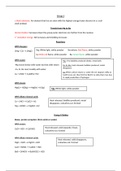
s-block elements: An element that has an atom with the highest energy/outer electron in a s sub-
shell (orbital)
Trends from Mg to Ba
Atomic Radius: Increases down the group-outer electrons are further from the nucleus
1st ionisation energy: AR increases and shielding increases
Reactions
With Oxygen:
Mg: White light, white powder Strontium: Red flame, white powder
2Mg + O2 → 2MgO
Ca: Brick red flame, white powder Ba: Green flame, white powder
With water Mg : Few bubbles produced slowly, metal dulls
-Mg reacts slowly with water but fast with steam Ca, Sr, Ba : heat released, bubbles produced, metal
disappears
-Ca, Sr, Ba react readily with water
Ca: When calcium reacts w. water the sol. Appears milky as
Ca + 2H20 → Ca(OH)2 +H2 CaOH is less sol. than SrOH or BaOH. Ca sinks then rises due
to rapid production of hydrogen
With steam
Mg(s) + H20(g) → Mg0(s) + H2(g) Mg: White light, white powder
With dilute mineral acids
Ca + 2HCl → CaCl2 + H2 Heat released, bubbles produced, metal
disappears, colourless sol. formed
Mg + H2S04 → MgS04 + H2
Group II Oxides
Bases, proton acceptors (from acids or water)
With water:
Heat released, solid expands, hisses,
CaO + H20 → Ca(OH)2
colourless sol. formed
With dilute mineral acids:
Heat released, solid disappears,
Mg0 + 2HCl → MgCl2 + H20 colourless sol. formed
CaO + H2S04 → CaSO4 + H20
Ba0 + 2HNO3 → Ba(NO3)2 + H20
s-block elements: An element that has an atom with the highest energy/outer electron in a s sub-
shell (orbital)
Trends from Mg to Ba
Atomic Radius: Increases down the group-outer electrons are further from the nucleus
1st ionisation energy: AR increases and shielding increases
Reactions
With Oxygen:
Mg: White light, white powder Strontium: Red flame, white powder
2Mg + O2 → 2MgO
Ca: Brick red flame, white powder Ba: Green flame, white powder
With water Mg : Few bubbles produced slowly, metal dulls
-Mg reacts slowly with water but fast with steam Ca, Sr, Ba : heat released, bubbles produced, metal
disappears
-Ca, Sr, Ba react readily with water
Ca: When calcium reacts w. water the sol. Appears milky as
Ca + 2H20 → Ca(OH)2 +H2 CaOH is less sol. than SrOH or BaOH. Ca sinks then rises due
to rapid production of hydrogen
With steam
Mg(s) + H20(g) → Mg0(s) + H2(g) Mg: White light, white powder
With dilute mineral acids
Ca + 2HCl → CaCl2 + H2 Heat released, bubbles produced, metal
disappears, colourless sol. formed
Mg + H2S04 → MgS04 + H2
Group II Oxides
Bases, proton acceptors (from acids or water)
With water:
Heat released, solid expands, hisses,
CaO + H20 → Ca(OH)2
colourless sol. formed
With dilute mineral acids:
Heat released, solid disappears,
Mg0 + 2HCl → MgCl2 + H20 colourless sol. formed
CaO + H2S04 → CaSO4 + H20
Ba0 + 2HNO3 → Ba(NO3)2 + H20