Chapter 1:Homeostasis and the Kidney
Homeostasis: The maintenance of constant or steady state conditions within the body
Control system with sensors for monitoring
Corrective mechanism
Negative feedback system
Why?
provides optimum conditions for enzyme reactions e.g. pH and temp.
avoids osmotic problems in cells and body fluids
The Kidney
Excretion: removal of the toxic waste of metabolism e.g. urea (nitrogenous waste)
Osmoregulation: control of the water potential of body fluids
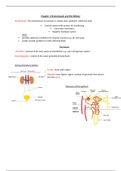
Urinary/Excretory System
Cortex: Outer dark region
Medulla: Inner lighter region, number of pyramids that extend
into the pelvis
Structure of the nephron
Homeostasis: The maintenance of constant or steady state conditions within the body
Control system with sensors for monitoring
Corrective mechanism
Negative feedback system
Why?
provides optimum conditions for enzyme reactions e.g. pH and temp.
avoids osmotic problems in cells and body fluids
The Kidney
Excretion: removal of the toxic waste of metabolism e.g. urea (nitrogenous waste)
Osmoregulation: control of the water potential of body fluids
Urinary/Excretory System
Cortex: Outer dark region
Medulla: Inner lighter region, number of pyramids that extend
into the pelvis
Structure of the nephron