In Exile
by Arthur Nortje
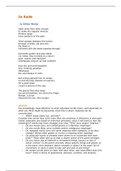
Open skies flare wide enough
to make me vaguely anxious.
Nimbus wisps
trace patterns of the past.
Wind sweeps between the towers
through runnels, old and new.
My heart is
hollowed with the boots passing through.
Garments gather and play about
my limbs: they tremble to a return
gust. Leaves and transient
streetscape conjure up that southern
blue sky and wind-beautiful
day, creating paradise.
Otherwise:
the soul decays in exile.
But wrong pigment has no scope,
so clot the blue channel of memory.
On a sand slope
I build a picture of the sea.
The grains that slide away
are wind-breathed, are stirred by finger.
Benign, a cloud
obscures the sun, this hunger.
Words
Pay exceedingly close attention to what individual words mean—and especially to
what you think might be keywords, since this is where meaning can be
concentrated.
▪ Which words stand out, and why?
Consider how words may carry more than one meaning. A dictionary is obviously
useful, especially one based on historical principles, since it will point to how the
meanings of words may have changed over time. “Silly” once meant “helpless.”
▪ Do any words carry non-contemporary or unfamiliar meanings?
▪ Do any words likely carry multiple and/or ambiguous meanings?
▪ Do repeated words carry the same meaning when repeated, or do they
change? Words often gather or evolve in meaning when repeated.
▪ Do particular words or phrases seem drawn to or connected with each
other? These often add up so that a clearer sense of the poem emerges.
▪ Do you notice lots of material or immaterial things (nouns) or lots of
action (verbs)? Is the poem concrete, about specific things and places, or
is the poem more abstract, about concepts or ideas? Is the poem full of
movement, or does it seem to stay still and look at one thing?
▪ Do certain words seem to clash with each other, and what effect does this
have? Think in terms of oppositions, tensions, conflicts, and binaries.
, Diction
▪ Is the word choice distinctive? Does it add up to a kind of style—for
example, is it elaborate, dense, simple, archaic, formal, conversational,
descriptive, abstract, and so on?
▪ How would you describe the level of language and vocabulary (register):
informal, formal, common, casual, neutral, mixed?
Tone
Address the tone of the speaker or narrator, which is the attitude taken by the
poem’s voice toward the subject or subjects in the poem:
▪ What is the attitude taken by the “voice” of the poem toward the subjects
of the poem? Is the tone serious, ironic, amorous, argumentative,
distant, intimate, somber, abrupt, playful, cheerful, despondent,
conversational, yearning, etc.—or is it mixed, changing, ambiguous, or
unclear?
Word Order
Focus on how the words are ordered. Look for patterns; in drawing attention to
themselves, they require your attention:
▪ Is the word order or sentence structure (syntax) unusual in any way, and
what is the effect of this?
▪ Are there any noticeable patterns in the ordering of words? If so, how do
the patterns contribute to meaning?
▪ Do the lines have strong end-stops, or do they break across lines
(enjamb)? Do the lines end with a final stress or rhyme? Does each line
tend to be a self-contained, grammatical unit, or does it vary? What effect
does this have?
▪ Are there lots of long, complete sentences (simple or complex?), or are
there many sentence fragments and phrases? Does the poem stop and
start, or does it move or flow continuously? What is the effect of this?
Punctuation
Punctuation organizes and creates relationship between words, phrases, clauses,
and sentences. In poetry, where lines are often seen as units of meaning, the
importance of punctuation is sometimes magnified, though often overlooked.
Punctuation can create or reinforce rhythm. It can also control meaning or make
meaning uncertain by its placement and usage, especially if it is used minimally,
or in some cases, not at all.
▪ What role does punctuation have in the poem?
▪ Does it follow accepted rules and conventions, or is it used in unusual
ways?
Figurative Language
Related to word meaning is figurative language, which often plays a crucial role
in both condensing language yet expanding meaning. Most generally, figurative
language refers to language that is not literal. The phrase “fierce tears” (the
personification of tears) is not literal, but it is both precise and suggestive in
carrying meaning.
▪ Are certain words used in unusual, non-literal, non-standard, exaggerated,
by Arthur Nortje
Open skies flare wide enough
to make me vaguely anxious.
Nimbus wisps
trace patterns of the past.
Wind sweeps between the towers
through runnels, old and new.
My heart is
hollowed with the boots passing through.
Garments gather and play about
my limbs: they tremble to a return
gust. Leaves and transient
streetscape conjure up that southern
blue sky and wind-beautiful
day, creating paradise.
Otherwise:
the soul decays in exile.
But wrong pigment has no scope,
so clot the blue channel of memory.
On a sand slope
I build a picture of the sea.
The grains that slide away
are wind-breathed, are stirred by finger.
Benign, a cloud
obscures the sun, this hunger.
Words
Pay exceedingly close attention to what individual words mean—and especially to
what you think might be keywords, since this is where meaning can be
concentrated.
▪ Which words stand out, and why?
Consider how words may carry more than one meaning. A dictionary is obviously
useful, especially one based on historical principles, since it will point to how the
meanings of words may have changed over time. “Silly” once meant “helpless.”
▪ Do any words carry non-contemporary or unfamiliar meanings?
▪ Do any words likely carry multiple and/or ambiguous meanings?
▪ Do repeated words carry the same meaning when repeated, or do they
change? Words often gather or evolve in meaning when repeated.
▪ Do particular words or phrases seem drawn to or connected with each
other? These often add up so that a clearer sense of the poem emerges.
▪ Do you notice lots of material or immaterial things (nouns) or lots of
action (verbs)? Is the poem concrete, about specific things and places, or
is the poem more abstract, about concepts or ideas? Is the poem full of
movement, or does it seem to stay still and look at one thing?
▪ Do certain words seem to clash with each other, and what effect does this
have? Think in terms of oppositions, tensions, conflicts, and binaries.
, Diction
▪ Is the word choice distinctive? Does it add up to a kind of style—for
example, is it elaborate, dense, simple, archaic, formal, conversational,
descriptive, abstract, and so on?
▪ How would you describe the level of language and vocabulary (register):
informal, formal, common, casual, neutral, mixed?
Tone
Address the tone of the speaker or narrator, which is the attitude taken by the
poem’s voice toward the subject or subjects in the poem:
▪ What is the attitude taken by the “voice” of the poem toward the subjects
of the poem? Is the tone serious, ironic, amorous, argumentative,
distant, intimate, somber, abrupt, playful, cheerful, despondent,
conversational, yearning, etc.—or is it mixed, changing, ambiguous, or
unclear?
Word Order
Focus on how the words are ordered. Look for patterns; in drawing attention to
themselves, they require your attention:
▪ Is the word order or sentence structure (syntax) unusual in any way, and
what is the effect of this?
▪ Are there any noticeable patterns in the ordering of words? If so, how do
the patterns contribute to meaning?
▪ Do the lines have strong end-stops, or do they break across lines
(enjamb)? Do the lines end with a final stress or rhyme? Does each line
tend to be a self-contained, grammatical unit, or does it vary? What effect
does this have?
▪ Are there lots of long, complete sentences (simple or complex?), or are
there many sentence fragments and phrases? Does the poem stop and
start, or does it move or flow continuously? What is the effect of this?
Punctuation
Punctuation organizes and creates relationship between words, phrases, clauses,
and sentences. In poetry, where lines are often seen as units of meaning, the
importance of punctuation is sometimes magnified, though often overlooked.
Punctuation can create or reinforce rhythm. It can also control meaning or make
meaning uncertain by its placement and usage, especially if it is used minimally,
or in some cases, not at all.
▪ What role does punctuation have in the poem?
▪ Does it follow accepted rules and conventions, or is it used in unusual
ways?
Figurative Language
Related to word meaning is figurative language, which often plays a crucial role
in both condensing language yet expanding meaning. Most generally, figurative
language refers to language that is not literal. The phrase “fierce tears” (the
personification of tears) is not literal, but it is both precise and suggestive in
carrying meaning.
▪ Are certain words used in unusual, non-literal, non-standard, exaggerated,