Critical Thinking
Assessment B
Report on Fake News Topic Bonsai Kitten
PART ONE: The origins
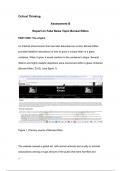
An internet phenomenon that was later debunked as a hoax. Bonsai Kitten
provided detailed instructions on how to grow a unique kitten in a glass
container. When it grew, it would conform to the container's shape. Several
distinct and highly realistic depictions were ensconced within a glass container
(Bonsai Kitten, 2012). (see figure 1)
Figure 1, Primary source of Bonsai Kitten.
The website caused a global stir, with animal activists and cruelty to animals
associations among a huge amount of the public that were horrified and
1
, concerned over the website's claims. The Bonsai kitten was created in the late
2000s by academics studying at the Massachusetts Institute of Technology.
aid to have been an experiment to promote ethical discussions around Human
manipulation (The Chronicle: Daily news, 2008). Although it was found that
the web servers at MIT were the primary source of the hoax, the founders
were never officially revealed, releasing any correspondence or interview
statement as an alias of Dr Michael Wong Chang. (Mikkelson, D. 2003)
PART TWO: The spread
Fake news is one of the most talked about topics, but it was originally used to
praise and ridicule government actions. Fake news is a demonstration of false
claims designed to mislead the target audience (Baym, 2005). There is
limited evidence on turnover between social media groups and individuals,
(Egelhofer and Lecheler, 2019). The Fake news on bonsai kittens is tangled
with much misinformation which also has links to disinformation, giving
perceptive information that was intended to mislead. While using the fallacy of
giving false information on how to mould a kitten into a Bonsai Kitten. This
appears in many places, including shared emails and links to the original
source. Twitter, Facebook, social media platforms where users often share
videos or other forms of information that people copy and share on the
internet, often with content altered. These sources are not credible or of good
reputation. The media is reporting this trend and traffic to primary sources are
increasing. There are a number of mirror sites selling bonsai kitten products
worldwide. For example OmegaGrafix.com (no date), selling Christmas
ornaments. Figure 2.
2
Assessment B
Report on Fake News Topic Bonsai Kitten
PART ONE: The origins
An internet phenomenon that was later debunked as a hoax. Bonsai Kitten
provided detailed instructions on how to grow a unique kitten in a glass
container. When it grew, it would conform to the container's shape. Several
distinct and highly realistic depictions were ensconced within a glass container
(Bonsai Kitten, 2012). (see figure 1)
Figure 1, Primary source of Bonsai Kitten.
The website caused a global stir, with animal activists and cruelty to animals
associations among a huge amount of the public that were horrified and
1
, concerned over the website's claims. The Bonsai kitten was created in the late
2000s by academics studying at the Massachusetts Institute of Technology.
aid to have been an experiment to promote ethical discussions around Human
manipulation (The Chronicle: Daily news, 2008). Although it was found that
the web servers at MIT were the primary source of the hoax, the founders
were never officially revealed, releasing any correspondence or interview
statement as an alias of Dr Michael Wong Chang. (Mikkelson, D. 2003)
PART TWO: The spread
Fake news is one of the most talked about topics, but it was originally used to
praise and ridicule government actions. Fake news is a demonstration of false
claims designed to mislead the target audience (Baym, 2005). There is
limited evidence on turnover between social media groups and individuals,
(Egelhofer and Lecheler, 2019). The Fake news on bonsai kittens is tangled
with much misinformation which also has links to disinformation, giving
perceptive information that was intended to mislead. While using the fallacy of
giving false information on how to mould a kitten into a Bonsai Kitten. This
appears in many places, including shared emails and links to the original
source. Twitter, Facebook, social media platforms where users often share
videos or other forms of information that people copy and share on the
internet, often with content altered. These sources are not credible or of good
reputation. The media is reporting this trend and traffic to primary sources are
increasing. There are a number of mirror sites selling bonsai kitten products
worldwide. For example OmegaGrafix.com (no date), selling Christmas
ornaments. Figure 2.
2