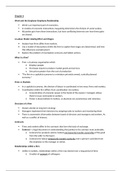
Chapter 6
Work and the Employer-Employee Relatonnhhp
Work is an important part of economics.
In models of economic interactonss bargaining determines the division of social surplus.
All partes gain from these interactonss but have confictng interests over how these gains
are shared.
A Labour Model relatng Efort and Wagen
Analyse how frms difer from markets.
Use a model of interactons within the frm to explain how wages are determineds and how
this infuences unemployment.
Explore the problem of incomplete contracts and hidden actons.
What hn a firm?
Firm = a business organisaton which
o Employs people
o Purchases inputs to produce market goods and services
o Sets prices greater than the cost of producton
“The frm in a capitalist economy is a miniature privately owneds centrally planned
economy.”
Fhrmn vn Marketn
In a capitalist economys the division of labour is coordinated in two ways: frms and markets.
Coordinaton within frm difers from coordinaton via markets:
o Concentraton of economic power in the hands of the owners/ managers allows
them to issue commands to workers.
o Power is decentralised in marketss so decisions are autonomous and voluntary.
Structure of a firm
Owners decide on long term strategy
Managers implement their decisions by assigning tasks to workers and monitoring them
There is asymmetric informaton between board of directors and managers and workers. As
well as a confict of interest.
Contractn
Firms and markets difer in the contracts that form the basis of exchange.
Contract = a legal document or understanding that partes to the contract must undertake.
o Contracts for products sold in markets permanently transfer ownership of the good
from the seller to the buyer.
o Contracts for labour temporarily transfer authority over a person’s actvites from
the employee to the manager or owner.
Relatonnhhpn whthhn a firm
Unlike in marketss relatonships within a frm may extend over a long period of tme.
o Creaton of network of colleagues
Work and the Employer-Employee Relatonnhhp
Work is an important part of economics.
In models of economic interactonss bargaining determines the division of social surplus.
All partes gain from these interactonss but have confictng interests over how these gains
are shared.
A Labour Model relatng Efort and Wagen
Analyse how frms difer from markets.
Use a model of interactons within the frm to explain how wages are determineds and how
this infuences unemployment.
Explore the problem of incomplete contracts and hidden actons.
What hn a firm?
Firm = a business organisaton which
o Employs people
o Purchases inputs to produce market goods and services
o Sets prices greater than the cost of producton
“The frm in a capitalist economy is a miniature privately owneds centrally planned
economy.”
Fhrmn vn Marketn
In a capitalist economys the division of labour is coordinated in two ways: frms and markets.
Coordinaton within frm difers from coordinaton via markets:
o Concentraton of economic power in the hands of the owners/ managers allows
them to issue commands to workers.
o Power is decentralised in marketss so decisions are autonomous and voluntary.
Structure of a firm
Owners decide on long term strategy
Managers implement their decisions by assigning tasks to workers and monitoring them
There is asymmetric informaton between board of directors and managers and workers. As
well as a confict of interest.
Contractn
Firms and markets difer in the contracts that form the basis of exchange.
Contract = a legal document or understanding that partes to the contract must undertake.
o Contracts for products sold in markets permanently transfer ownership of the good
from the seller to the buyer.
o Contracts for labour temporarily transfer authority over a person’s actvites from
the employee to the manager or owner.
Relatonnhhpn whthhn a firm
Unlike in marketss relatonships within a frm may extend over a long period of tme.
o Creaton of network of colleagues