The Universe
The scale of the universe
1. Planck length: smallest distance scale
2. Quark : fundamental particle of the universe
3. Carbon nucleus
4. DNA structure
5. Red blood cell
6. Micro organism/Hair thickness
7. Humans
8. Earth diameter
9. Earth-Moon distance
10. Venus, Earth and Mars
11. Solar system
12. Distance to nearest stars
13. Milky Way
14. Distance to other galaxies : stars, gas, and dust held together by gravitational forces.
15. Clusters of galaxies : two or more galaxies that are close enough to each other to affect each
other through gravitation.
16. Super clusters : group of galaxy clusters
17. Universe
The standard model
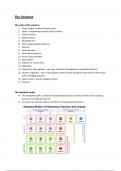
● The standard model is a theory of fundamental particles and forces which are the starting
points for anything we know of.
● It’s made up of quarks, leptons and force carrying particles (bosons)
, ● For each matter particle there is it’s antimatter particle, they behave the same but have
opposite charges
● QUARKS are fundamental particles that aren’t made up by any other particle, they make up
subatomic particles such as protons and neutrons.
○ There are 6 quarks and are usually seen in paris (up/down, charm/strange,
top/bottom), each of these have their own antimatter particle
○ Up, charm, top have a charge of ⅔
○ Down, strange, bottom have a charge of -⅓
● Quarks are never found alone, composite particles made of quarks are called HARDON
○ The charge of a hardon is determined by the sum of the quark charge
■ E.g A proton is made of two up and one down quark
+⅔e + ⅔e - ⅓e = +1e
○ Hardons are separated into two groups:
○ BARYONS: made of three quarks (qqq) suchs as protons and neutrons
○ MESONS: made of one quark (q) and one antiquark (-q), meaning that they are not
very stable. An example is a pion
● LEPTONS, three of them have electrical charge, three of them don’t. An example of a charged
lepton is an electron as well as a muon and tau. The other leptons are neutrinos, which are
very small and difficult to study. Each lepton has an antilepton, but “anti electrons” are called
positrons. They are particles that can exist on their own
○ Heavy leptons decay easily , one of the particles in decays into is always a neutrino
○ Leptons are divided into three families: electron + neutrino, muon+neutrino, tau +
neutrino
EXAMPLE OF PARTICLE DECAY
● INTERACTION FORCES: can be attributed to all forces in the world
○ Strong nuclear
○ Weak nuclear
○ Electromagnetic - carried by photons
○ Gravity - which is not included in the standard model because it is yet to be
understood by scientists
The scale of the universe
1. Planck length: smallest distance scale
2. Quark : fundamental particle of the universe
3. Carbon nucleus
4. DNA structure
5. Red blood cell
6. Micro organism/Hair thickness
7. Humans
8. Earth diameter
9. Earth-Moon distance
10. Venus, Earth and Mars
11. Solar system
12. Distance to nearest stars
13. Milky Way
14. Distance to other galaxies : stars, gas, and dust held together by gravitational forces.
15. Clusters of galaxies : two or more galaxies that are close enough to each other to affect each
other through gravitation.
16. Super clusters : group of galaxy clusters
17. Universe
The standard model
● The standard model is a theory of fundamental particles and forces which are the starting
points for anything we know of.
● It’s made up of quarks, leptons and force carrying particles (bosons)
, ● For each matter particle there is it’s antimatter particle, they behave the same but have
opposite charges
● QUARKS are fundamental particles that aren’t made up by any other particle, they make up
subatomic particles such as protons and neutrons.
○ There are 6 quarks and are usually seen in paris (up/down, charm/strange,
top/bottom), each of these have their own antimatter particle
○ Up, charm, top have a charge of ⅔
○ Down, strange, bottom have a charge of -⅓
● Quarks are never found alone, composite particles made of quarks are called HARDON
○ The charge of a hardon is determined by the sum of the quark charge
■ E.g A proton is made of two up and one down quark
+⅔e + ⅔e - ⅓e = +1e
○ Hardons are separated into two groups:
○ BARYONS: made of three quarks (qqq) suchs as protons and neutrons
○ MESONS: made of one quark (q) and one antiquark (-q), meaning that they are not
very stable. An example is a pion
● LEPTONS, three of them have electrical charge, three of them don’t. An example of a charged
lepton is an electron as well as a muon and tau. The other leptons are neutrinos, which are
very small and difficult to study. Each lepton has an antilepton, but “anti electrons” are called
positrons. They are particles that can exist on their own
○ Heavy leptons decay easily , one of the particles in decays into is always a neutrino
○ Leptons are divided into three families: electron + neutrino, muon+neutrino, tau +
neutrino
EXAMPLE OF PARTICLE DECAY
● INTERACTION FORCES: can be attributed to all forces in the world
○ Strong nuclear
○ Weak nuclear
○ Electromagnetic - carried by photons
○ Gravity - which is not included in the standard model because it is yet to be
understood by scientists