coronary arteries means blood travels to the arteries:
lungs and coronaries veins travel to the lungs. narrow lumen
coronary arteries has blood from the aorta thick walls
which has high pressure. aorta has high more collagen
pressure and elastic fibres which then recoils no valves
which gives the blood a second push
veins:
wide lumen
describe the structure of the mammalian thinner walls
heart less collagen
valves
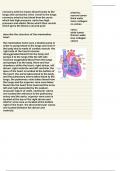
the mammalian heart uses a double pump in
order to pump blood to the lungs and rest of
the body and is made of cardiac muscle. the
right side of the heart receives
deoxygenated blood from the body and
pumps it to the lungs hilts the left side
receives oxygenated blood from the lungs
and pumps it to the body. there are four
chambers within the heart: right atrium, left
atrium, right ventricle and left ventricle. the
apex of the heart is located at the bottom of
the heart. the aorta takes blood to the body
and the pulmonary artery takes blood to the
lungs. the pulmonary veins takes blood from
the lungs and the superior vena cava takes
blood into the heart from head and the arms.
left and right separated by the septum.
muscular nature of walls. semilunar valves
are located the entrance to the pulmonary
artery and the aorta. superior vena cava is
located at the top of the right atrium and
inferior vena cava us located at the bottom
right of the heart. the atrioventricular valves
are located between the atrium and
ventricle.
lungs and coronaries veins travel to the lungs. narrow lumen
coronary arteries has blood from the aorta thick walls
which has high pressure. aorta has high more collagen
pressure and elastic fibres which then recoils no valves
which gives the blood a second push
veins:
wide lumen
describe the structure of the mammalian thinner walls
heart less collagen
valves
the mammalian heart uses a double pump in
order to pump blood to the lungs and rest of
the body and is made of cardiac muscle. the
right side of the heart receives
deoxygenated blood from the body and
pumps it to the lungs hilts the left side
receives oxygenated blood from the lungs
and pumps it to the body. there are four
chambers within the heart: right atrium, left
atrium, right ventricle and left ventricle. the
apex of the heart is located at the bottom of
the heart. the aorta takes blood to the body
and the pulmonary artery takes blood to the
lungs. the pulmonary veins takes blood from
the lungs and the superior vena cava takes
blood into the heart from head and the arms.
left and right separated by the septum.
muscular nature of walls. semilunar valves
are located the entrance to the pulmonary
artery and the aorta. superior vena cava is
located at the top of the right atrium and
inferior vena cava us located at the bottom
right of the heart. the atrioventricular valves
are located between the atrium and
ventricle.