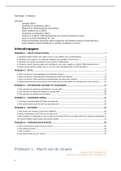
Breinontwikkeling en neurotransmitters
• 1. Negative affect is related to reduced differential neural responses to
social and non-social stimuli in 5-to-8-month-old infants
• 2. The basics of brain development
Perceptie en motorische vaardigheden
• 1. Development of visual perception
• 2. Motor skill learning in children with Developmental Coordination
Disorder (DCD)
• 3. Systematic Review and Meta-Analyses: Motor Skill Interventions to
Improve Fine Motor Development in Children Aged Birth to 6 Years
Aandacht en EF
• 1. Associations of Early-Life Threat and Deprivation with Executive
Functioning in Childhood
• 2. Child EF and future externalizing and internalizing problems: A meta-
analysis of prospective longitudinal studies
Taal en spraak
• 1. Brain mechanisms in early language acquisition
• 2. Relations among speech, language, and reading disorders
• 3. Language assessment and development in toddlers with autism
spectrum disorders
Emotie en sociale cognitie
• 1. SOCIAL: an integrative framework for the development of social skills
• 2. Using the transporters DVD as a learning tool for children with ASD
• 3. Social attention, affective arousal and empathy in men with Klinefelter
syndrome (47, XXY): evidence from eyetracking and skin conductance
Geheugen
• 1. Declarative/nondeclarative memory: Multiple brain systems
supporting learning, memory
• 2. Attention- versus significance-driven memory formation: Taxonomy,
neural substrates
,Breintrauma en Breintumoren
• 1. Neuropsychological impairment in childhood absence epilepsy: Review
of the literature
• 2. Behaviour and school performance after brain injury
• 3. Searching for effective components of cognitive rehabilitation for
children and adolescents with acquired brain injury: A systematic review
• 4. A summary on the effectiveness of the Amsterdam memory and
attention training for children (Amat-c) in children with brain injury
Genetische ziektes
• 1. A review of neurocognitive functioning of children with sex
chromosome trisomies: Identifying targets for early intervention
• 2. The 22q11.2 Deletion Syndrome as a window into complex
neuropsychiatric disorders
• 3. Noonan Syndrome: Clinical features, diagnosis, and management
guidelines
Neurologische ontwikkelingsstoornissen
• 1. The dual pathway model of AD/HD: an elaboration of neuro-
developmental characteristics
• 2. Autistic spectrum disorders: A review of clinical features, theories and
diagnosis
• 3. Mindfulness-Based Stress Reduction in Prison: Experiences of Inmates,
Instructors, staff
,HC1 Artikel 1) Negative affect is related to reduced differential neural responses to
social and non-social stimuli in 5-to-8-month-old infants: A functional near-infrared
spectroscopy-study.
Onderwep:
- Negatief affect (temperament) werd gerelateerd aan verminderde neurale respons
(lagere hemodynamische respons) in de rechter postirieure temporale kwab.
- Een moeilijk temperament kan dus worden verklaard op breinniveau.
- Het bevestigt dat 5-8 maanden oude baby’s al corticale specializatie vertonen voor
sociale perceptie in de posterieure temporale cortex
- social brain network: including the amygdala, ACC, medial PFC and posterior STS/TPJ
, HC1 Artikel 2) The basics of brain development
Onderwerp:
- Breinontwikkeling embryo (conceptie-W8):
- Neocortex & subcortical nuclei (samen: grijze stof): belangrijkste breininformatie
verwerkers
o NC: laag cellen dat brein omhult
o SN: clusters neuronen, dient als signaalschakelaar tussen NC en rest vh
lichaam.
o Grijze stof (cellichamen) = informatieverwerking = NC + SN
o Witte stof (uitlopers; wit myeline) = verbindingen zenuwcellen = dendrieten
(takjes; korte afstand; ontvangen) + axonen (takken; lange afstand; versturen)
= witte stof
1) Gastrulatie (E13): embryo 13 dagen → begin gastrulatie: de tweelaagse structuur
cellen (epiblast+hypoblast) wordt een drielaagse structuur cellen.
o epiblast cellen vormen 3 nieuwe stamcellijnen (o.a. neurale stamcellen)
o hypoblast cellen vormen weefsels (o.a. placenta)
o 1e stap gastrulatie: vorming primitive streak = opening bovenste laag embryo
waardoor epiblast cellen kunnen migreren naar andere delen van embryo.
▪ Endoderm (onder/diep): cellen die diepst migreren vervangen
hypoblast cellen voor endoderm cellaag (darmen/longen) gevormd.
▪ Mesoderm (midden): cellen die naar de middelste, tweede, laag
migereren vormen de mesoderm cellaag (spieren, botten, bloedvaten).
▪ ectoderm (boven/oppervlakkig): De cellen die naar de derde,
bovenste laag migreren vormen het de ectoderm cellaag:
• deze kunnen differentiëren in twee soorten:
o Epidermal ectodermal stamcellen
vormen huid, nagels en zweetkanalen
o Neuroectodermal stamcellen
(= neurale stamcellen/neural progenitor cells):
vormen brein en C.Z.S.
- Neurale stamcellen (neural progenitor cells): heel belangrijk want vormen de
hersenen + C.Z.S. Zijn in staat om alle soorten neuronen te maken.
o Fate restriction:
▪ Neurale stamcellen transplanteren jong → oud dier: deze stamcellen
produceren neuronen die bij het oude dier passen
▪ Neurale stamcellen transplanteren oud → jong dier: deze stamcellen
produceren neuronen die bij het oude dier passen
▪ Conclusie: neurale stamcellen kunnen alle neuronen produceren, maar
door ontwikkeling met de tijd worden ze beperkt (restricted) in het
soort cellen die ze kunnen aanmaken, omdat een ouder organisme
bepaalde celtypen niet meer nodig heeft. Dus zal het dier nooit meer
in staat zijn (ook niet met donorstamcellen van jong dier) om deze wel
aan te maken.
2) Vorming Neurale buis (E20-27): neurale stamcellen vormen
• 1. Negative affect is related to reduced differential neural responses to
social and non-social stimuli in 5-to-8-month-old infants
• 2. The basics of brain development
Perceptie en motorische vaardigheden
• 1. Development of visual perception
• 2. Motor skill learning in children with Developmental Coordination
Disorder (DCD)
• 3. Systematic Review and Meta-Analyses: Motor Skill Interventions to
Improve Fine Motor Development in Children Aged Birth to 6 Years
Aandacht en EF
• 1. Associations of Early-Life Threat and Deprivation with Executive
Functioning in Childhood
• 2. Child EF and future externalizing and internalizing problems: A meta-
analysis of prospective longitudinal studies
Taal en spraak
• 1. Brain mechanisms in early language acquisition
• 2. Relations among speech, language, and reading disorders
• 3. Language assessment and development in toddlers with autism
spectrum disorders
Emotie en sociale cognitie
• 1. SOCIAL: an integrative framework for the development of social skills
• 2. Using the transporters DVD as a learning tool for children with ASD
• 3. Social attention, affective arousal and empathy in men with Klinefelter
syndrome (47, XXY): evidence from eyetracking and skin conductance
Geheugen
• 1. Declarative/nondeclarative memory: Multiple brain systems
supporting learning, memory
• 2. Attention- versus significance-driven memory formation: Taxonomy,
neural substrates
,Breintrauma en Breintumoren
• 1. Neuropsychological impairment in childhood absence epilepsy: Review
of the literature
• 2. Behaviour and school performance after brain injury
• 3. Searching for effective components of cognitive rehabilitation for
children and adolescents with acquired brain injury: A systematic review
• 4. A summary on the effectiveness of the Amsterdam memory and
attention training for children (Amat-c) in children with brain injury
Genetische ziektes
• 1. A review of neurocognitive functioning of children with sex
chromosome trisomies: Identifying targets for early intervention
• 2. The 22q11.2 Deletion Syndrome as a window into complex
neuropsychiatric disorders
• 3. Noonan Syndrome: Clinical features, diagnosis, and management
guidelines
Neurologische ontwikkelingsstoornissen
• 1. The dual pathway model of AD/HD: an elaboration of neuro-
developmental characteristics
• 2. Autistic spectrum disorders: A review of clinical features, theories and
diagnosis
• 3. Mindfulness-Based Stress Reduction in Prison: Experiences of Inmates,
Instructors, staff
,HC1 Artikel 1) Negative affect is related to reduced differential neural responses to
social and non-social stimuli in 5-to-8-month-old infants: A functional near-infrared
spectroscopy-study.
Onderwep:
- Negatief affect (temperament) werd gerelateerd aan verminderde neurale respons
(lagere hemodynamische respons) in de rechter postirieure temporale kwab.
- Een moeilijk temperament kan dus worden verklaard op breinniveau.
- Het bevestigt dat 5-8 maanden oude baby’s al corticale specializatie vertonen voor
sociale perceptie in de posterieure temporale cortex
- social brain network: including the amygdala, ACC, medial PFC and posterior STS/TPJ
, HC1 Artikel 2) The basics of brain development
Onderwerp:
- Breinontwikkeling embryo (conceptie-W8):
- Neocortex & subcortical nuclei (samen: grijze stof): belangrijkste breininformatie
verwerkers
o NC: laag cellen dat brein omhult
o SN: clusters neuronen, dient als signaalschakelaar tussen NC en rest vh
lichaam.
o Grijze stof (cellichamen) = informatieverwerking = NC + SN
o Witte stof (uitlopers; wit myeline) = verbindingen zenuwcellen = dendrieten
(takjes; korte afstand; ontvangen) + axonen (takken; lange afstand; versturen)
= witte stof
1) Gastrulatie (E13): embryo 13 dagen → begin gastrulatie: de tweelaagse structuur
cellen (epiblast+hypoblast) wordt een drielaagse structuur cellen.
o epiblast cellen vormen 3 nieuwe stamcellijnen (o.a. neurale stamcellen)
o hypoblast cellen vormen weefsels (o.a. placenta)
o 1e stap gastrulatie: vorming primitive streak = opening bovenste laag embryo
waardoor epiblast cellen kunnen migreren naar andere delen van embryo.
▪ Endoderm (onder/diep): cellen die diepst migreren vervangen
hypoblast cellen voor endoderm cellaag (darmen/longen) gevormd.
▪ Mesoderm (midden): cellen die naar de middelste, tweede, laag
migereren vormen de mesoderm cellaag (spieren, botten, bloedvaten).
▪ ectoderm (boven/oppervlakkig): De cellen die naar de derde,
bovenste laag migreren vormen het de ectoderm cellaag:
• deze kunnen differentiëren in twee soorten:
o Epidermal ectodermal stamcellen
vormen huid, nagels en zweetkanalen
o Neuroectodermal stamcellen
(= neurale stamcellen/neural progenitor cells):
vormen brein en C.Z.S.
- Neurale stamcellen (neural progenitor cells): heel belangrijk want vormen de
hersenen + C.Z.S. Zijn in staat om alle soorten neuronen te maken.
o Fate restriction:
▪ Neurale stamcellen transplanteren jong → oud dier: deze stamcellen
produceren neuronen die bij het oude dier passen
▪ Neurale stamcellen transplanteren oud → jong dier: deze stamcellen
produceren neuronen die bij het oude dier passen
▪ Conclusie: neurale stamcellen kunnen alle neuronen produceren, maar
door ontwikkeling met de tijd worden ze beperkt (restricted) in het
soort cellen die ze kunnen aanmaken, omdat een ouder organisme
bepaalde celtypen niet meer nodig heeft. Dus zal het dier nooit meer
in staat zijn (ook niet met donorstamcellen van jong dier) om deze wel
aan te maken.
2) Vorming Neurale buis (E20-27): neurale stamcellen vormen