PROPERTY AND CASUALTY BASICS EXAM PREP QUESTIONS AND ANSWERS 2024
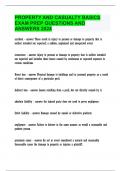
accident These result in injury to persons or damage to property that is neither intended nor expected; a sudden, unplanned and unexpected event. occurrence injury to persons or damage to property that is neither intended nor expected and includes those losses caused by continuous or repeated exposure to certain conditions Direct loss Physical damage to buildings and/or personal property as a result of direct consequence of a particular peril. Indirect loss Losses resulting from a peril, but not directly caused by it. absolute liability the injured party does not need to prove negligence. Strict liability Damage caused by unsafe or defective products. negligence Failure to behave in the same manner as would a reasonable and prudent person. proximate cause An act or event considered a natural and reasonably foreseeable cause the damage to property or injuries a plaintiff. contributory negligence The injured party must be completely free of fault in order to collect. Any negligence on the part of the injured party that contributed to the injury, however slight, will normally defeat the claim. comparative negligence This will not necessarily defeat the claim, but will be used to mitigate the damages payable to the other party. bodily injury It is more difficult to determine the loss monetarily since it may lead to claims by the injured party not only for medical expenses and lost wages, but also for disfigurement, pain and suffering, mental anguish, and loss of consortium. property damage damage to tangible property of others intentional tort Any deliberate act that causes harm to another person. blanket insurance a single property insurance policy provides coverage for multiple classes of property at one location, or for one or more classes of property at multiple locations. actual cash value This method valuation reinforces the principle of indemnity because it recognizes the reduction of value of property as it ages and becomes subject to wear and tear and obsolescence. underwriter Their basic function is evaluating applications submitted to the insurer and determining whether a policy should be issued. loss ratio formula (Incurred losses + Loss adjusting expense) / Earned premium = X class rating the practice of computing a price per unit of insurance that applies to all applicants possessing a given set of characteristics. schedule rating the rating, the rates are developed by applying a schedule of charges and credits to some base rate to determine the appropriate rate for an individual exposure. judgment rating used when credible statistics are lacking or when the exposure units are so varied that it is impossible to construct a class. declarations the basic underwriting information (such as the insured's name, address, amount of coverage and premiums, and a description of insured locations), and any supplemental representations by the insured. additional or supplementary payments provides an additional amount of coverage for specific loss expense,. at no additional premium. conditions This includes the general rules or procedures that the insurer and insured agree to follow under the terms of the policy,. exclusions This details what perils are not insured against and what persons are not insured. Endorsements The term used to describe printed addendums to a contract that are used to change the policy's original terms, conditions, or coverages cancellation The termination of an insurance policy by either party prior to the expiration date shown in the policy. nonrenewal The termination of a policy at its expiration date by not offering a continuation of the existing policy or a replacement policy. vacancy An insured structure in which no people have been living or working and no property has been stored for the specified period of time. unoccupancy An insured structure in which no people have been living or working within the required period of time, but some property is stored. abandonment The abdication of insured property into the hands of another, or into the possession of no one in particular. subrogation The acquisition by an insurer of an insured's rights against any third party for indemnification of loss or other payment, to the extent that the insurer pays the loss. salvage The amount of money realized from the sale of damaged merchandise.
Written for
- Institution
- Property & Casualty
- Module
- Property & Casualty
Document information
- Uploaded on
- April 16, 2024
- Number of pages
- 4
- Written in
- 2023/2024
- Type
- Exam (elaborations)
- Contains
- Questions & answers
Subjects
-
property and casualty basics exam prep

Also available in package deal