

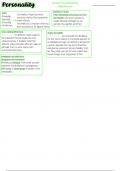
Personality Context of individual
differences
Definition of traits
KAPA Personality is shaped by various Traits=behavioural consistency over time
Knowledge processes and has fixed components
:.
↑
Appraisals
Personality
which interacts
and situations. We tend to go back to
regular behaviours although we can
Personality has a structure which has override it by cognition and effect
s
Architecture been deascribed as the dynamic lattice
Cross cultural differences Origins and stability
Allik & McCrae 34 different nations-supports Costa & McCRea are responsible for developing
the proposition that personality has cross the five factor model as a trait based approach. At
cultural invariance. It should be noted that an individual level origins are deemed to be based on
different nations may place different values on a genetic disposition but may also be shaped by
particular traits so some may be more early learning experinces and role modelling. Traits
accentuated than others are fairy stable over tike but some studies have
traced changes cover long periods of time
Individualism and collectivism
(Ideographic and nomothetic)
I&I=looking at individuals, their profile, personal
experience and development and uniqueness
C&N=looking at whole groups of people to find
commonalities
,Personality Five factor model (OCEAN or
CANOE)
-
Each of the 5 factors have 10 items which load to each factor (50
items)
y
On each item there is a likert scaled response format
↑
The items are linked together in clusters which are all independent and
work alone-shouldn’t correlate
-
Eysenck suggested that the FFM was very similar to his EPQ-
extroversion, introversion, neuroticism
-
A latent variable (hidden) and comes out in observed indicators-has a directional causation
e.g. self esteem, depression, intelligence
I
Openness-individuals having openness to new experiences
~
Conscientiousness-the individuals degree of self discipline and control
I
Extraversion-measure of the individuals sociability
-
Agreeableness-characteristics of the individual which are relevant for social interaction
/
Neuroticism-measures the individuals emotional stability and personal adjustment
,Personality Origins of personality theories
Adjective groupings-Allport & Cattell
Use the adjective approach to arrange behaviours and descriptors under clusters then found labels
which described these as broad traits. Later developed by personality tests/inventories such as the
FFM and EPQ. E.g. extroversion=sociability, talkativeness, impulsivity etc
Psychoanalytic and psychodynamic approaches Behavioural and situational perspectives
Freud sees personality as being related to early Skinner emphasised behaviour reinforcement
childhood experiences and that later personality and stimuli that could be observed and
development would be stifled if a child was fixated measured objectively-personality is difficult to
and trapped by early childhood experiences-could be measure
overturned by psychoanalysis Reinforcement history was seen as more
Neo-Freudian a see problems may be related to useful than any attempt to capture hidden
social development rather than just psycho sexual depths and complexities of personality
problems
Eysenck
Scientific method for studying personality through psychometric measure-EPQ, as well as experimental
methods no the factor analytic approach
People will conform to each other and to standards in strong situations
But, in come cases some individuals will take risks where others will not-weak situations bring out
individual differences
Scientific approach is better than implicit personality theory
Implicit personality theory-Many will attribute characteristics to others we don’t know based on a
modicum if information (often negative). May be based on prejudice, stereotyping or anxiety.
Gestalt psychologists argue we tend to fill in the blanks at a social level so studying personality as a
scientific level is a welcome move to understand people mire comprehensively and fairly
, Personality The science of personality
Biological and developmental approach
Eysenck concluded that extraversion vs introversion was attributable to brain arousal (biological element)
extroverts need more brain arousal and introverts need less
Personality shaped to some extent by early learning but Eysenck postulated the autonomic nervous system
has a causal influence on neuroticism and hormones as suggested in psychoticism
He suggested biological/brain activity for all 3 aspects of his PEN model
Brain studies Twin studies
Progress has been made on the links between Much research into twins has been based on
neurotransmitters/ hormones and behavioural intelligence but can also be applied to personality.
markers e.g. testosterone been linked to There’s a genetic basis for similarities between
aggression, dopamine to agreeableness and MZ and DZ twins
oxytocin related to bonding
Theories and validity
Self reports and peer ratings Solid theories of personality Such as FFM and
Self reports can being out very clear patterns EPQ have acceptability as validities and
of behaviours with similarities over time and reliabilities have been reported for them all.
differences across groups. Eysenck argued that conscientiousness and
Peer ratings of those who are closest to us agreeableness were just the positive side of
usually give ratings most similar to individuals own psychoticism in his PEN model
ratings
Traits cognitions and dynamic
Traits cover personality
Cognition covers beliefs, information processing and attention Dynamic lattice
Dynamics covers emotions, moods, motivations, effects
differences
Definition of traits
KAPA Personality is shaped by various Traits=behavioural consistency over time
Knowledge processes and has fixed components
:.
↑
Appraisals
Personality
which interacts
and situations. We tend to go back to
regular behaviours although we can
Personality has a structure which has override it by cognition and effect
s
Architecture been deascribed as the dynamic lattice
Cross cultural differences Origins and stability
Allik & McCrae 34 different nations-supports Costa & McCRea are responsible for developing
the proposition that personality has cross the five factor model as a trait based approach. At
cultural invariance. It should be noted that an individual level origins are deemed to be based on
different nations may place different values on a genetic disposition but may also be shaped by
particular traits so some may be more early learning experinces and role modelling. Traits
accentuated than others are fairy stable over tike but some studies have
traced changes cover long periods of time
Individualism and collectivism
(Ideographic and nomothetic)
I&I=looking at individuals, their profile, personal
experience and development and uniqueness
C&N=looking at whole groups of people to find
commonalities
,Personality Five factor model (OCEAN or
CANOE)
-
Each of the 5 factors have 10 items which load to each factor (50
items)
y
On each item there is a likert scaled response format
↑
The items are linked together in clusters which are all independent and
work alone-shouldn’t correlate
-
Eysenck suggested that the FFM was very similar to his EPQ-
extroversion, introversion, neuroticism
-
A latent variable (hidden) and comes out in observed indicators-has a directional causation
e.g. self esteem, depression, intelligence
I
Openness-individuals having openness to new experiences
~
Conscientiousness-the individuals degree of self discipline and control
I
Extraversion-measure of the individuals sociability
-
Agreeableness-characteristics of the individual which are relevant for social interaction
/
Neuroticism-measures the individuals emotional stability and personal adjustment
,Personality Origins of personality theories
Adjective groupings-Allport & Cattell
Use the adjective approach to arrange behaviours and descriptors under clusters then found labels
which described these as broad traits. Later developed by personality tests/inventories such as the
FFM and EPQ. E.g. extroversion=sociability, talkativeness, impulsivity etc
Psychoanalytic and psychodynamic approaches Behavioural and situational perspectives
Freud sees personality as being related to early Skinner emphasised behaviour reinforcement
childhood experiences and that later personality and stimuli that could be observed and
development would be stifled if a child was fixated measured objectively-personality is difficult to
and trapped by early childhood experiences-could be measure
overturned by psychoanalysis Reinforcement history was seen as more
Neo-Freudian a see problems may be related to useful than any attempt to capture hidden
social development rather than just psycho sexual depths and complexities of personality
problems
Eysenck
Scientific method for studying personality through psychometric measure-EPQ, as well as experimental
methods no the factor analytic approach
People will conform to each other and to standards in strong situations
But, in come cases some individuals will take risks where others will not-weak situations bring out
individual differences
Scientific approach is better than implicit personality theory
Implicit personality theory-Many will attribute characteristics to others we don’t know based on a
modicum if information (often negative). May be based on prejudice, stereotyping or anxiety.
Gestalt psychologists argue we tend to fill in the blanks at a social level so studying personality as a
scientific level is a welcome move to understand people mire comprehensively and fairly
, Personality The science of personality
Biological and developmental approach
Eysenck concluded that extraversion vs introversion was attributable to brain arousal (biological element)
extroverts need more brain arousal and introverts need less
Personality shaped to some extent by early learning but Eysenck postulated the autonomic nervous system
has a causal influence on neuroticism and hormones as suggested in psychoticism
He suggested biological/brain activity for all 3 aspects of his PEN model
Brain studies Twin studies
Progress has been made on the links between Much research into twins has been based on
neurotransmitters/ hormones and behavioural intelligence but can also be applied to personality.
markers e.g. testosterone been linked to There’s a genetic basis for similarities between
aggression, dopamine to agreeableness and MZ and DZ twins
oxytocin related to bonding
Theories and validity
Self reports and peer ratings Solid theories of personality Such as FFM and
Self reports can being out very clear patterns EPQ have acceptability as validities and
of behaviours with similarities over time and reliabilities have been reported for them all.
differences across groups. Eysenck argued that conscientiousness and
Peer ratings of those who are closest to us agreeableness were just the positive side of
usually give ratings most similar to individuals own psychoticism in his PEN model
ratings
Traits cognitions and dynamic
Traits cover personality
Cognition covers beliefs, information processing and attention Dynamic lattice
Dynamics covers emotions, moods, motivations, effects


