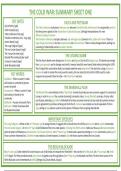
THE COLD WAR: SUMMARY SHEET ONE
KEY DATES YALTA AND POTSDAM
End of WW1 (1918) The Yalta Conference took place in February 1945 between Churchill, Stalin and Roosevelt. It was generally positive –
USSR Created (1922) the three powers agreed to the ‘Declaration of Liberated Europe’, although interpretations of it were
Yalta Conference (Feb 1945) different, leading to tension.
Potsdam Conference (July – Aug 1945) The Potsdam Conference took place between July and August 1945 between Atlee, Stalin and Truman. There is a
Atomic Bomb (1945) huge change of personnel, who are inexperienced and anti-communist. There are many disagreements, leading to a
The Long Telegram (1946) worsening of relationships and an increase in tension.
The Iron Curtain Speech (1946)
The Truman Doctrine (1947)
Marshall Plan Instituted (Apr 1948) THE ATOMIC BOMB
Comecon Created (1949) The first Atomic Bombs were dropped on Hiroshima and Nagasaki by the US in August 1945. The bomb was stronger
Berlin Blockade (1948) than 20,000 grenades and its damage was horrific. America tested this new Atomic Bomb without inviting the USSR.
The US hoped this would soften Stalin, but instead made him more determined. This also led to a huge increase in
tensions. In order to remain the most powerful country, the two sides (the US and the USSR) raced to create
KEY WORDS weapons more powerful than the other – the ‘Arms Race’ was born.
Capitalism – Where a country’s trade
and industry is controlled by private
owners for profit THE MARSHALL PLAN
Communism – Where a country’s trade
The Marshall Plan was instituted on the 3rd April 1948. It aimed to provide post-war economic support for countries in
and industry is shared by the
Europe, in order to prevent the countries becoming Communist states. George Marshall, secretary of state, rolled
community.
out this plan, delivering $13.5 billion of Marshall Aid to those countries involved. He also made all countries involved
Bolsheviks – Russian Communist Party
sign an agreement to purchase certain goods from the US. Comecon was created as a Soviet equivalent of this in
Red Scare – Period of paranoia after
1949, aiming to stop Eastern countries in the sphere of influence from accepting Marshall Aid.
the Russian Revolution
IMPORTANT SPEECHES
The Long Telegram – Written on the 22nd February 1946 by George Kennan. It suggests the US should view the USSR as a threat and aim to contain Communism.
The Iron Curtain Speech – On March 6th 1946, Churchill delivered the Iron Curtain speech, criticising the USSR’s actions. Stalin saw this as a deliberate attempt to
paint the sphere of influence as untrustworthy. The Truman Doctrine – On 12th March 1947, Truman made a speech promising to contain Communism, and support
those countries threatened by it. Cominform was created as a Soviet response, it created unity with those countries behind the Iron Curtain.
THE BERLIN BLOCKADE
On 24th June 1948, Stalin ordered his Soviet troops to cut off all modes of transport into West Berlin – this was the Berlin Blockade. On 26th June 1948, the Berlin
Airlift began. The West provided around 4000 tonnes of supplies a day through planes. On 12th May 1949, the blockade was lifted. The short-term causes of the
Berlin Blockade can be remembered as MADE. (Merged, Aid, Deutschmark, Escape)
KEY DATES YALTA AND POTSDAM
End of WW1 (1918) The Yalta Conference took place in February 1945 between Churchill, Stalin and Roosevelt. It was generally positive –
USSR Created (1922) the three powers agreed to the ‘Declaration of Liberated Europe’, although interpretations of it were
Yalta Conference (Feb 1945) different, leading to tension.
Potsdam Conference (July – Aug 1945) The Potsdam Conference took place between July and August 1945 between Atlee, Stalin and Truman. There is a
Atomic Bomb (1945) huge change of personnel, who are inexperienced and anti-communist. There are many disagreements, leading to a
The Long Telegram (1946) worsening of relationships and an increase in tension.
The Iron Curtain Speech (1946)
The Truman Doctrine (1947)
Marshall Plan Instituted (Apr 1948) THE ATOMIC BOMB
Comecon Created (1949) The first Atomic Bombs were dropped on Hiroshima and Nagasaki by the US in August 1945. The bomb was stronger
Berlin Blockade (1948) than 20,000 grenades and its damage was horrific. America tested this new Atomic Bomb without inviting the USSR.
The US hoped this would soften Stalin, but instead made him more determined. This also led to a huge increase in
tensions. In order to remain the most powerful country, the two sides (the US and the USSR) raced to create
KEY WORDS weapons more powerful than the other – the ‘Arms Race’ was born.
Capitalism – Where a country’s trade
and industry is controlled by private
owners for profit THE MARSHALL PLAN
Communism – Where a country’s trade
The Marshall Plan was instituted on the 3rd April 1948. It aimed to provide post-war economic support for countries in
and industry is shared by the
Europe, in order to prevent the countries becoming Communist states. George Marshall, secretary of state, rolled
community.
out this plan, delivering $13.5 billion of Marshall Aid to those countries involved. He also made all countries involved
Bolsheviks – Russian Communist Party
sign an agreement to purchase certain goods from the US. Comecon was created as a Soviet equivalent of this in
Red Scare – Period of paranoia after
1949, aiming to stop Eastern countries in the sphere of influence from accepting Marshall Aid.
the Russian Revolution
IMPORTANT SPEECHES
The Long Telegram – Written on the 22nd February 1946 by George Kennan. It suggests the US should view the USSR as a threat and aim to contain Communism.
The Iron Curtain Speech – On March 6th 1946, Churchill delivered the Iron Curtain speech, criticising the USSR’s actions. Stalin saw this as a deliberate attempt to
paint the sphere of influence as untrustworthy. The Truman Doctrine – On 12th March 1947, Truman made a speech promising to contain Communism, and support
those countries threatened by it. Cominform was created as a Soviet response, it created unity with those countries behind the Iron Curtain.
THE BERLIN BLOCKADE
On 24th June 1948, Stalin ordered his Soviet troops to cut off all modes of transport into West Berlin – this was the Berlin Blockade. On 26th June 1948, the Berlin
Airlift began. The West provided around 4000 tonnes of supplies a day through planes. On 12th May 1949, the blockade was lifted. The short-term causes of the
Berlin Blockade can be remembered as MADE. (Merged, Aid, Deutschmark, Escape)