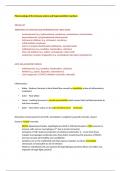
Pharmacology of the immune system and Hypersensitivity reactions
DRUGS LIST
TREATMENT OF IMMUNE AND HYPERSENSITIVITY REACTIONS
- Corticosteroids (e.g. hydrocortisone, prednisone, prednisolone, triamcinolone,
dexamethasone) cyclophosphamide alemtuzumab
- Calcineurin inhibitors (e.g. ciclosporin, tacrolimus,
- mTOR inhibitor (sirolimus)
- Anti-IL-2 receptor (basiliximab) azathioprine, mycophenolate
- Antihistamines (e.g. loratidine, fexofenadine, cetirizine)
- Mast cell stabiliser (e.g. sodium cromoglicate, nedecromil)
- Leukotriene receptor antagonists (e.g. montelukast) adrenaline (epinephrine)
ANTI-INFLAMMATORY DRUGS
- Antihistamines (e.g. loratidine, fexofenadine, cetirizine)
- NSAIDS (e.g. aspirin, ibuprofen, indomethacin)
- Cyclo-oxygenase-2 (COX-2) inhibitors (celecoxib, rofecoxib)
Inflammation:
• Rubor - Redness (increase in local blood flow caused by vasodilator action of inflammatory
mediators)
• Calor - Heat (ditto)
• Tumor - Swelling (increase in vascular permeability which causes fluid and blood proteins to
leak from venules).
• Dolor - Pain (direct action on the pain-sensitive nerve terminals)
Remember innate (present from birth, immediate) vs adaptive (acquired immunity, slower)
Events in innate immunity:
- PAMPs (lipopolysaccharides, peptidoglycans) bind to Toll-Like Receptors (TLRs) present on
immune cells such as macrophages (1st step in innate immunity)
- Activation of TLR’s leads to production of cytokines (interleukin 1) – come from tissue
resident macrophages (sentinels) when they detect a bacterium/the presence of PAMPs
- Increase vascular permeability and vasodilation
- Cytokines act on the endothelial cells that express receptors to attract neutrophils –
chemotaxis of neutrophils to site of infection
- Attach to endothelial cells and squeeze through tight gap junctions (Bind, roll, flatten out,
migration through tight junction)
, - Neutrophils move by intercellular calcium – zone of high calcium generated at front of cell,
directs the cell, zone can turn to steer cell opposite direction
- Neutrophils are the first to invade infected tissue
- Bacteria killed by oxidative bust, release of reactive oxygen species (NOS from neutrophils)
- Or phagocytosis
- Not without consequences, process damaging to neutrophil and in widespread infection
process damaging to the body (sepsis)
Adaptive immunity:
- Antigen engulfed by antigen presenting cell (dendritic cell, or any cell in body)
- Dangerous protein processed into small pieces (proteasome)
- Peptide presented to t cells by MHC class 1 for CD8+ or class 2 for CD4+
- Immunological synapse – Interaction between t cell and APC
- APC presents antigen to B cell by BCR - B cell differentiation into memory cell or plasma cell
that produced antibodies
- Switch off antibody production to prevent autoimmune disease – by monoclonal antibody
against receptor for interleukin 2 or others
- Antibody based immunity or cell based (humoral ) immunity produced
- Lytic synapse – between target cell and NK or t cell
,Autoimmune diseases
Autoimmune diseases are caused when the immune system becomes directed against the body’s
own tissues. The initial causative event is likely to be pathogen invasion (perhaps with only mild
symptoms), against which an immune attack is mounted, but which expresses a protein with
sequence similarity to endogenous proteins. In general the causative pathogen in autoimmune
diseases has not been identified.
Examples:
Multiple sclerosis (immune attack on oligodendrocytes)
Type I diabetes (immune attack on pancreatic beta cells)
Rheumatoid arthritis (immune attack on synovium surrounding joints)
Hyper and hypothyroidism (Graves disease and Hashimoto’s thyroiditis respectively)\
Corticosteroids:
- Are released from the outer layer (cortex) of the adrenal glands.
- The name glucocorticoids is reserved for endogenous steroids regulating glucose metabolism
(hydrocortisone, corticosterone)
- Corticosteroids includes these plus artificial steroids used in therapy (e.g. dexamethasone,
prednisolone).
- Corticosteroids produce anti-inflammatory effects by inhibiting or activating transcription of
genes encoding proteins involved in regulating inflammation. Many genes associated with
inflammation are up or down-regulated in most cells of the body.
- E.g. interleukins down regulated by corticosteroids – dampen immune system
Clinically used corticosteroids:
• short acting (< 24hrs): hydrocortisone
(cortisol, the natural corticosteroid)
prednisone, prednisolone
, (NB prednisone is a prodrug of prednisolone, which is the active
steroid)
• intermediate (24-48 hrs): triamcinolone
• long acting; (>48 hrs): dexamethasone
Prodrug – drug precursor that gets metabolized and produces the active compound drug (active
metabolite), increases lifetime of drug
Clinically differ in duration of effect
Many side effects of long term use of corticosteroids such as buffalo hump, easy bruising and poor
wound healing, thin arms and legs due to muscle wasting, increased abdominal fat etc
(Cushing’s syndrome)
Immunosuppressive drugs:
Short-term immunosuppression
High-dose corticosteroids (often I/V). Severe side effects with long-term usage (see
Cushing’s syndrome above).
Cyclophosphamide – a prodrug from which the active compound is released in liver.
Alkylates DNA (binding covalently) so DNA cant be replicated - and so kills proliferating B, T
cells. Severe side effects – hair loss, haemorrhagic cystitis, infertility.
Drugs suppress adaptive immune system but do not effect innate immune system
Longer-term immunosuppression:
Drugs used in maintenance therapy
- antibodies against T cell markers (alemtuzumab)
- calcineurin inhibitors (cyclosporin, tacrolimus). (calcineurin enzyme that activates t cells)
- mTOR (Target Of Rapamycin) inhibitors (sirolimus aka rapamycin) (transplant rejection and
anti-cancer)
- antibodies against IL-2 receptors on T cells (basiliximab)
DRUGS LIST
TREATMENT OF IMMUNE AND HYPERSENSITIVITY REACTIONS
- Corticosteroids (e.g. hydrocortisone, prednisone, prednisolone, triamcinolone,
dexamethasone) cyclophosphamide alemtuzumab
- Calcineurin inhibitors (e.g. ciclosporin, tacrolimus,
- mTOR inhibitor (sirolimus)
- Anti-IL-2 receptor (basiliximab) azathioprine, mycophenolate
- Antihistamines (e.g. loratidine, fexofenadine, cetirizine)
- Mast cell stabiliser (e.g. sodium cromoglicate, nedecromil)
- Leukotriene receptor antagonists (e.g. montelukast) adrenaline (epinephrine)
ANTI-INFLAMMATORY DRUGS
- Antihistamines (e.g. loratidine, fexofenadine, cetirizine)
- NSAIDS (e.g. aspirin, ibuprofen, indomethacin)
- Cyclo-oxygenase-2 (COX-2) inhibitors (celecoxib, rofecoxib)
Inflammation:
• Rubor - Redness (increase in local blood flow caused by vasodilator action of inflammatory
mediators)
• Calor - Heat (ditto)
• Tumor - Swelling (increase in vascular permeability which causes fluid and blood proteins to
leak from venules).
• Dolor - Pain (direct action on the pain-sensitive nerve terminals)
Remember innate (present from birth, immediate) vs adaptive (acquired immunity, slower)
Events in innate immunity:
- PAMPs (lipopolysaccharides, peptidoglycans) bind to Toll-Like Receptors (TLRs) present on
immune cells such as macrophages (1st step in innate immunity)
- Activation of TLR’s leads to production of cytokines (interleukin 1) – come from tissue
resident macrophages (sentinels) when they detect a bacterium/the presence of PAMPs
- Increase vascular permeability and vasodilation
- Cytokines act on the endothelial cells that express receptors to attract neutrophils –
chemotaxis of neutrophils to site of infection
- Attach to endothelial cells and squeeze through tight gap junctions (Bind, roll, flatten out,
migration through tight junction)
, - Neutrophils move by intercellular calcium – zone of high calcium generated at front of cell,
directs the cell, zone can turn to steer cell opposite direction
- Neutrophils are the first to invade infected tissue
- Bacteria killed by oxidative bust, release of reactive oxygen species (NOS from neutrophils)
- Or phagocytosis
- Not without consequences, process damaging to neutrophil and in widespread infection
process damaging to the body (sepsis)
Adaptive immunity:
- Antigen engulfed by antigen presenting cell (dendritic cell, or any cell in body)
- Dangerous protein processed into small pieces (proteasome)
- Peptide presented to t cells by MHC class 1 for CD8+ or class 2 for CD4+
- Immunological synapse – Interaction between t cell and APC
- APC presents antigen to B cell by BCR - B cell differentiation into memory cell or plasma cell
that produced antibodies
- Switch off antibody production to prevent autoimmune disease – by monoclonal antibody
against receptor for interleukin 2 or others
- Antibody based immunity or cell based (humoral ) immunity produced
- Lytic synapse – between target cell and NK or t cell
,Autoimmune diseases
Autoimmune diseases are caused when the immune system becomes directed against the body’s
own tissues. The initial causative event is likely to be pathogen invasion (perhaps with only mild
symptoms), against which an immune attack is mounted, but which expresses a protein with
sequence similarity to endogenous proteins. In general the causative pathogen in autoimmune
diseases has not been identified.
Examples:
Multiple sclerosis (immune attack on oligodendrocytes)
Type I diabetes (immune attack on pancreatic beta cells)
Rheumatoid arthritis (immune attack on synovium surrounding joints)
Hyper and hypothyroidism (Graves disease and Hashimoto’s thyroiditis respectively)\
Corticosteroids:
- Are released from the outer layer (cortex) of the adrenal glands.
- The name glucocorticoids is reserved for endogenous steroids regulating glucose metabolism
(hydrocortisone, corticosterone)
- Corticosteroids includes these plus artificial steroids used in therapy (e.g. dexamethasone,
prednisolone).
- Corticosteroids produce anti-inflammatory effects by inhibiting or activating transcription of
genes encoding proteins involved in regulating inflammation. Many genes associated with
inflammation are up or down-regulated in most cells of the body.
- E.g. interleukins down regulated by corticosteroids – dampen immune system
Clinically used corticosteroids:
• short acting (< 24hrs): hydrocortisone
(cortisol, the natural corticosteroid)
prednisone, prednisolone
, (NB prednisone is a prodrug of prednisolone, which is the active
steroid)
• intermediate (24-48 hrs): triamcinolone
• long acting; (>48 hrs): dexamethasone
Prodrug – drug precursor that gets metabolized and produces the active compound drug (active
metabolite), increases lifetime of drug
Clinically differ in duration of effect
Many side effects of long term use of corticosteroids such as buffalo hump, easy bruising and poor
wound healing, thin arms and legs due to muscle wasting, increased abdominal fat etc
(Cushing’s syndrome)
Immunosuppressive drugs:
Short-term immunosuppression
High-dose corticosteroids (often I/V). Severe side effects with long-term usage (see
Cushing’s syndrome above).
Cyclophosphamide – a prodrug from which the active compound is released in liver.
Alkylates DNA (binding covalently) so DNA cant be replicated - and so kills proliferating B, T
cells. Severe side effects – hair loss, haemorrhagic cystitis, infertility.
Drugs suppress adaptive immune system but do not effect innate immune system
Longer-term immunosuppression:
Drugs used in maintenance therapy
- antibodies against T cell markers (alemtuzumab)
- calcineurin inhibitors (cyclosporin, tacrolimus). (calcineurin enzyme that activates t cells)
- mTOR (Target Of Rapamycin) inhibitors (sirolimus aka rapamycin) (transplant rejection and
anti-cancer)
- antibodies against IL-2 receptors on T cells (basiliximab)