2.2.1 The heart and monitoring heart function
Overview
The heart
The heart pumps blood around the body in a series of
coordinated contractions.
2 pumps separated by a muscular wall
Left: Lungs → pulmonary vein → left atrium → left ventricle → aorta
→ body
Right: Body → vena cava → RA → RV → pulmonary artery → lungs
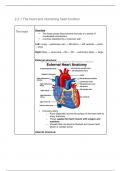
External structure:
Coronary artery
o Runs diagonally across the surface of the heart with its
many branches
o These supply the heart muscle with oxygen and
nutrients
o Vessels that can become blocked and cause heart
attack or cardiac arrest.
Internal structure:
, Two atria at the top with two ventricles below each atrium
Between the atria and ventricles are the atrioventricular valves.
The left side one is called the tricuspid valve and the right hand
one bicuspid.
o Both are under pressure when the ventricular wall
contracts so they are held in place by the chordae
tendineae, which prevent them from becoming inverted.
o These are attached to the muscle wall of the ventricle.
Left ventricle wall is much thicker than the right. Both ventricle
walls are very much thicker than the atrial walls.
The two pulmonary veins open into the left atrium bringing
oxygenated blood from the lungs, while the two vena cava
open into the right atrium, bringing deoxygenated blood from
the head and body.
The aorta leaves the left ventricle, which carries blood to all
parts of the body. The pulmonary arteries leave the right
ventricle and carry blood only as far as the lungs.
o This explains why the right ventricle wall is so much
thinner than the left. It does not need to pump blood as
far, or under as high a pressure.
Overview
The heart
The heart pumps blood around the body in a series of
coordinated contractions.
2 pumps separated by a muscular wall
Left: Lungs → pulmonary vein → left atrium → left ventricle → aorta
→ body
Right: Body → vena cava → RA → RV → pulmonary artery → lungs
External structure:
Coronary artery
o Runs diagonally across the surface of the heart with its
many branches
o These supply the heart muscle with oxygen and
nutrients
o Vessels that can become blocked and cause heart
attack or cardiac arrest.
Internal structure:
, Two atria at the top with two ventricles below each atrium
Between the atria and ventricles are the atrioventricular valves.
The left side one is called the tricuspid valve and the right hand
one bicuspid.
o Both are under pressure when the ventricular wall
contracts so they are held in place by the chordae
tendineae, which prevent them from becoming inverted.
o These are attached to the muscle wall of the ventricle.
Left ventricle wall is much thicker than the right. Both ventricle
walls are very much thicker than the atrial walls.
The two pulmonary veins open into the left atrium bringing
oxygenated blood from the lungs, while the two vena cava
open into the right atrium, bringing deoxygenated blood from
the head and body.
The aorta leaves the left ventricle, which carries blood to all
parts of the body. The pulmonary arteries leave the right
ventricle and carry blood only as far as the lungs.
o This explains why the right ventricle wall is so much
thinner than the left. It does not need to pump blood as
far, or under as high a pressure.