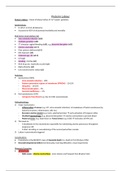
Preterm Labour
Preterm labour = Onset of labour before 37-0/7 weeks’ gestaton
Epidemiology
8-12% (1 in 8) of all deliveries
Accounts for 85% of all perinatal morbidity and mortality
Risk factors (and relatve risk)
Intra-amniotc infecton (x50)
Multple gestaton (x40)
3rd trimester vaginal bleeding (x10), e.g. placental abrupton (x35)
Uterine anomalies (x5-7)
Prior preterm delivery (x2-5)
DES exposure (x4)
Maternal age >35 (x2-3)
UTI (x2)
Smoking >10/day (x2)
Illicit drug use, especially cocaine (x2)
Black ethnicity (x2)
Low socioeconomic status (x2)
Aetology
Spontaneous (80%)
- Intra-amnioti infeiton – 30%
- Preterm premature rupture of membrane (PPROM) – 20-25%
- Idiopathii – 20-25%
- Plaiental abrupton – 5%
- Cerviial insufiieniy - <1%
Non-spontaneous (20%)
- Iatrogenii/intentonal (e.g. due to IUGR, preeclampsia)
Pathophysiology
1) Major mechanisms:
- Inflammaton of uterus (e.g. UTI, intra-amniotc infecton) breakdown of foetal membranes (by
bacterial enzymes, infammatory cells etc.)
- Exiessive uterine stretih (e.g. twins, polyhydramnios) early actvaton of Ferguson refex
- Deiidual haemorrhage (e.g. placental abrupton) uterine contractons to prevent bleed
- Maternal stress (e.g. depression) or Foetal stress (e.g. IUGR) Actvaton of HPA axis
2) This leads to
- A breakdown in the mechanisms responsible for maintaining uterine quiescence throughout
pregnancy OR
- A short circuitng or overwhelming of the normal parturiton cascade
3) Labour is prematurely triggered
Complicatons
Prematurity is the BIGGEST cause of Neonatal death (i.e. death in frst 28 days of life)
Neurodevelopmental defiit (Cerebral palsy, learning difcultes, visual impairment)
Diagnosis/Screening
Examinaton
- Abdo exam - Uterine iontraitons –more intense and frequent than Braxton hicks
Preterm labour = Onset of labour before 37-0/7 weeks’ gestaton
Epidemiology
8-12% (1 in 8) of all deliveries
Accounts for 85% of all perinatal morbidity and mortality
Risk factors (and relatve risk)
Intra-amniotc infecton (x50)
Multple gestaton (x40)
3rd trimester vaginal bleeding (x10), e.g. placental abrupton (x35)
Uterine anomalies (x5-7)
Prior preterm delivery (x2-5)
DES exposure (x4)
Maternal age >35 (x2-3)
UTI (x2)
Smoking >10/day (x2)
Illicit drug use, especially cocaine (x2)
Black ethnicity (x2)
Low socioeconomic status (x2)
Aetology
Spontaneous (80%)
- Intra-amnioti infeiton – 30%
- Preterm premature rupture of membrane (PPROM) – 20-25%
- Idiopathii – 20-25%
- Plaiental abrupton – 5%
- Cerviial insufiieniy - <1%
Non-spontaneous (20%)
- Iatrogenii/intentonal (e.g. due to IUGR, preeclampsia)
Pathophysiology
1) Major mechanisms:
- Inflammaton of uterus (e.g. UTI, intra-amniotc infecton) breakdown of foetal membranes (by
bacterial enzymes, infammatory cells etc.)
- Exiessive uterine stretih (e.g. twins, polyhydramnios) early actvaton of Ferguson refex
- Deiidual haemorrhage (e.g. placental abrupton) uterine contractons to prevent bleed
- Maternal stress (e.g. depression) or Foetal stress (e.g. IUGR) Actvaton of HPA axis
2) This leads to
- A breakdown in the mechanisms responsible for maintaining uterine quiescence throughout
pregnancy OR
- A short circuitng or overwhelming of the normal parturiton cascade
3) Labour is prematurely triggered
Complicatons
Prematurity is the BIGGEST cause of Neonatal death (i.e. death in frst 28 days of life)
Neurodevelopmental defiit (Cerebral palsy, learning difcultes, visual impairment)
Diagnosis/Screening
Examinaton
- Abdo exam - Uterine iontraitons –more intense and frequent than Braxton hicks