Task 3 (D4)
12986391
Iman B.Zamani
Task 3
To be carried out in class. Undertake a detailed discussion and evaluation of the
regulation of glycolysis, depending on the energy requirements of organisms and
their cells. You must include an explanation of how lactate production affects muscle
cells.
The flux through the glycolytic pathway must be adjusted in response to conditions both
inside and outside the cell. The rate of conversion of glucose into pyruvate is regulated to
meet two major cellular needs:
1, the production of ATP, generated by the degradation of glucose, and
2, the provision of building blocks for synthetic reactions, such as the formation of fatty acids.
In metabolic pathways, enzymes catalyzing essentially irreversible reactions are potential
sites of control.
In glycolysis, the reactions catalyzed by hexokinase, phosphofructokinase, and pyruvate
kinase are virtually irreversible; hence, these enzymes would be expected to have regulatory
as well as catalytic roles.
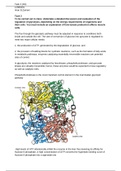
Phosphofructokinase is the most important control element in the mammalian glycolytic
pathway
High levels of ATP allosterically inhibit the enzyme in the liver thus lowering its affinity for
fructose 6-phosphate. A high concentration of ATP converts the hyperbolic binding curve of
fructose 6-phosphate into a sigmoidal one
12986391
Iman B.Zamani
Task 3
To be carried out in class. Undertake a detailed discussion and evaluation of the
regulation of glycolysis, depending on the energy requirements of organisms and
their cells. You must include an explanation of how lactate production affects muscle
cells.
The flux through the glycolytic pathway must be adjusted in response to conditions both
inside and outside the cell. The rate of conversion of glucose into pyruvate is regulated to
meet two major cellular needs:
1, the production of ATP, generated by the degradation of glucose, and
2, the provision of building blocks for synthetic reactions, such as the formation of fatty acids.
In metabolic pathways, enzymes catalyzing essentially irreversible reactions are potential
sites of control.
In glycolysis, the reactions catalyzed by hexokinase, phosphofructokinase, and pyruvate
kinase are virtually irreversible; hence, these enzymes would be expected to have regulatory
as well as catalytic roles.
Phosphofructokinase is the most important control element in the mammalian glycolytic
pathway
High levels of ATP allosterically inhibit the enzyme in the liver thus lowering its affinity for
fructose 6-phosphate. A high concentration of ATP converts the hyperbolic binding curve of
fructose 6-phosphate into a sigmoidal one