NR548 Week 5 and 6 Complete Solution Verified 100%
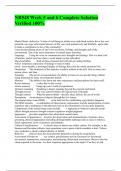
NR548 Week 5 and 6 Complete Solution Verified 100% Mental Status defined as "a state of well-being in which every individual realizes his or her own potential, can cope with normal stresses of life, can work productively and fruitfully, and is able to make a contribution to her or his community" Consciousness Being aware of one's own existence, feelings, and thoughts and of the environment. This is the most elementary of mental status functions. Language Using the voice to communicate one's thoughts and feelings. This is a basic tool of humans, and its loss has a heavy social impact on the individual. Mood and affect Both of these elements deal with the prevailing feelings. Affect temporary expression of feelings or state of mind mood more durable, a prolonged display of feelings that color the whole emotional life. Orientation The awareness of the objective world in relation to the self. Able to name own person, place, and time Attention The power of concentration, the ability to focus on one specific thing without being distracted by many environmental stimuli. Memory The ability to lay down and store experiences and perceptions for later recall. Recent memory evokes day-to-day events remote memory brings up years' worth of experiences. Abstract reasoning Pondering a deeper meaning beyond the concrete and literal. Thought process The way a person thinks; the logical train of thought. Thought content What the person thinks—specific ideas, beliefs, the use of words. Perceptions An awareness of objects through the five senses. The mental status exam (MSE) is the best tool for establishing a psychiatric diagnosis. The MSE includes a combination of observations, impressions, and the interpretation of client responses and is analogous to the physical exam in the formulation of an accurate diagnosis. Components of the mental status exam include •: appearance• behavior• speech• mood• affect• thought process• thought content• cognition• insight/judgment appearance provides important clues about their mental status. Assessment of appearancce involves the observation and documentation of posture, dress, grooming, physical appearance (including distinguishable markings such as scars or tattoos), facial expressions, level of alertness, and attitudes. Cultural Considerations A client's dress or tattoos can reflect culture. For example, in the Samoan and Hawaiian cultures, men sometimes wear a pareo which resembles a skirt. Tattoos may symbolize a client's cultural identity or beliefs Behavior refers to how the client presents themselves during the examination. Assessment of behavior eye contact, psychomotor activity (increased or decreased), movements, mannerisms, stereotypies, and posturing. Behavioral assessment: Observe how the client responds to the exam. Are their responses appropriate to the topics? Can they sit still
Written for
- Institution
- NR548
- Module
- NR548
Document information
- Uploaded on
- March 16, 2024
- Number of pages
- 4
- Written in
- 2023/2024
- Type
- Exam (elaborations)
- Contains
- Questions & answers
Subjects
-
nr548 week 5 and 6 complete solution verified 100

Also available in package deal