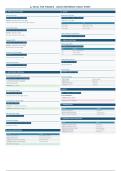
4.4.2: Linear Discriminant analysis for p>1
Positive class: the one we care most about predicting
Two types of prediction in prediction
1. Soft prediction : phat = Pr(in pos.class) : expected value between 0 and 1.
a. Soft prediction is more fundamental: hard prediction is done from the
result of soft prediction.
2. Hard prediction: a particular class predicted by comparing the soft prediction phat
to a threshold value
a. hard prediction heavily depends on the decision threshold
Classification metrics
Binary classifier’s error types
1. False positive (e.g., individual who does not defaults to the default)
2. False negative (e.g., individual who defaults to the no default)
Confusion matrix address the interest of displaying the information of which of these
two types of errors are made.
Despite that the overall accuracy might be satisfactory, individual error for FP/FN could
be unacceptably high.
Statistics that reflects the precision and recall :
F1 : harmonic mean of precision and recall
FM : geometric mean of precision and recall.
They both ignore true negatives. : if there is class imbalance, they depend on the positive
cases, so might perform worse in some cases.
Alternatives: correlation coefficients
Correlation between true and predicted class :
Correlation does not explicitly measure prediction accuracy. It only captures
the strength and direction of a linear relationship.
Cohen’s K: 0 is hit when you expect that TN and TP are at the same rate as chance.
, Comparisons of the 4 metrics
Class-specific performance
Sensitivity /recall/TPR : Percentage of true positive that are predicted as positive.
Specificity / True negative rate: Percentage of true negatives that are predicted as
negative.
Precision/Positive predicted value : different from the first two. Proportion of the
positive classified items that are actually positive.
When they are used as pairs…
Precision + recall is useful when the focus is on the positive class
(they ignore TN) ; it does not directly assess predictions for the
negative class.
Recall + specificity treats both positives and negatives as important.
The Bayes classifier works by assigning an observation to the class for which the
posterior probability pk(X) is greatest
- In binary classifier, a value will be assigned to the positive class if
Pr(positive = yes |X=x) >0.5
- This threshold is adjustable.
o Tidymodel uses the default of 0.5 and it is hard to adjust the value
The Bayes classifier will yield the smallest possible total number of misclassified
observations, regardless of the class from which the errors stem.
Thresholds and class imbalance
There is a trade off between the TP and TN, and FP and FN, depends on the threshold
value for the confusion matrix.
By varying the decision threshold, we determine the elements of the confusion matrix.
- The lower the threshold, the more observations classified to the positive class.
Positive class: the one we care most about predicting
Two types of prediction in prediction
1. Soft prediction : phat = Pr(in pos.class) : expected value between 0 and 1.
a. Soft prediction is more fundamental: hard prediction is done from the
result of soft prediction.
2. Hard prediction: a particular class predicted by comparing the soft prediction phat
to a threshold value
a. hard prediction heavily depends on the decision threshold
Classification metrics
Binary classifier’s error types
1. False positive (e.g., individual who does not defaults to the default)
2. False negative (e.g., individual who defaults to the no default)
Confusion matrix address the interest of displaying the information of which of these
two types of errors are made.
Despite that the overall accuracy might be satisfactory, individual error for FP/FN could
be unacceptably high.
Statistics that reflects the precision and recall :
F1 : harmonic mean of precision and recall
FM : geometric mean of precision and recall.
They both ignore true negatives. : if there is class imbalance, they depend on the positive
cases, so might perform worse in some cases.
Alternatives: correlation coefficients
Correlation between true and predicted class :
Correlation does not explicitly measure prediction accuracy. It only captures
the strength and direction of a linear relationship.
Cohen’s K: 0 is hit when you expect that TN and TP are at the same rate as chance.
, Comparisons of the 4 metrics
Class-specific performance
Sensitivity /recall/TPR : Percentage of true positive that are predicted as positive.
Specificity / True negative rate: Percentage of true negatives that are predicted as
negative.
Precision/Positive predicted value : different from the first two. Proportion of the
positive classified items that are actually positive.
When they are used as pairs…
Precision + recall is useful when the focus is on the positive class
(they ignore TN) ; it does not directly assess predictions for the
negative class.
Recall + specificity treats both positives and negatives as important.
The Bayes classifier works by assigning an observation to the class for which the
posterior probability pk(X) is greatest
- In binary classifier, a value will be assigned to the positive class if
Pr(positive = yes |X=x) >0.5
- This threshold is adjustable.
o Tidymodel uses the default of 0.5 and it is hard to adjust the value
The Bayes classifier will yield the smallest possible total number of misclassified
observations, regardless of the class from which the errors stem.
Thresholds and class imbalance
There is a trade off between the TP and TN, and FP and FN, depends on the threshold
value for the confusion matrix.
By varying the decision threshold, we determine the elements of the confusion matrix.
- The lower the threshold, the more observations classified to the positive class.