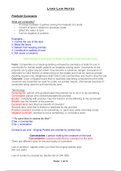
Land Law Notes
Freehold Covenants
What are covenants?
• Promises between 2 parties owning the freehold of 2 lands
• Control of land in relation to promises made
• Effect the value of land
• Can be negative or positive
Examples....
1. Control the use of the land
2. Mend the fence
3. Refrain from keeping animals
4. Contribute to upkeep of road
5. Not cause a nuisance
C&G Homes v Secretary of State for Health (controversial case)
Facts: 2 properties on a housing estate purchased by secretary of state for use in
community for mental health patients as hospitals closing down. Covenants on the
property not to allow any act which 'may become a nuisance, danger, annoyance or
detriment' to C&G Homes or others living on the estate and must be used as private
dwelling houses only. Neighbours didn't want care communities and tried to stop the use.
Outcome: Court of Appeal found that no business was being conducted but the other
covenant was breached as used for public not private means. Unfortunate exercise of
covenants being used for anti-community care.
Terminology
Convenantor: person who grants/makes the promise not to do or to do something
Convenatee: person who receives/accepts the promise
Burden: complying with promise. Has the 'burden' of the adhering to the convenant
Benefit: has the 'benefit' of the promise
Dominant land: land that has benefit of covenant
Servient land: land that is limited or restricted by the promise
Positive covenant: promise to do something i.e. paint door white (normally costs)
Negative covenant: promise to not to something i.e. not build a shed
***To save time in exams do this***
C'tee = covenantee
C'tor = covenantor
Contract Law Link - Original Parties are covered by contract law
Convenantee = person making the covenant on the land
Conventantor = person restricted by covenant on the land
There are different rules for law and equity of covenants.
Law of contract - applies when you have the original parties only!
(No one sells)
Law of contact is covered by: Section 56 of LPA 1925
Page 1 of 9
Freehold Covenants
What are covenants?
• Promises between 2 parties owning the freehold of 2 lands
• Control of land in relation to promises made
• Effect the value of land
• Can be negative or positive
Examples....
1. Control the use of the land
2. Mend the fence
3. Refrain from keeping animals
4. Contribute to upkeep of road
5. Not cause a nuisance
C&G Homes v Secretary of State for Health (controversial case)
Facts: 2 properties on a housing estate purchased by secretary of state for use in
community for mental health patients as hospitals closing down. Covenants on the
property not to allow any act which 'may become a nuisance, danger, annoyance or
detriment' to C&G Homes or others living on the estate and must be used as private
dwelling houses only. Neighbours didn't want care communities and tried to stop the use.
Outcome: Court of Appeal found that no business was being conducted but the other
covenant was breached as used for public not private means. Unfortunate exercise of
covenants being used for anti-community care.
Terminology
Convenantor: person who grants/makes the promise not to do or to do something
Convenatee: person who receives/accepts the promise
Burden: complying with promise. Has the 'burden' of the adhering to the convenant
Benefit: has the 'benefit' of the promise
Dominant land: land that has benefit of covenant
Servient land: land that is limited or restricted by the promise
Positive covenant: promise to do something i.e. paint door white (normally costs)
Negative covenant: promise to not to something i.e. not build a shed
***To save time in exams do this***
C'tee = covenantee
C'tor = covenantor
Contract Law Link - Original Parties are covered by contract law
Convenantee = person making the covenant on the land
Conventantor = person restricted by covenant on the land
There are different rules for law and equity of covenants.
Law of contract - applies when you have the original parties only!
(No one sells)
Law of contact is covered by: Section 56 of LPA 1925
Page 1 of 9